
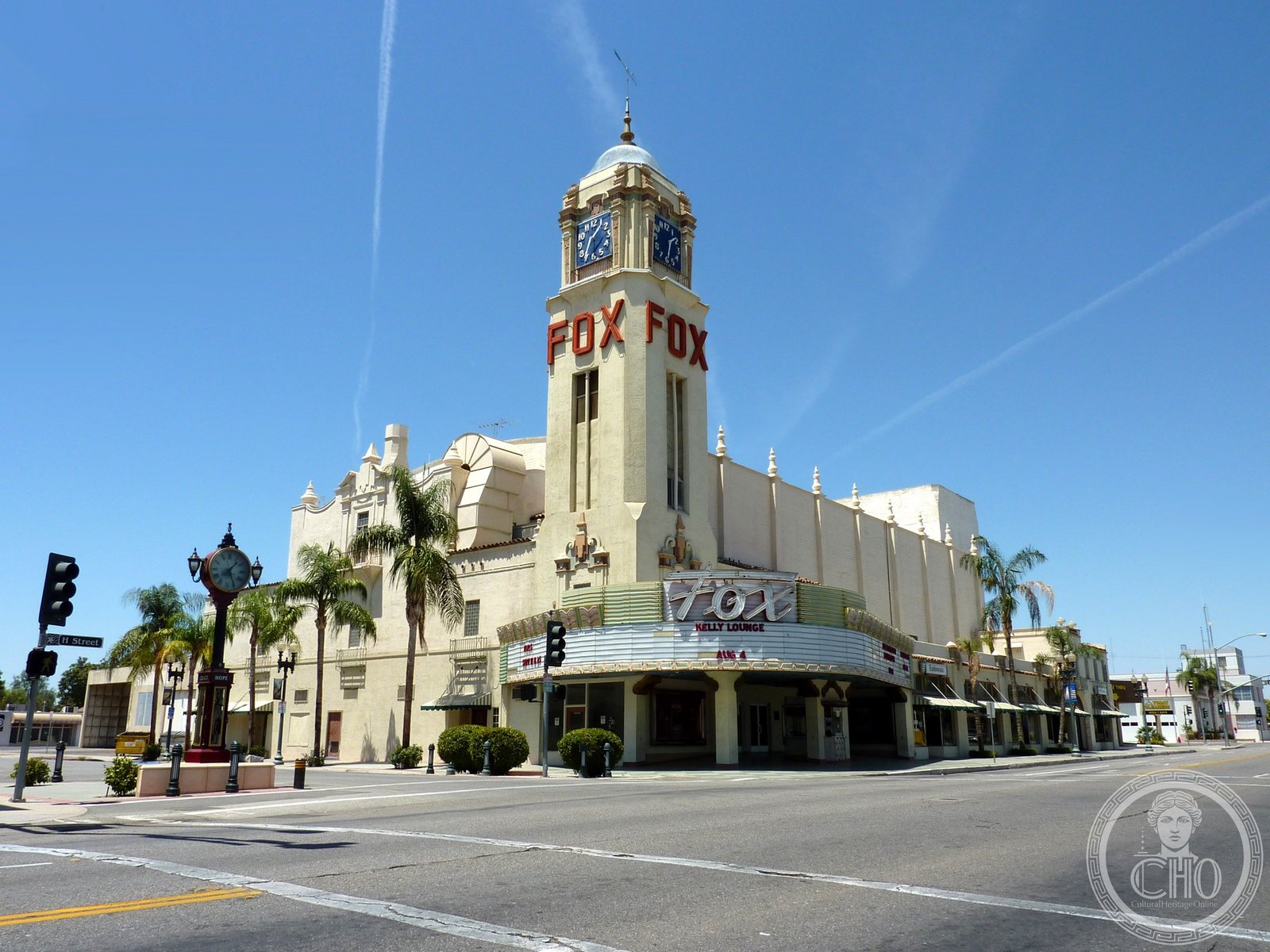
Downtown Bakersfield’s most commanding facade belongs to the 1930 Fox Theater—a full-width Art Deco composition in terra cotta and neon whose three-story vertical sign has anchored H Street through nearly a century of transformation from movie palace to concert venue.
At a glance
The Fox Theater opened in 1930 as one of the largest and most elaborately equipped movie palaces in California’s Central Valley. Its Art Deco facade in polychrome terra cotta, flanked by a tower marquee visible from several blocks on H Street, set a scale that nothing else in downtown Bakersfield matched. The theater operated as a first-run cinema house for decades, transitioned through various ownership arrangements, and today operates as a concert venue and event hall for the Bakersfield community—the facade and auditorium substantially intact.
Key facts
- Address: 2001 H Street, Bakersfield, CA 93301
- GPS: 35.3720° N, 119.0180° W
- Built: 1930
- Style: Art Deco / Zigzag Moderne
- Capacity: approximately 2,200 seats
- Status: Active concert venue and event hall
- NRHP: Listed on National Register of Historic Places
History
Bakersfield’s growth in the 1920s—driven by oil extraction in the Kern River field and agricultural expansion in the southern San Joaquin Valley—supported a downtown entertainment corridor substantial enough to attract a major Fox West Coast Theatres commission. The Fox chain’s Bakersfield house opened in 1930, during the first wave of large purpose-built sound cinema construction in California. The H Street site put the theater at the commercial center of a downtown organized around its intersection with 19th Street.
The Fox ran first-run Hollywood films through the peak studio era and into the television decades, when its programming shifted toward second-run and specialty bills. The multiplex era of the 1970s and 1980s pulled first-run audiences to suburban venues, and the Fox narrowed its operations before closing as a cinema. Preservation and conversion efforts over the following years restored core systems and reopened the building as a performing arts venue. The Art Deco facade—polychrome terra cotta, neon signage, and the vertical tower element—survived the transition intact and provides one of the most complete surviving examples of 1930 Central Valley commercial architecture.
Bakersfield’s musical heritage intersects with the theater through what became known as the Bakersfield Sound—the country music tradition developed by Buck Owens and Merle Haggard that distinguished the city’s musical output from the Nashville mainstream. The Fox’s stage hosted performers from both the Hollywood and country music circuits during its peak decades.
What you see
The H Street elevation presents a three-bay composition in glazed terra cotta across the full width of the theater’s frontage. The central bay carries a vertical tower element rising above the roofline that once held the theater’s neon “FOX” letters; the outer bays frame the entrance portals in stepped Zigzag Moderne ornament. The terra cotta palette runs from cream to gold with black accents—standard for Fox West Coast Theatres’ house style of the period.
Inside, the auditorium retains its original bowl geometry with orchestra, mezzanine, and balcony levels. The proscenium arch carries Art Deco sunburst ornament; side wall panels between pilasters show the geometric abstraction characteristic of 1930 commercial Deco. The ceiling carries concealed lighting channels derived from the atmospheric theater technique, adapted here to a Zigzag Moderne register rather than the Mughal or Mediterranean fantasies of the true atmospheric style. The net effect is less transportive than the great atmospheric palaces but more architecturally coherent—the building reads as a resolved Art Deco object rather than a scenic environment.
Practical information
- The Fox Theater operates as a concert venue; check the theater’s website for current shows and events.
- No regular film programming; the stage is configured for concerts, comedy, and theatrical productions.
- Fully accessible main floor; elevator access to upper levels.
- Downtown Bakersfield parking garages are within two blocks on H Street and 20th Street.
- The exterior is visible and worth photographing from the sidewalk at any time.
Getting there
The Fox Theater is at 2001 H Street in downtown Bakersfield, at the corner of H Street and 20th Street. Bakersfield is served by Amtrak’s San Joaquins line (Bakersfield station on Truxtun Avenue, 0.5 miles west) with multiple daily connections to Los Angeles and the Bay Area. By car, Bakersfield is 110 miles north of Los Angeles via I-5 and CA-99; from Sacramento, 290 miles south via CA-99. Meadows Field Airport serves the city with connections to several major hub airports.
Nearby
- Bakersfield Museum of Art (0.5 miles west): the regional art museum on Truxtun Avenue mounts traveling exhibitions and maintains a permanent collection focused on California art.
- Buck Owens’ Crystal Palace (1 mile northwest): the honky-tonk venue and museum dedicated to the Bakersfield Sound and Buck Owens’ career.
- Kern County Museum (1 mile north): the outdoor history museum at 3801 Chester Ave includes a Pioneer Village of relocated historic structures from across Kern County.
- Panorama Bluffs: the overlook above the Kern River gives the best panoramic view of the oil field and Valley floor that shaped the economy behind the Fox’s 1930 construction.
Sources
- Fox Theater Bakersfield venue history
- National Register of Historic Places, “Fox Theater Bakersfield” nomination
- Kern County Historical Society records
- Cinema Treasures, “Fox Theater, Bakersfield” database entry
Find it on the map
See this place and what’s around it →Record researched and written by Luigi De Marchi for Cultural Heritage Online, 2026.
📷 Become a Cultural Heritage Online photographer
Share your photos of places: they stay published under your name as the author. The more they're seen, the more you get noticed — and soon a contest will reward the most appreciated photos.
Log in or sign up free to add a photoIs this page about you?
This page is read by travellers and heritage enthusiasts who find it on Google. Tell us how you are connected to this place and we will take it from there.