
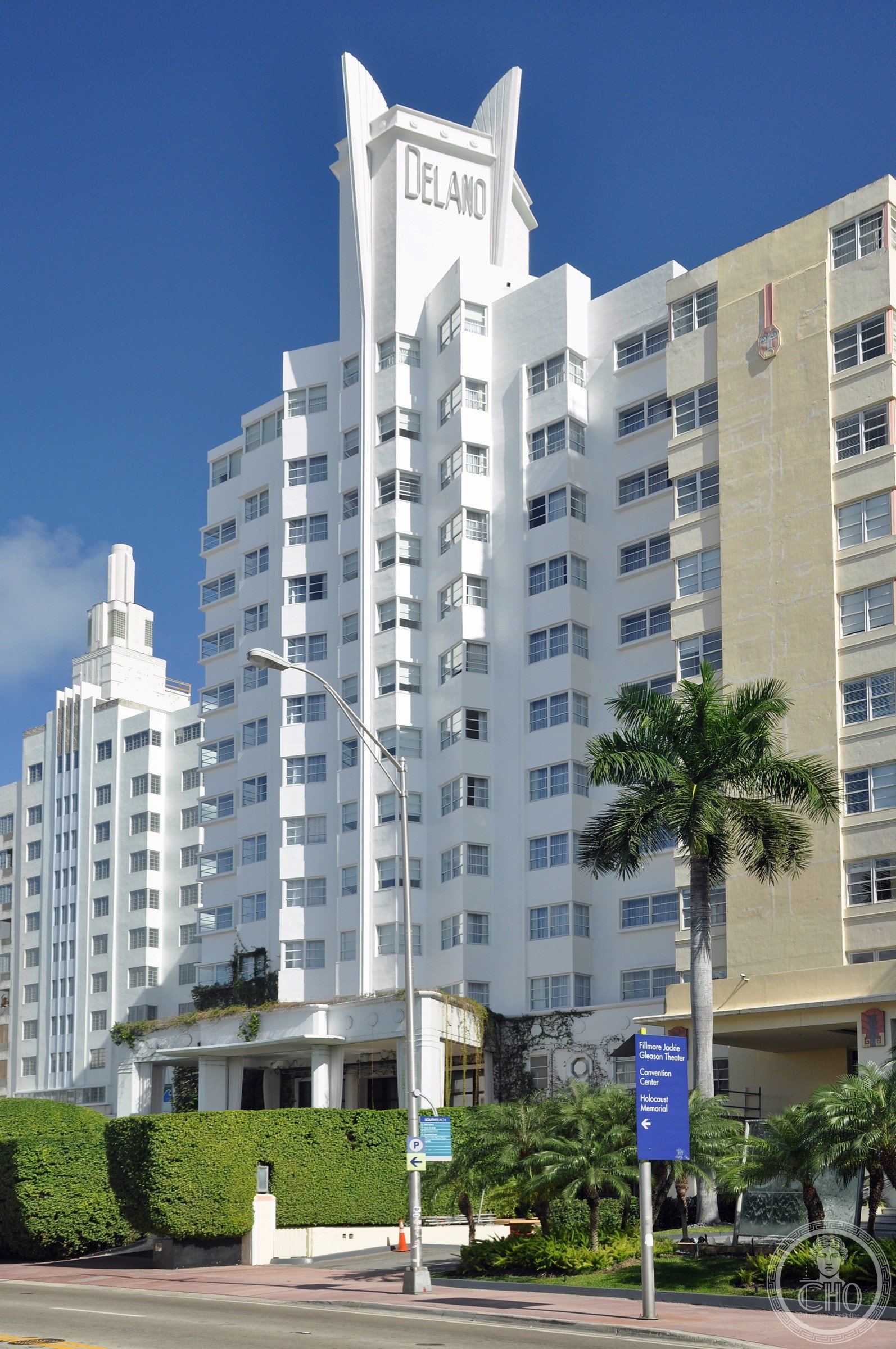
On Collins Avenue in the northern reaches of South Beach’s Art Deco Historic District, the Delano Hotel stands as one of the most distinctive buildings of late Art Deco design in the United States — a 1947 tower whose soaring white vertical fin has defined the Miami Beach skyline for nearly eight decades and whose dramatic interior has made it one of the most influential hotel spaces of the late twentieth century.
At a glance
The Delano Hotel at 1685 Collins Avenue is one of the most architecturally recognizable buildings in Miami Beach, its white vertical tower and distinctive rooftop fin visible from considerable distances along Collins Avenue. Designed by Robert Swartburg and completed in 1947, it represents the latest expression of the Art Deco idiom in South Beach — a building that retained the white stucco, horizontal banding, and aerodynamic profile of the prewar Streamline Moderne while adding the elongated verticality and refined elegance of the postwar period. The hotel’s subsequent renovation in 1994 by Ian Schrager and Philippe Starck transformed its interiors into one of the seminal hotel design statements of the 1990s, introducing an aesthetic that influenced hospitality design worldwide while preserving the building’s historic exterior.
Key facts
- Address: 1685 Collins Avenue, Miami Beach, FL 33139
- Opened: 1947
- Architect: Robert Swartburg
- Style: Late Art Deco / Streamline Moderne
- Designation: Contributing structure, Miami Beach Architectural District (NRHP since 1979)
- GPS: 25.7920° N, 80.1302° W
History
The Delano was built in 1947, at the end of the extended boom in Miami Beach hotel construction that had begun in the early 1930s and continued through the war years as Miami Beach served as a major military training and recuperation base. By 1947, thousands of servicemen had passed through Miami Beach, many returning after the war as permanent residents or frequent visitors, driving a postwar expansion of the hotel industry that continued the prewar architectural vocabulary while adapting it to the scale and elegance of the postwar economy.
Robert Swartburg’s design for the Delano captured this transition: a building that looked like it belonged in the prewar Art Deco tradition — white, streamlined, horizontally banded — but that had a height and a refinement of detail that marked it as a postwar design. The tower’s vertical fin, rising above the roofline and visible from the street, gave the building a landmark quality that distinguished it from the lower-profile prewar hotels.
The hotel’s place in American design history was transformed in 1994 when hotelier Ian Schrager and designer Philippe Starck undertook a complete renovation of the interior. Starck’s design — a dramatic white-on-white scheme that extended the building’s exterior aesthetic into a surrealist interior characterized by overscaled furniture, theatrical curtains, and the famous outdoor pool that became one of the most photographed spaces in Miami — created what is widely considered one of the most influential hotel interiors of the 1990s. The renovation introduced the concept of the “design hotel” to mainstream hospitality, influencing a generation of hotel projects worldwide.
What you see
The Collins Avenue facade presents the Delano’s distinctive tower: white stucco, clean horizontal banding, and the soaring vertical fin that rises above the roofline and creates the building’s unmistakable silhouette on the Miami Beach skyline. The fin — a Streamline Moderne device borrowed from automotive and aviation design of the 1940s — functions as both an ornamental element and a wind-sail, catching the ocean breezes that define the South Beach microclimate. The building’s entrance arcade and ground-floor treatment maintain the continuity with the street that characterizes the best of the Miami Beach hotel tradition.
The pool area behind the hotel, though transformed by the Starck renovation, preserves the spatial logic of the mid-century Miami Beach outdoor space: a sequence of pools, gardens, and terraced areas that extend the hotel experience into the subtropical landscape, connecting the building’s interior to the Atlantic Ocean just a block beyond. The Delano’s pool has functioned as one of Miami Beach’s most significant social spaces since the Starck renovation, a role that continues the tradition of the outdoor pool as the defining amenity of the South Beach hotel experience.
Practical information
- Hotel: Active luxury hotel; the Delano has undergone several management changes since the Starck renovation; check current operator for reservations
- Pool: The Delano pool is one of Miami Beach’s most distinctive hotel amenity spaces; access varies with guest status and current management policies
- Collins Avenue: The northern section of Collins Avenue where the Delano is located (around 16th–17th Streets) has a slightly different character from the southernmost blocks — larger buildings, more recent construction mixed with the historic fabric
Getting there
The Delano is in the northern section of South Beach’s Art Deco district, at Collins Avenue and 17th Street. Miami International Airport (MIA) is approximately 12 miles via the MacArthur Causeway. The South Beach area is walkable; the Delano is at the northern end of the pedestrian-friendly portion of Collins Avenue, where it transitions from the historic Art Deco district into the larger hotel towers of Mid-Beach. The hotel is accessible via the South Beach local bus routes and the free Electrowave shuttle that runs along Washington Avenue.
Nearby
- Lincoln Road Mall — the pedestrian promenade two blocks north, designed by Morris Lapidus in 1960, which functions as the principal commercial and social street of Miami Beach; the mall’s Deco and postwar architecture, the open-air restaurants, and the weekend farmers’ market make it one of the most vibrant public spaces in Florida
- New World Center — Frank Gehry’s 2011 campus for the New World Symphony at 17th Street and Collins Avenue, where the outdoor projection wall broadcasts performances to Lincoln Road; the building introduces twenty-first-century architecture into the historic neighborhood in deliberate conversation with the Deco buildings surrounding it
- Miami Beach Convention Center — the major convention and exhibition facility two blocks from the Delano, which hosts Art Basel Miami Beach each December — the most significant contemporary art fair in the Western Hemisphere; the convention center’s December crowds transform the entire neighborhood into one of the most concentrated gatherings of the international art world
- Holocaust Memorial — Kenneth Treister’s 1990 memorial at Meridian Avenue and Dade Boulevard, one of the most powerful outdoor memorials in the United States, set in a garden that reflects the large Jewish community that shaped Miami Beach’s mid-century character and that experienced the full weight of the European catastrophe documented in the memorial’s bronze figures
Sources
- National Register of Historic Places, Miami Beach Architectural District nomination
- Miami Design Preservation League documentation
- Capitman, Barbara Baer. Deco Delights. E.P. Dutton, 1988.
- Florida Division of Historical Resources architectural surveys
- Schrager, Ian and Starck, Philippe. Delano Hotel renovation documentation, 1994.
Find it on the map
See this place and what’s around it →Record researched and written by Luigi De Marchi for Cultural Heritage Online, 2026.
📷 Become a Cultural Heritage Online photographer
Share your photos of places: they stay published under your name as the author. The more they're seen, the more you get noticed — and soon a contest will reward the most appreciated photos.
Log in or sign up free to add a photoIs this page about you?
This page is read by travellers and heritage enthusiasts who find it on Google. Tell us how you are connected to this place and we will take it from there.