
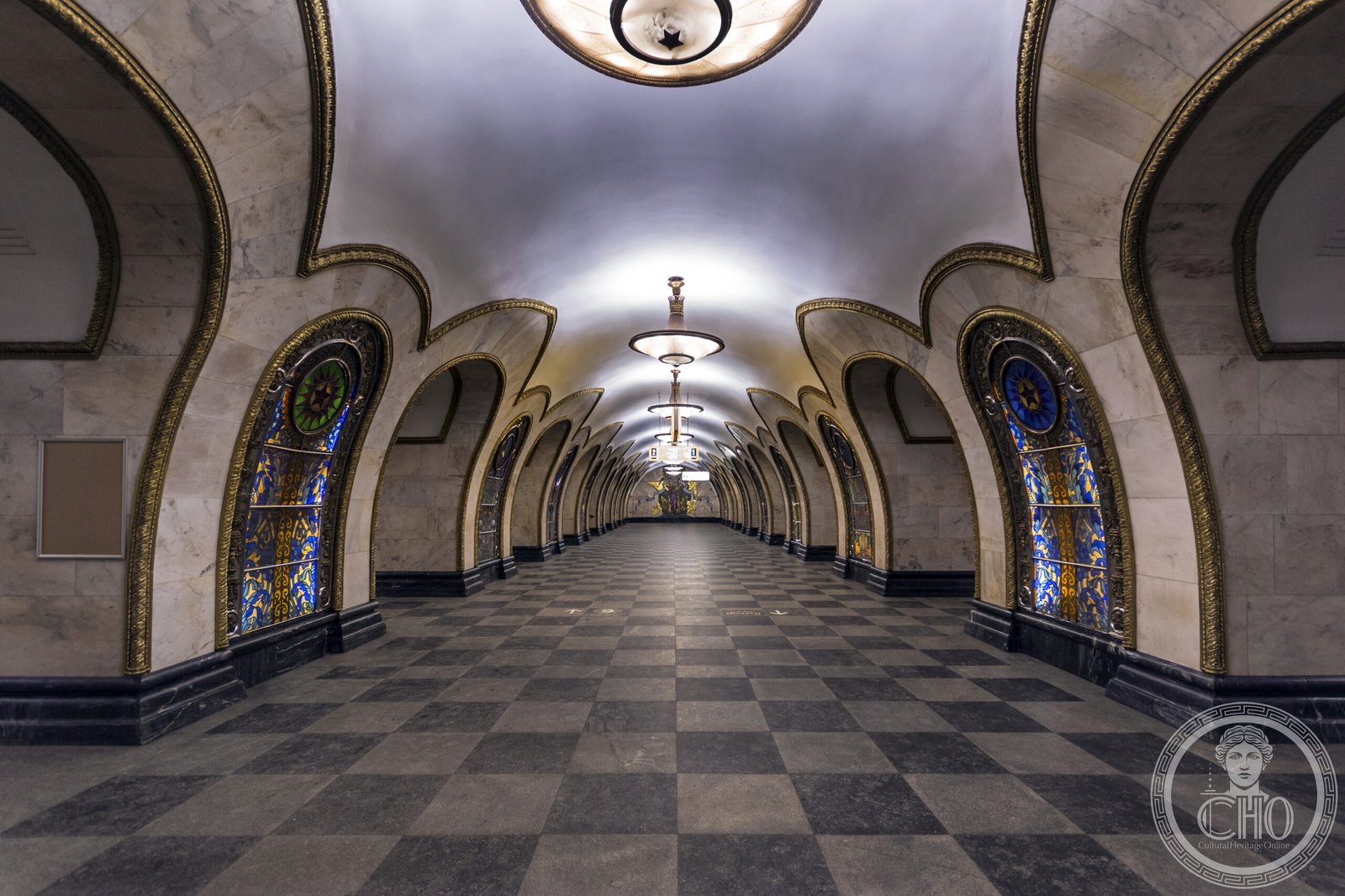
Novoslobodskaya is widely considered the most spectacular station on the Moscow Metro — and among the most beautiful underground spaces ever built. Opened on 30 January 1952 as part of the Circle Line, it was designed by Aleksei Dushkin, the architect of Mayakovskaya station. Thirty-two stained-glass panels set in ornate gilded Art Deco frames line the entire length of the platform, each one depicting a Soviet worker in a different profession: an architect, a scientist, a sailor, a mother with child, a soldier, an artist. The glass was crafted by Latvian artisans from the Riga Cathedral works — the same craftsmen who made windows for religious buildings — and the panels were deliberately conceived as secular equivalents of medieval cathedral windows. At the far end of the hall, a monumental mosaic by Pavel Korin, “Peace Throughout the World,” brings the composition to its rhetorical conclusion. The station received Stalin Prize recognition. The combination of Art Deco geometry, iridescent coloured glass, and Soviet iconography creates an effect that has no parallel anywhere else in the public architecture of the twentieth century.
At a glance
- Type
- Metro station
- Period
- 1950–1952
- Style
- Soviet Art Deco / Stalinist
- Location
- Novoslobodskaya Street, Moscow, Russia
- Coordinates
- 55.7760° N, 37.5905° E
- Architect(s)
- Aleksei Dushkin
Overview
Novoslobodskaya station is on the Circle Line (Line 5) of the Moscow Metro. It sits beneath Novoslobodskaya Street at the intersection with Lesnaya Street, serving as a transfer hub for the northern arc of the ring. The station hall is single-vaulted with a colonnade of pylons, each bay filled by a backlit stained-glass panel. Travellers passing through do so inside what amounts to a continuous luminous frieze. The station was included in the Moscow Cultural Heritage Registry and is frequently cited in international rankings of the world's most beautiful metro stations.
History
The Moscow Circle Line was planned in the late 1940s under Stalin as both a functional transit artery and a showcase of Soviet civilisation. Each station was assigned to a different architect and given a distinct visual programme. Dushkin, fresh from his celebrated Mayakovskaya station (1938), was given Novoslobodskaya. Construction ran from 1950 to 1952. The decision to commission Latvian glassworkers was pragmatic as well as aesthetic: Latvia's artisan tradition in stained glass was unmatched in the Soviet Union. The panels were manufactured in Riga and transported to Moscow for installation. The station opened as part of the second phase of Circle Line construction, along with seven other stations, on 30 January 1952.
Architecture & Design
The platform hall is 155 metres long and is divided by two rows of pylons clad in pale marble. Between the pylons, 32 arched niches each contain a backlit stained-glass panel approximately 2 metres high by 1 metre wide, set in a gilded frame of Art Deco floral and geometric ornament. The panels depict Soviet workers in idealised poses — a geographer with a globe, an architect with blueprints, a nurse, a soldier — rendered in a palette of jewel colours: cobalt, amber, emerald, ruby. Ceiling mouldings in cream and gold reinforce the cathedral effect. The end wall is dominated by Korin's mosaic, 3.2 metres high, showing a female figure bearing an olive branch above a globe, flanked by doves. The floor is laid in polished granite in a geometric pattern.
Cultural significance
Novoslobodskaya exemplifies the Soviet doctrine that public infrastructure should elevate the worker's daily life. Dushkin — like other Palace of the Metro architects — understood his brief as an explicitly civilisational one: the metro rider should feel they were passing through a monument to human achievement, not a utility tunnel. The secular stained glass is the most direct expression of this programme. The station has become an emblem of Moscow's identity and a pilgrimage site for lovers of twentieth-century design and public art worldwide.
Visiting today
The station is fully operational and free to enter with a standard Moscow Metro ticket. The best time to photograph the stained glass is during off-peak hours (mid-morning or early afternoon on weekdays) when the platform is less crowded. Photography is permitted. The station is accessible from street level via escalators. There is no dedicated visitor entrance separate from the transit function.
Getting there
Take the Moscow Metro Circle Line (Line 5, brown) to Novoslobodskaya station. The station is also within walking distance of Mendeleyevskaya (Line 9) and Savyolovskaya (Lines 9 and 10), making it easily reachable from central Moscow. From Komsomolskaya (the major railway-hub station and another Dushkin masterpiece) the journey is four stops anticlockwise on the Circle Line.
Sources & resources
Find it on the map
See this place and what’s around it →Record researched and written by Luigi De Marchi for Cultural Heritage Online, 2026.
📷 Become a Cultural Heritage Online photographer
Share your photos of places: they stay published under your name as the author. The more they're seen, the more you get noticed — and soon a contest will reward the most appreciated photos.
Log in or sign up free to add a photoIs this page about you?
This page is read by travellers and heritage enthusiasts who find it on Google. Tell us how you are connected to this place and we will take it from there.