
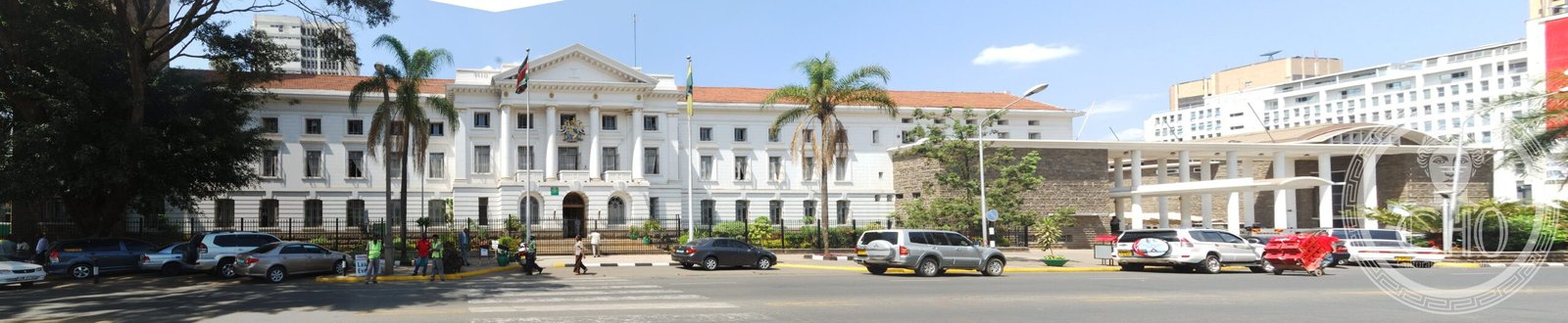
Nairobi City Hall stands at the symbolic heart of an independent Kenya — a modernist civic monument purpose-built to mark the end of British colonial rule and the birth of a new nation. Positioned on City Hall Way opposite Uhuru Park, the building was completed in 1962 in anticipation of independence, projecting post-colonial confidence in concrete and glass. On 12 December 1963, Jomo Kenyatta arrived here to the cheers of Nairobi’s citizens as the country’s first Prime Minister, making this the physical stage of Kenya’s founding moment. The building replaced earlier colonial administrative structures and represents a deliberate architectural break from the British imperial Neo-Classical style that had dominated Nairobi’s civic core. Today it houses the Nairobi County Assembly and remains a working seat of city government — as well as a heritage landmark visited by those who wish to stand where modern Kenya began.
At a glance
- Type
- Civic / Government Building
- Period
- 1962
- Style
- Modernist / British Colonial Late
- Location
- City Hall Way, Nairobi, Kenya
- Coordinates
- 1.2870° S, 36.8200° E
- Architect(s)
- Amyas Connell (original 1935 design); later reconstruction by government architects
Overview
Nairobi City Hall is the seat of Nairobi County government and one of the most historically charged buildings in East Africa. Its modernist concrete form — clean horizontal lines, generous glazing, and a functional civic plan — represented a deliberate rejection of colonial pomp in favour of a forward-looking aesthetic suited to an independent capital. The building is situated on a ceremonial axis between Uhuru Park and the Central Business District, flanked by Nairobi Law Courts and Parliament buildings, forming a civic quarter that encapsulates Kenya’s constitutional institutions within a single walkable precinct.
History
Nairobi’s civic administration occupied several colonial-era buildings before the current structure was commissioned in the early 1960s. The decision to erect a new City Hall was tied directly to preparations for independence: British authorities and Kenyan nationalist leaders both understood that the capital needed civic infrastructure that would project the dignity of self-governance. Construction proceeded from 1960 to 1962. On 12 December 1963, Prime Minister Jomo Kenyatta arrived at City Hall to a scene of jubilation — crowds lined the streets as colonial rule formally ended. The building subsequently served as headquarters of the Nairobi City Council and later the Nairobi County Government following Kenya’s 2010 constitutional devolution, which transferred significant powers to county level.
Architecture & Design
The building is a restrained example of late-colonial modernism adapted for a tropical East African climate. Its facade features horizontal concrete sun-breakers (brise-soleils) that reduce glare and heat gain while lending the exterior a rhythmic texture. The entrance is marked by a wide canopied approach that allows for ceremonial gatherings — a practical concession to Nairobi’s outdoor civic culture. The plan is organized around a central council chamber with surrounding administrative offices, following a logical civic hierarchy. The use of poured concrete rather than dressed stone signals a break from the quarried Nairobi stone favoured in earlier colonial buildings such as the nearby Kenya National Archives. The overall effect is sober, authoritative, and decidedly of its modernist moment.
Cultural significance
Beyond its architectural merit, Nairobi City Hall carries the weight of Kenya’s founding memory. The independence declaration and Kenyatta’s arrival transformed the building into a site of national pilgrimage. It remains the venue for Nairobi County Assembly debates, making it a living democratic institution rather than a museum piece. For the pan-African tradition, the building also represents the broader wave of post-colonial civic construction that swept the continent from the late 1950s through the 1970s — an era when newly independent nations built their capitals as statements of sovereignty and modernity.
Visiting today
Nairobi City Hall is a working government building. The exterior and the surrounding City Hall Way precinct are freely accessible and worth visiting for the civic ensemble — City Hall, the Nairobi Law Courts, Parliament, and Uhuru Park form a coherent heritage circuit. County Assembly sessions are sometimes open to visitors with advance permission. The building is most impressive on national holidays when ceremonial events are held in the adjacent plaza. The area is safe and well-policed during business hours.
Getting there
City Hall Way is in the heart of Nairobi’s Central Business District, within walking distance of major hotels along Kenyatta Avenue and University Way. Nairobi commuter rail terminates at Nairobi Railway Station roughly 1.5 km south; matatus (shared minibus taxis) serve all CBD routes. Uber and Bolt operate reliably in central Nairobi. The nearest landmark navigation point is Uhuru Park, immediately to the west.
Sources & resources
Find it on the map
See this place and what’s around it →📷 Diventa un fotografo di Cultural Heritage Online
Condividi le tue foto dei luoghi: restano pubblicate con la tua firma come autore. Più vengono viste, più ti fai conoscere — e presto un concorso premierà le foto più apprezzate.
Accedi o registrati gratis per aggiungere una fotoDo you manage this place?
This page is read by travellers and heritage enthusiasts who find it on Google. Keep it accurate — and make it work for you. Free for non-profit heritage institutions.