

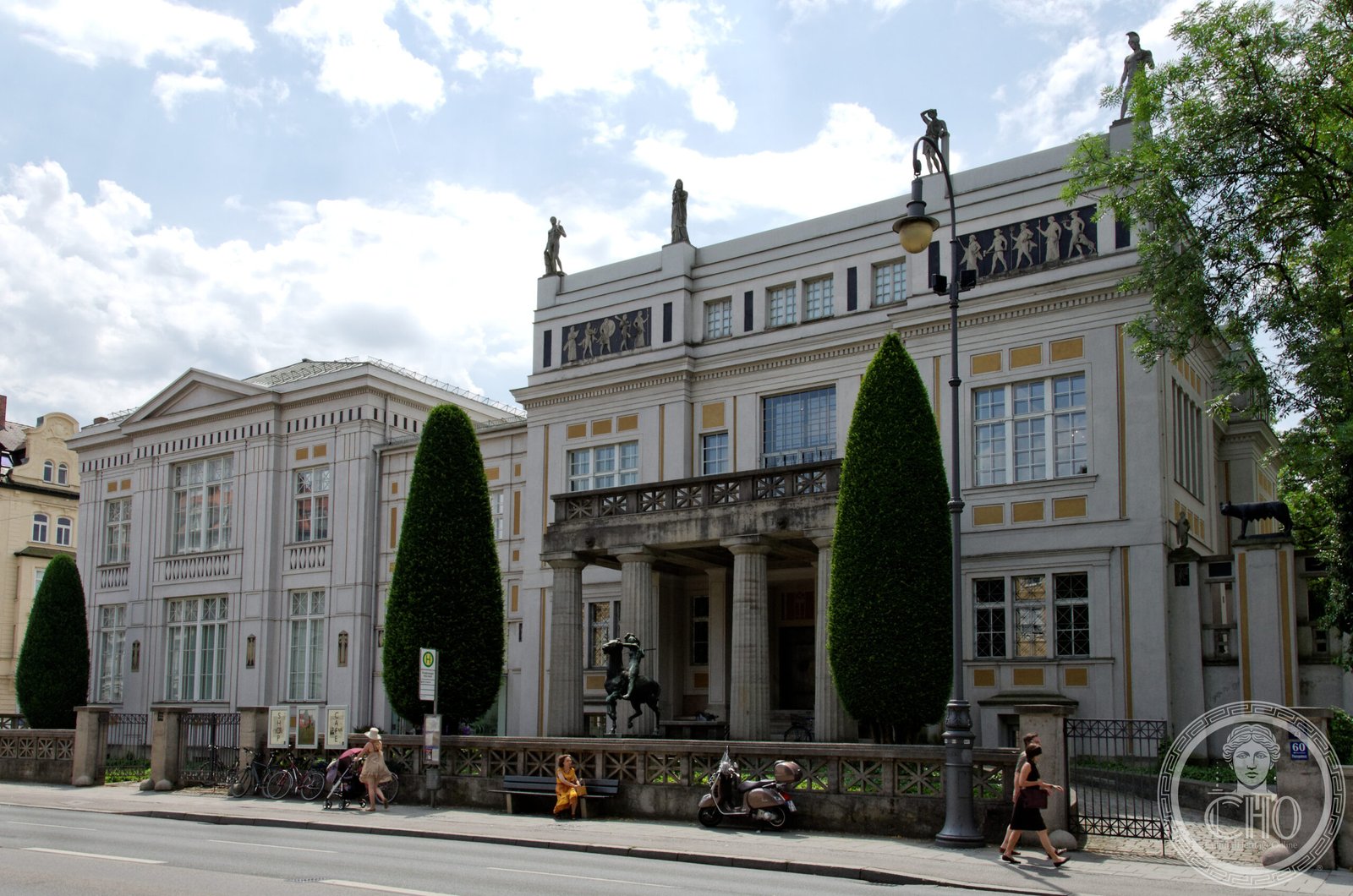

Franz von Stuck designed his own home as a total work of art. The result, completed in 1898, is one of the most coherent Gesamtkunstwerk interiors in Germany.
At a glance
Villa Stuck stands in Munich’s Bogenhausen quarter at Prinzregentenstrasse 60, a few minutes east of the Isar. Franz von Stuck (1863–1928) designed the building himself, overseeing everything from the floor plan to the gilded frames of his own paintings. The villa served as his private residence, studio, and public statement simultaneously. Since 1992 it has operated as a museum dedicated to Stuck’s life and work. A 13.5 million euro renovation completed in October 2025 has restored the interiors to exhibition standard.
Key facts
- Address: Prinzregentenstrasse 60, 81675 Munich, Germany
- Built: 1897–1898, designed by Franz von Stuck
- Style: Neoclassical exterior; Jugendstil / Symbolist interior
- Museum founded: 1992
- Renovation: 13.5 million euros; reopened October 2025
- Nearest U-Bahn: Max-Weber-Platz (U4/U5)
- GPS: 48.1406556, 11.5996444 — Google Maps
History
Franz Stuck was born in 1863 in Tettenweis near Passau and arrived in Munich in 1878. By 1892, when he co-founded the Munich Secession, he was one of the most commercially successful painters in Germany. His painting The Sin (1893) brought him international renown; he was ennobled as Franz von Stuck shortly after. In 1895 he was appointed professor at the Munich Academy, where he would teach Wassily Kandinsky, Paul Klee, and Josef Albers, among others.
In 1897 Stuck began designing his own villa on a plot in Bogenhausen, then a fashionable address for Munich’s cultural elite along the newly extended Prinzregentenstrasse. The building was completed in 1898. Stuck treated the project as an extension of his artistic practice, designing the floor plan, the interior decorations, and the furniture. In 1900 he won a gold medal for furniture design at the Paris World Exposition — the villa itself was the portfolio.
After Stuck’s death in 1928, his reputation faded as modernism marginalised Symbolist painting. The villa passed through different uses before interest in Art Nouveau revived in the late 1960s. The Museum Villa Stuck was formally established in 1992. The building underwent its most substantial renovation since construction in the early 2020s; a 13.5 million euro programme completed in October 2025 restored the historic interiors and upgraded the exhibition infrastructure.
What you see
The exterior reads as late-nineteenth-century neoclassicism: stone facades, pilasters, and a temple-front entrance portico that announces a serious building rather than a domestic one. The restraint is deliberate. Stuck wanted the street-side face to project authority, not ornament — the ornamentation waits inside.
Cross the threshold and the temperature of the decoration changes entirely. The interiors are Jugendstil in material and Symbolist in mood: coffered ceilings with deep-relief gilding, walls lined in coloured marble and stucco, and paintings by Stuck himself set permanently into the architectural fabric. The integration is the point. Frames were not hung on walls; they were designed as part of the wall surface. Light enters through stained glass and bounces off polished surfaces. The studio — a large north-lit room — still holds Stuck’s working equipment. Standing in it, the gap between the villa as a home and the villa as a manifesto for total design collapses.
Franz von Stuck and Jugendstil
Stuck was central to Munich’s role in the Jugendstil movement, which took its name from the magazine Jugend founded in the city in 1896. His co-founding of the Munich Secession in 1892 established a node of resistance to the conservative Kunstverein, and his early career success gave that resistance institutional weight. The Secession exhibitions brought German, Austrian, and Scandinavian work into productive contact.
As a painter, Stuck worked within Symbolism — mythological subjects, large-format figure compositions, figures drawn from the visual vocabulary of fate and allegory. The Sin (1893), showing a nude woman wrapped in a serpent, was reproduced across Europe and gave Stuck a reputation that crossed genre boundaries. He designed the frames of his own paintings with carved panels, gilt ornament, and inscriptions, so that each frame became a component of its wall rather than an addition to it.
The villa was, in part, a restatement of this position. Stuck was arguing, in stone and gilded plaster, that the applied arts — architecture, furniture, frame-making — were as serious as painting. That argument was the common thread of European Jugendstil from Glasgow to Vienna. In Munich, Villa Stuck made it with particular directness.
The Interior as Gesamtkunstwerk
The concept of the Gesamtkunstwerk — the total work of art integrating all disciplines into a unified whole — runs through Villa Stuck with unusual consistency. Most buildings that claim the label show it in the decorative programme alone. Here, the claim extends to the structural logic of the rooms: circulation, threshold, light, and surface are all coordinated toward the same effect.
Stuck designed everything from the floor plan to the furniture. Paintings were not selected for positions; they were made for specific walls at specific scales, then framed as part of the architecture. The studio wing was conceived to produce work that would feed back into the house’s own surfaces. The result is a building that does not separate the artist’s making from the artist’s living — a position that anticipates, by several decades, the debates around the artist’s house as artwork that became explicit in the twentieth century. The 2025 renovation has returned the rooms as close as possible to their appearance during Stuck’s lifetime.
Practical information
- Address: Prinzregentenstrasse 60, 81675 Munich
- Reopened: October 2025 after 13.5 million euro renovation
- Getting there: U-Bahn U4/U5 to Max-Weber-Platz, then a 10-minute walk east along Prinzregentenstrasse
- Current hours and admission: Check villastuck.de — hours may differ from pre-renovation schedule
- Photography: Confirm on-site; historic house museums in Germany vary by room
- Time needed: Allow 90 minutes for the historic rooms alone; longer if a temporary exhibition is running
Getting there
Villa Stuck sits on Prinzregentenstrasse in the Bogenhausen quarter, east of the Isar river. The closest public transport is Max-Weber-Platz on U-Bahn lines U4 and U5, a 10-minute walk east. Tram 16 also runs along Prinzregentenstrasse and stops closer to the building. The Bayerisches Nationalmuseum and the Haus der Kunst are both within a 20-minute walk westward along the same street.
Nearby heritage
- Haus der Kunst — 1937 exhibition building on Prinzregentenstrasse, now a contemporary art institution; 20 minutes west
- Bayerisches Nationalmuseum — decorative arts collection including Jugendstil applied arts; 15 minutes west on Prinzregentenstrasse
- Friedensengel — the gilded Peace Angel monument (1899) stands on the Isar bank 10 minutes west, erected the year after the villa was completed
- Englischer Garten — the 370-hectare city park begins immediately north of Prinzregentenstrasse
Sources
- Wikipedia: Villa Stuck
- Wikipedia: Franz von Stuck
- Wikimedia Commons: Museum Villa Stuck Munich.jpg (Yelkrokoyade, CC BY-SA 4.0)
- GPS coordinates: 48.1406556N, 11.5996444E — Wikipedia infobox
Find it on the map
See this place and what’s around it →Record researched and written by Luigi De Marchi for Cultural Heritage Online, 2026.
📷 Become a Cultural Heritage Online photographer
Share your photos of places: they stay published under your name as the author. The more they're seen, the more you get noticed — and soon a contest will reward the most appreciated photos.
Log in or sign up free to add a photoIs this page about you?
This page is read by travellers and heritage enthusiasts who find it on Google. Tell us how you are connected to this place and we will take it from there.