
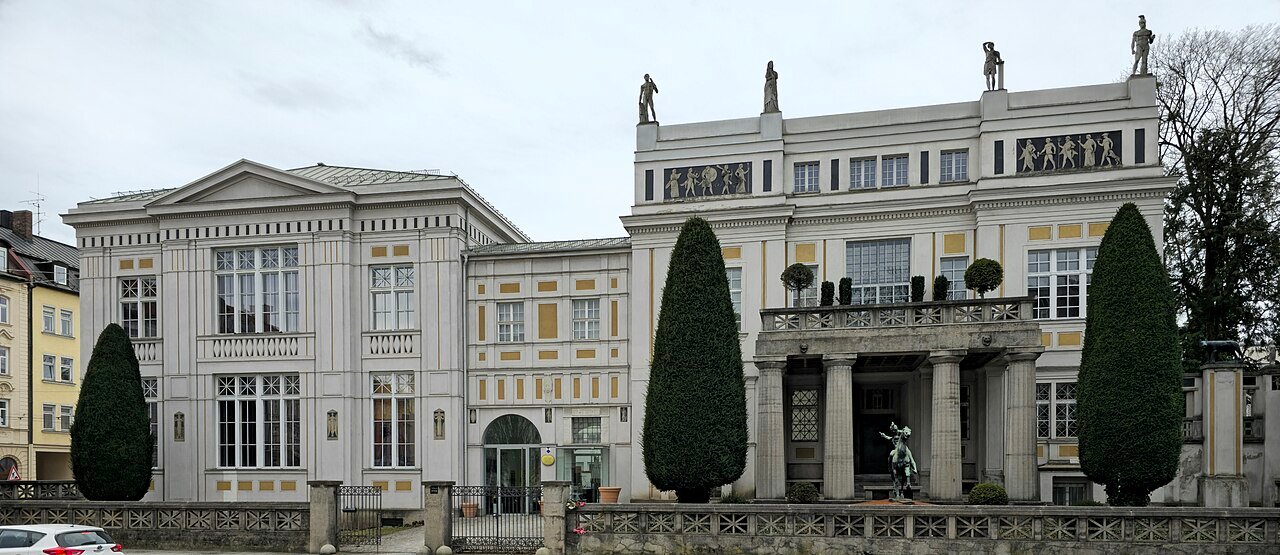
In Munich the German variant of Art Nouveau found both its name and its first practitioners. The city gave the style the word that still carries it: Jugendstil.
At a glance
Munich is where Jugendstil began as a coherent movement and where it acquired its name. In 1892 a group of artists broke from the academy to form the Munich Secession, and in 1896 the journal Jugend appeared in the city, lending the new style the word by which it is still known in German. Painters, architects and designers who gathered here — among them August Endell, Richard Riemerschmid and Franz Stuck — pushed ornament toward abstraction and reform. Much of what they built was lost in the Second World War, but Villa Stuck survives intact as a museum, and the city’s design history remains legible in its institutions and surviving interiors.
Key facts
- Country: Germany
- Key period: c. 1896–1914
- Key figures: August Endell (1871–1925), Richard Riemerschmid (1868–1957), Franz Stuck (1863–1928), Georg Hirth (founder of Jugend)
- Origin of the name: “Jugendstil” after the magazine Jugend, founded in Munich in 1896 by Georg Hirth
- Essential sites: Villa Stuck (Prinzregentenstrasse 60)
History
The story of Jugendstil in Munich begins with a refusal. In 1892 a body of visual artists broke away from the more formal historical and academic styles of the academy and founded the Munich Secession, an association that Georg Hirth named. The break created room for a younger generation impatient with revivalism and drawn instead toward reform, ornament and the applied arts.
The decisive moment came in 1896, when Hirth launched the illustrated weekly Jugend in Munich. The journal became the most visible showcase of the new manner, and its title gave the German-speaking world the term it would use ever after: Jugendstil, literally “youth style.” Artists associated with the city, including Otto Eckmann and Richard Riemerschmid, supplied illustrations to its pages. The same impulse toward renewal reached the workshop floor: in 1897–1898 Riemerschmid was among the co-founders of the Vereinigte Werksttten fr Kunst im Handwerk, the United Workshops for Art in Handcrafts, which sought to unite design and manufacture.
Architecture followed quickly. In 1897 August Endell received the commission to design the facade for the Atelier Elvira, a photographic studio in Munich, covering it with an abstract relief of dragon-like and coral forms emerging from waves. Endell was one of the founders of the Jugendstil movement, and his conviction that invented forms could move the viewer directly — without representing nature — pointed toward later abstraction. The Atelier Elvira was burned to the ground during the Second World War, one of many Munich monuments of the period that did not survive the bombing.
What you see
The clearest surviving statement of the era is Villa Stuck, completed in 1898 as the home of the painter Franz Stuck. From the street the building presents a restrained Classical exterior; the drama is held inside, where Stuck decorated the rooms in a striking Art Nouveau idiom that doubled as a frame for his own paintings. The house is a total work of design, with the artist controlling furniture, fittings and decorative schemes alike.
The villa stands at Prinzregentenstrasse 60, in the Bogenhausen district east of the city centre. It has functioned as a museum since 1992 and reopened in October 2025 after a substantial renovation, so its historic interiors and changing exhibitions can be visited together. Because so much of Munich’s Jugendstil fabric was lost, this single surviving house carries a disproportionate share of the period’s visible legacy.
Practical information
- Villa Stuck operates as a public museum at Prinzregentenstrasse 60, Munich.
- The villa reopened in October 2025 after renovation; check current opening days and hours before visiting.
- Allow time for both the historic house interiors and the temporary exhibition galleries.
- Munich’s broader Jugendstil story is told across the city’s design and history collections rather than at a single dedicated site.
- Several key monuments of the period, such as the Atelier Elvira, no longer exist and are known only from photographs.
Getting there
Villa Stuck lies on Prinzregentenstrasse in the Bogenhausen district, east of the river Isar and a short distance from Munich’s centre. The street is served by the city’s tram and bus network, and the museum is within reach on foot from the Prinzregentenstrasse cultural corridor; central Munich is easily reached by S-Bahn and U-Bahn.
Related in CHO
- Vienna — Capital of the Vienna Secession
- Darmstadt — Jugendstil and the Mathildenhhe
- Glasgow — Mackintosh and the Arts & Crafts Movement
Sources
Find it on the map
See this place and what’s around it →Record researched and written by Luigi De Marchi for Cultural Heritage Online, 2026.
Historical events at this place (1)
📷 Become a Cultural Heritage Online photographer
Share your photos of places: they stay published under your name as the author. The more they're seen, the more you get noticed — and soon a contest will reward the most appreciated photos.
Log in or sign up free to add a photo