
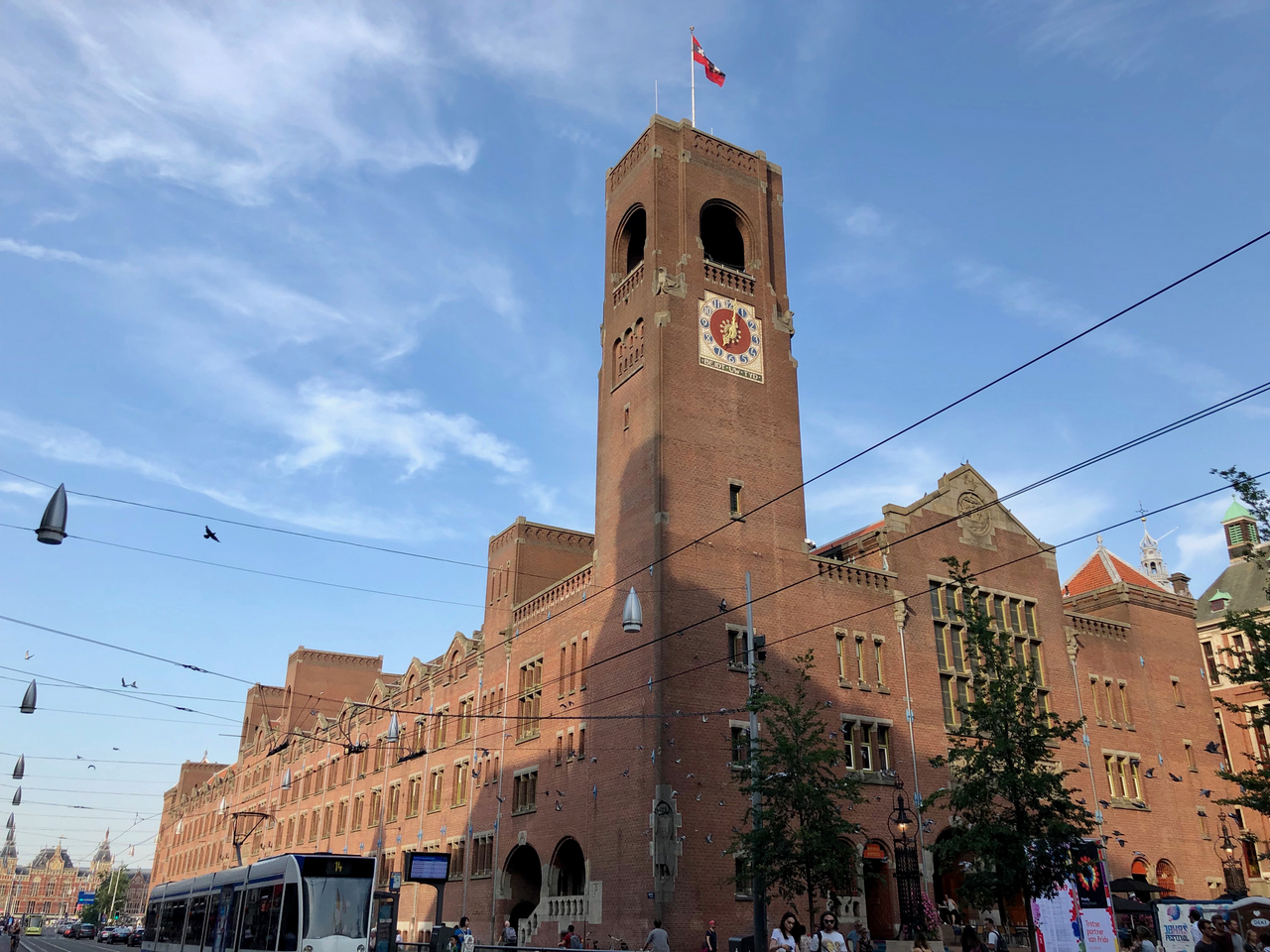
Amsterdam documents the full arc from Art Nouveau to social modernism within a single generation: Berlage’s rational brick architecture cleared the way for the Amsterdam School’s expressionist public housing, producing a city where working-class facades are as elaborately ornamented as bourgeois palaces.
At a glance
The Dutch variant of Art Nouveau — Nieuwe Kunst — arrived later and left more restraint than its French or Belgian counterparts. Its most important practitioner, Hendrik Petrus Berlage, rejected the floral excess of Horta and Guimard in favour of rational brick construction with disciplined surface ornament: the Beurs van Berlage (1896–1903), Amsterdam’s former stock exchange, introduced this grammar to the city’s civic architecture. The next generation — Michel de Klerk, Piet Kramer, Johan van der Mey — took Berlage’s brick honesty and applied it to the social housing programmes of the 1910s and 1920s, creating the Amsterdam School: an expressionist movement unique to the Netherlands, where bulging bay windows, sculpted brick reliefs and sinuous ironwork animate the facades of workers’ housing blocks across the city’s expansion areas.
Key facts
- Country: Netherlands
- Key period: 1890s–1930 (Nieuwe Kunst / Amsterdam School)
- Key figure: Hendrik Petrus Berlage (1856–1934) — architect, theorist, pioneer of Dutch rationalism
- Also notable: Michel de Klerk (Het Schip housing block), Johan van der Mey (Scheepvaarthuis), Tuschinski Theatre (Abe Tuschinski / H.L. de Jong, 1921)
- UNESCO heritage: Amsterdam’s seventeenth-century canal ring (World Heritage since 2010)
- Essential sites: Beurs van Berlage, Het Schip, Tuschinski Theatre, Scheepvaarthuis, Amsterdam School housing in De Baarsjes
History
Hendrik Petrus Berlage was born in Amsterdam in 1856 and trained at the Zurich Polytechnic under Gottfried Semper — an experience that instilled the belief that architecture must express its structure honestly. His Beurs van Berlage (1896–1903), commissioned as the city’s commodities exchange, made that belief monumental: a long brick volume whose round arches, frieze panels and tower are entirely integrated with the load-bearing structure, without the applied Renaissance or Gothic historicism that dominated Dutch civic architecture until then. Le Corbusier, who visited in 1911, named it the origin point of modern European architecture.
Berlage’s rationalism found an unexpected successor in the Amsterdam School of the 1910s–1920s. Michel de Klerk, working for the Eigen Haard housing corporation, designed the Het Schip block (1917–1921) in the Spaarndammerbuurt as a monument to the social democratic programme: its undulating brick facades, corner tower, post office and workers’ meeting hall were conceived as a total artwork serving the working class rather than the bourgeoisie. The Tuschinski Theatre (1921), built by a Jewish-Polish cinema entrepreneur with designs by several architects in a Hollywood-Expressionist hybrid, completed the Amsterdam visual palette: a six-storey facade of stained glass, mosaics and sculpted stone that remains the most extraordinary cinema exterior in Europe.
What you see
The Beurs van Berlage (Damrak 243) is now an events and concert venue; the main hall with Berlage’s original exposed brick vaults and Art Nouveau frieze programme is accessible on open days and during events — check beursvanberlage.com. The exterior is always visible from the Damrak waterfront. Het Schip Museum (Spaarndammerhout 22, Spaarndammerbuurt) is the best introduction to the Amsterdam School: a guided tour of the 1921 housing block and its post office, with reconstructed workers’ apartments, explains how De Klerk conceived social housing as civic art. Book via hetschip.nl.
The Tuschinski Theatre (Reguliersbreestraat 26) shows films daily and can be visited on guided heritage tours on Sunday mornings; the lobby’s mosaics and stained glass are among the most extraordinary interiors in Amsterdam. The Scheepvaarthuis (Prins Hendrikkade 108), now the Grand Hotel Amrâth, is the first Amsterdam School building (1916) and can be visited by entering the hotel bar.
Practical information
- Het Schip Museum: open Wed–Sun 11:00–17:00; hetschip.nl
- Tuschinski tours: Sunday mornings; book at pathe.nl/tuschinski
- Beurs van Berlage: open days and ticketed events; beursvanberlage.com
- Amsterdam City Card: covers public transport and most museums
- Time needed: full day for Beurs + Het Schip + Tuschinski; add half-day for De Baarsjes Amsterdam School district walk
Getting there
Amsterdam Schiphol Airport (AMS) is Europe’s fourth-busiest hub; direct trains reach Amsterdam Centraal in 15 minutes (€5.40). From Centraal, the Beurs van Berlage is a 5-minute walk on the Damrak. Het Schip is served by tram 3 (Spaarndammerstraat stop, 20 min from Centraal). Eurostar from London St Pancras takes 3h50 direct to Amsterdam Centraal; Thalys from Paris takes 3h15.
Related in CHO
- Brussels — Victor Horta and Art Nouveau Architecture
- Glasgow — Mackintosh and the Glasgow Style
- Riga — The World Capital of Art Nouveau
Sources
Find it on the map
See this place and what’s around it →Events here — now on & upcoming
- TEFAF Maastricht 202713 Mar 2027 — 18 Mar 2027See the event →
📷 Become a Cultural Heritage Online photographer
Share your photos of places: they stay published under your name as the author. The more they're seen, the more you get noticed — and soon a contest will reward the most appreciated photos.
Log in or sign up free to add a photo