
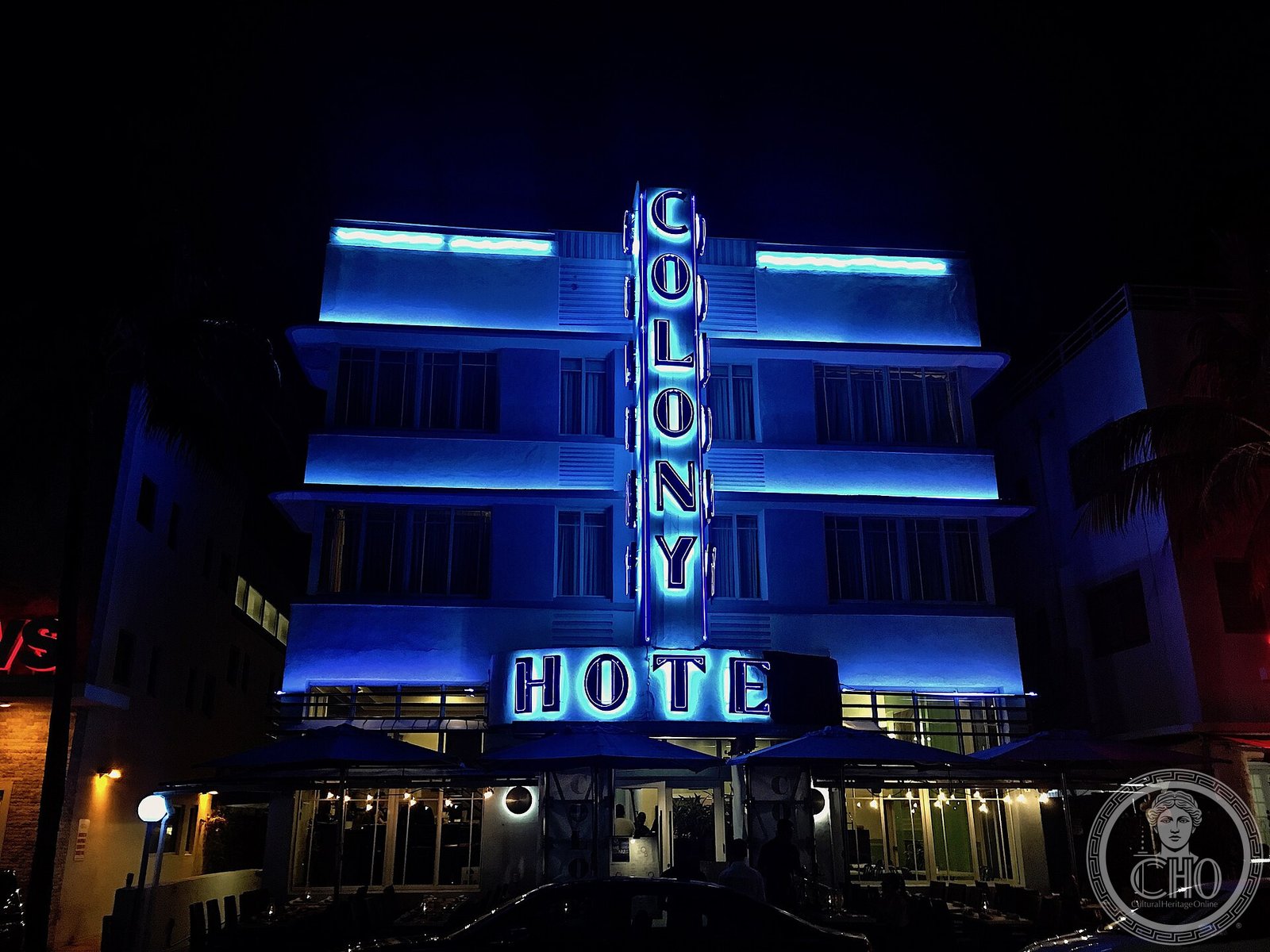
South Beach holds one of the largest concentrations of Art Déco architecture anywhere. A few blocks of pastel hotels turned a Depression-era resort into a design landmark.
At a glance
The Miami Beach Architectural District covers the southern tip of the barrier island, where roughly 960 historic buildings line Ocean Drive, Collins Avenue and the streets between them. Most went up in a tight burst between the Great Depression and the early 1940s, after a 1926 hurricane and the collapse of the Florida land boom forced builders toward something cheaper and faster than the Mediterranean Revival villas that came before. The result is a dense, walkable grid of small hotels and apartment houses in pastel stucco, their flat facades animated by curved corners, projecting “eyebrows” over the windows, stepped parapets and neon. Listed on the National Register of Historic Places in 1979, the district remains a working neighborhood of hotels, cafes and beach as much as an open-air museum of American Art Déco.
Key facts
- Country: United States
- Key period: 1930s–early 1940s
- Key figures: Henry Hohauser (1895–1963), L. Murray Dixon (1901–1949), Albert Anis, Russell Pancoast
- District: Miami Beach Architectural District, listed on the U.S. National Register of Historic Places on 14 May 1979 (about 960 historic buildings)
- Styles: Art Déco, Streamline Moderne, “Tropical” Deco, with earlier Mediterranean Revival
- Essential sites: Ocean Drive, Collins Avenue, Española Way, Washington Avenue
History
Miami Beach was largely dredged and built up in the 1910s and 1920s as a speculative resort on a sandy barrier island. The 1925 collapse of the Florida real-estate bubble and the destructive hurricane of 1926 ended the first wave of grand Mediterranean Revival building. When construction resumed in the 1930s, it did so under the constraints of the Depression: budgets were small, lots were narrow, and developers wanted hotels and apartment houses that looked modern and optimistic without the cost of heavy ornament.
Into that gap stepped a group of architects who would define the look of South Beach. Henry Hohauser, who designed more than 300 structures over his career, gave Ocean Drive some of its signature buildings — the Colony (1935), the Edison (1935), the Park Central (1937) and the Cardozo (1939). L. Murray Dixon worked in a closely related idiom, producing the Tides (1936), the Victor (1937), the Marlin (1939) and the Ritz Plaza (1940). Albert Anis, Russell Pancoast and others filled in the surrounding streets. Their buildings were deliberately economical: less ornate than the 1920s resorts, suited to a tourist economy of short stays and sunshine.
By the 1970s the district had fallen on hard times, its aging hotels threatened with demolition. A preservation campaign, led by the Miami Design Preservation League, secured the listing of the Miami Beach Architectural District on the National Register of Historic Places in 1979 — an early case of a twentieth-century commercial district being protected as heritage. Restoration over the following decades brought back the pastel color schemes and neon that now define South Beach.
What you see
Walk north along Ocean Drive and a vocabulary repeats from building to building. Facades are usually symmetrical, organized around a central vertical accent — a sign tower, a stepped parapet, a fluted pier — flanked by matching wings, often in groups of three. Horizontal “eyebrows,” thin concrete ledges, shade the windows and reinforce the streamlined, almost nautical feel; rounded corners, porthole windows and banded railings push the same maritime theme. Surfaces are smooth stucco in pale colors, with terrazzo floors at the entrances and glass block used for light and decoration.
The other essential element is light. Many of the hotels carry vertical neon signs and outlined parapets that come alive after dark, when Ocean Drive shifts from a sunlit beachfront to a corridor of colored neon. The district is best seen on foot and at two times of day — in daylight to read the relief detail of the eyebrows and parapets, and at night for the neon. Española Way, a short Mediterranean Revival street nearby, shows what came just before the Deco boom.
Practical information
- The Art Deco Welcome Center on Ocean Drive, run by the Miami Design Preservation League, is the starting point for orientation and guided walking tours.
- Self-guided and docent-led walking tours of the district are available; allow time to walk both Ocean Drive and Collins Avenue.
- Plan at least half a day; an evening return is worthwhile for the neon.
- The district is a living neighborhood — most buildings are working hotels, restaurants and shops, not museums.
Getting there
Miami International Airport (MIA) is the main gateway, roughly 15 km west of South Beach and connected by taxi, ride-share and bus. From mainland Miami, several causeways cross Biscayne Bay to the island; the southern end of Miami Beach, where the Architectural District sits, is compact and easily explored on foot once you arrive.
Related in CHO
- New York — Tiffany, the Gilded Age and Art Déco
- Mumbai — Art Déco
- Chicago — Wright and modern architecture
Sources
Find it on the map
See this place and what’s around it →Record researched and written by Luigi De Marchi for Cultural Heritage Online, 2026.
📷 Become a Cultural Heritage Online photographer
Share your photos of places: they stay published under your name as the author. The more they're seen, the more you get noticed — and soon a contest will reward the most appreciated photos.
Log in or sign up free to add a photo