
On a hill east of the city centre, Grand Duke Ernst Ludwig gathered a community of artists in 1899. Their buildings on the Mathildenhöhe became one of the defining statements of German Jugendstil.
At a glance
The Mathildenhöhe in Darmstadt is the site of the Darmstadt Artists’ Colony, founded in 1899 by Ernst Ludwig, Grand Duke of Hesse. Over four exhibitions held in 1901, 1904, 1908 and 1914, a group of architects, painters and designers built and furnished an integrated environment of houses, studios and public works in the new Jugendstil idiom — the German current of Art Nouveau. The colony’s central figure was the Austrian architect Joseph Maria Olbrich, who had earlier designed the Vienna Secession building; alongside him worked Peter Behrens and others. The ensemble that survives today, crowned by Olbrich’s Wedding Tower, was inscribed on the UNESCO World Heritage List in 2021.
Key facts
- Country: Germany
- Key period: 1899–1914 (artists’ colony, four exhibitions)
- Key figures: Ernst Ludwig, Grand Duke of Hesse (founder); Joseph Maria Olbrich (1867–1908); Peter Behrens (1868–1940)
- Essential sites: Wedding Tower (Hochzeitsturm), Ernst Ludwig House, Russian Chapel, Plane Tree Grove (Platanenhain)
- UNESCO: Mathildenhöhe inscribed 2021
History
In 1899 Ernst Ludwig, Grand Duke of Hesse, founded the Darmstadt Artists’ Colony, summoning a small group of artists to the Mathildenhöhe hill above the city. His ambition was summed up in the motto he chose for the venture — “Mein Hessenland blühe und in ihm die Kunst” (“My Hessian land shall flourish and in it, art”). The colony was conceived not as an academy but as a working community whose members would design buildings, interiors and everyday objects together, joining art and industry. Among those called to Darmstadt were Joseph Maria Olbrich, who became the colony’s central architect, and Peter Behrens.
The colony presented its work through four major exhibitions. The first, in 1901, was titled “A Document of German Art” and opened on 15 May; for it the artists built and furnished their own houses on the hill as a complete demonstration of the new style. Further exhibitions followed in 1904 and in 1908, the latter a Hesse regional exhibition that turned attention toward affordable residences. The final exhibition, in 1914, featured rental residences designed by Albin Müller.
Olbrich, who had co-founded the Vienna Secession in 1897 and designed its landmark exhibition building, brought that experience to Darmstadt before his early death in 1908 at the age of forty. The work of the colony — and of Behrens, whose career would later run toward industrial design and modern architecture — places the Mathildenhöhe among the early sites where Jugendstil began to shade into a recognisably modern design culture, a quality recognised in its 2021 World Heritage inscription as a testimony to early modern architecture and landscape design.
What you see
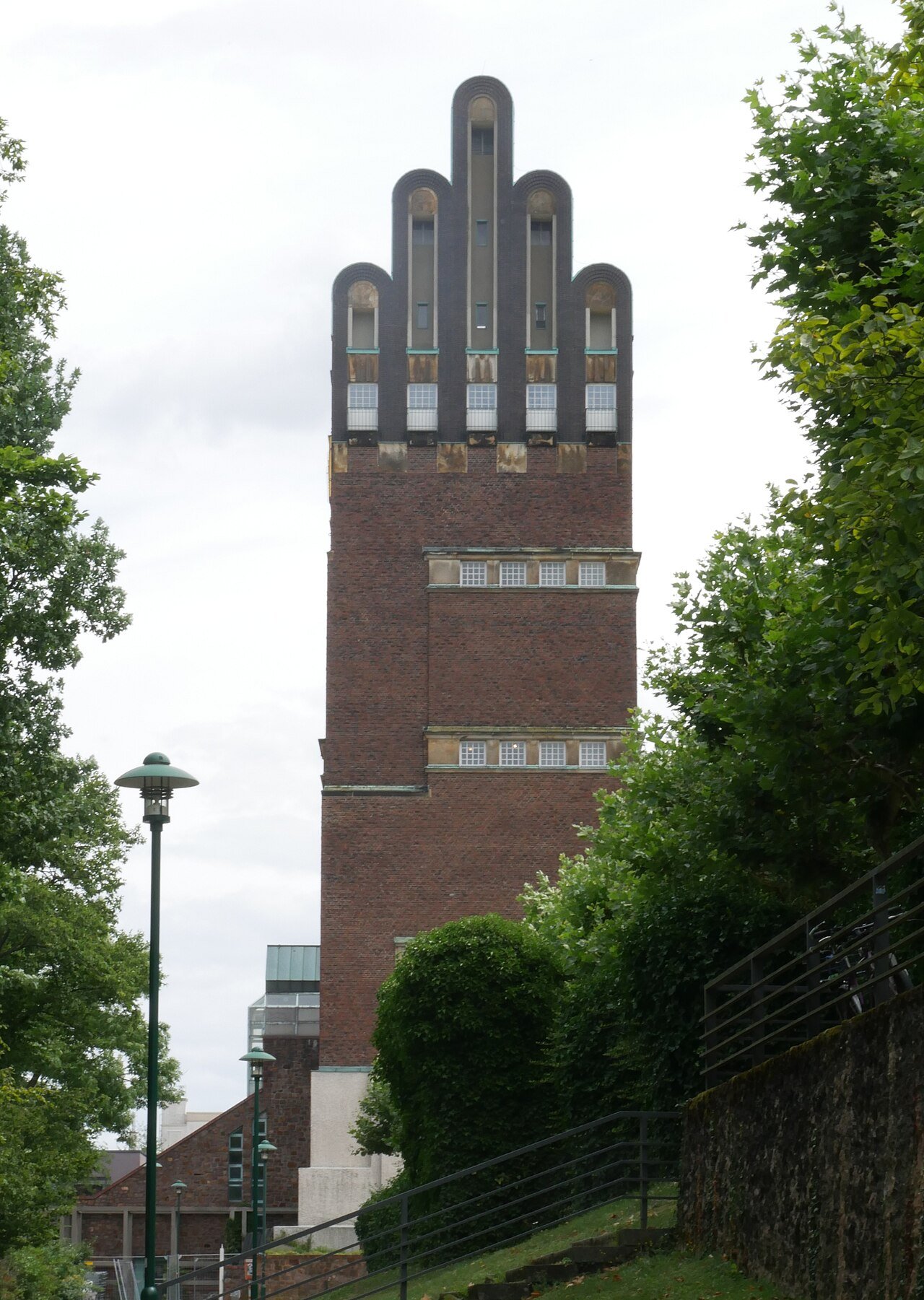
The most prominent structure on the hill is the Wedding Tower, the Hochzeitsturm, designed by Olbrich and opened in 1908. Its brick mass rises to a crown of rounded pinnacles often likened to the fingers of a raised hand, a silhouette that has become the emblem of Darmstadt. Beside it stands the Ernst Ludwig House, also by Olbrich, which served the colony as both a worksite and a venue for gatherings and now anchors the exhibition buildings. The Russian Chapel and the Plane Tree Grove (Platanenhain) complete the ensemble, the latter a landscaped grove that forms part of the protected World Heritage site.
The Mathildenhöhe rewards an unhurried walk: the buildings were designed as a coherent environment rather than isolated monuments, so the relationships between tower, house, chapel and grove are part of the experience. Exhibition spaces within the complex present the history of the colony and examples of its Jugendstil design; allow time to climb the Wedding Tower for the view over Darmstadt and to circle the surrounding artists’ houses on foot.
Practical information
- Plan roughly half a day to see the Wedding Tower, the exhibition buildings and the surrounding artists’ houses at an unhurried pace.
- The site is in the open air; the tower and museum buildings have their own opening hours, so check current times before visiting.
- The Mathildenhöhe is a UNESCO World Heritage Site (inscribed 2021) and is signposted across the city.
- Combine the visit with the wider Mathildenhöhe quarter, whose streets retain further colony houses.
- Official information: mathildenhoehe.eu and the city of Darmstadt cultural pages.
Getting there
Darmstadt lies in the German state of Hesse, about 30 km south of Frankfurt; Frankfurt Airport is the nearest international gateway, with frequent regional trains to Darmstadt Hauptbahnhof in well under half an hour. From the main station, local buses and trams cross the city toward the Mathildenhöhe, which sits on a hill east of the centre and is also a manageable walk or short ride from the old town.
Related in CHO
- Vienna — Capital of the Vienna Secession
- Munich — Jugendstil
- Brussels — Victor Horta and Art Nouveau
Sources
Find it on the map
See this place and what’s around it →Record researched and written by Luigi De Marchi for Cultural Heritage Online, 2026.
📷 Become a Cultural Heritage Online photographer
Share your photos of places: they stay published under your name as the author. The more they're seen, the more you get noticed — and soon a contest will reward the most appreciated photos.
Log in or sign up free to add a photo