

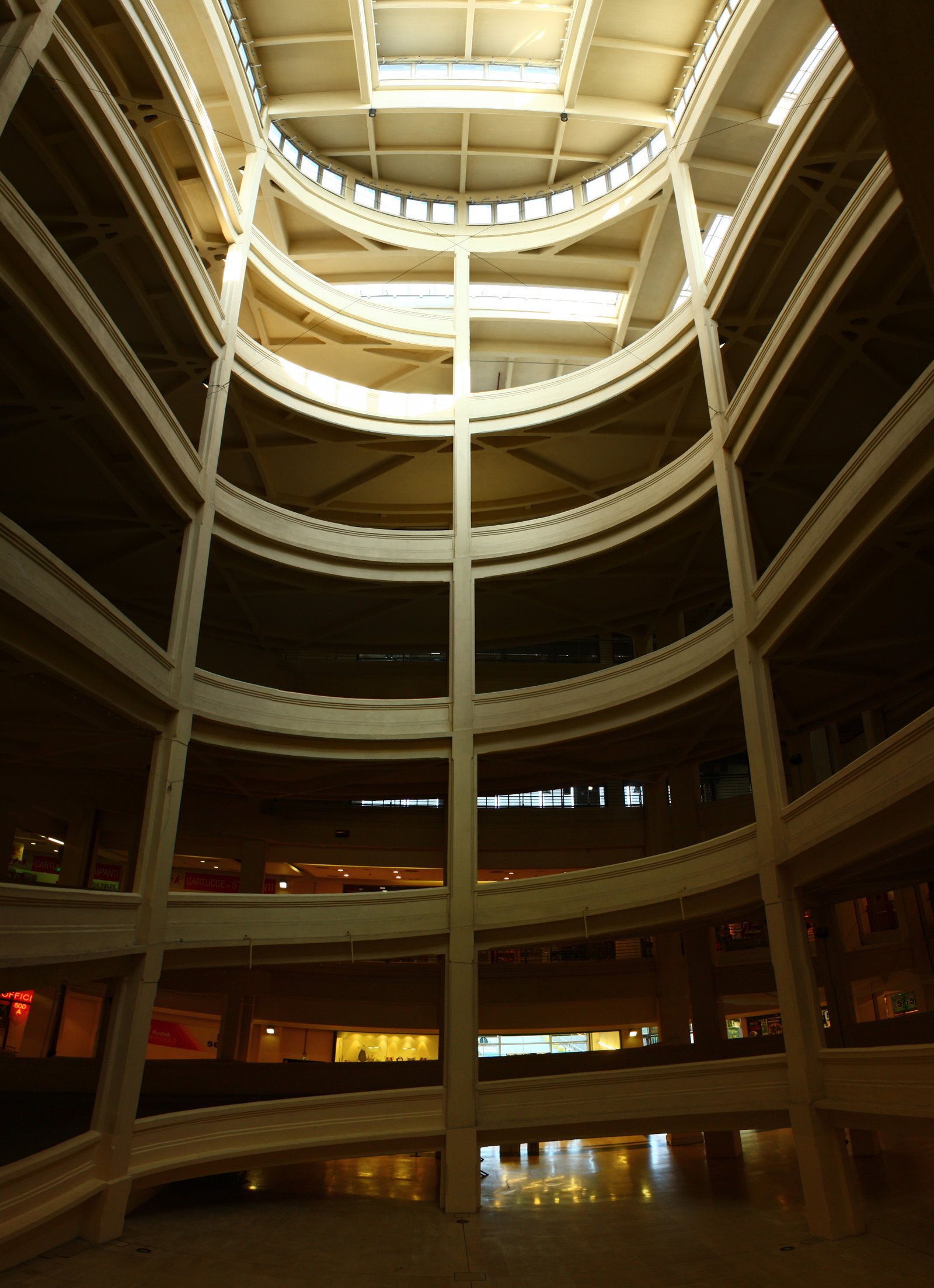
Built between 1916 and 1923 by the engineer Giacomo Matté-Trucco for FIAT, the Lingotto is a five-storey reinforced-concrete car factory in southern Turin whose finished automobiles emerged on a 1,500-metre test track laid out along the roof. At the time of its opening it was the largest car factory in the world. Closed in 1982 and converted by Renzo Piano from the mid-1980s into a multipurpose complex, it remains one of the few twentieth-century industrial buildings whose vertical production logic is still legible from the street.
- Address
- Via Nizza 230–294, 10126 Torino TO, Piedmont
- Period
- Designed and built 1916–1923 by FIAT; converted to its current civic use between 1985 and the late 1980s under Renzo Piano
- Engineer / architect
- Giacomo Matté-Trucco, FIAT engineer; construction by the firm of G. A. Porcheddu
- Conversion
- Renzo Piano Building Workshop, winner of the late-1970s architectural competition; first conversion works completed in 1989
- Original function
- Vertical car factory: raw materials in at ground level, finished cars emerging onto the rooftop test track at the fifth floor
- Current use
- Administrative headquarters of Fiat (now part of Stellantis), conference centre, concert hall, shopping arcade, hotel; Polytechnic University of Turin Automotive Engineering faculty in the eastern wing; Pinacoteca Agnelli on the top floor
- Coordinates
- 45.0298° N, 7.6622° E
- Notes
- Rooftop test track 1,500 m long with banked corners; helical concrete access ramps at each end of the building; Le Corbusier called it “one of the most impressive sights in industry”
Visit on the map
Via Nizza 230 · 45.0298° N, 7.6622° E
Download for your navigator
A single waypoint, ready for GPS apps, navigators, and contacts.
The Lingotto is, before anything else, a piece of industrial reasoning rendered in reinforced concrete. When construction began in 1916 in the southern outskirts of Turin, the brief was to consolidate FIAT’s scattered workshops into a single plant capable of producing the firm’s expanding range of cars in volume. The engineer Giacomo Matté-Trucco, working in-house at FIAT, organised production along a vertical line rather than the horizontal sheds favoured by American factory practice. Raw materials entered at the ground floor; sub-assemblies and bodies progressed upward through five stacked production levels; finished cars emerged at the top of the building to be driven directly onto the roof. The construction work itself was carried out by the firm of G. A. Porcheddu, a Turin contractor specialised in the Hennebique reinforced-concrete system.
That roof is the gesture that made the Lingotto famous beyond the trade. To absorb the finished cars and run them in, Matté-Trucco laid out a test track 1,500 metres long along the perimeter of the building, with concrete walls and banked corners at the two ends. Helical access ramps at the north and south extremities allowed cars to climb from the production floors to the roof under their own power, then descend the same way once the test run was complete. The factory was the largest of its kind in the world at the moment it opened in 1923, and the rooftop track turned an industrial necessity into a piece of architecture that Le Corbusier, visiting shortly after completion, called “one of the most impressive sights in industry” and, in the same breath, “a guideline for town planning”.
One of the most impressive sights in industry.
— Le Corbusier, on the Lingotto factory
Production continued at the Lingotto for almost six decades. The plant was overtaken in scale and process by FIAT’s much larger Mirafiori works in the post-war years and finally closed in 1982. Rather than demolish a structure that had become an emblem of Turin’s industrial twentieth century, the company launched an international architectural competition for its reuse. The brief was won by Renzo Piano, who set out to convert the long volume into a piece of mixed-use city. The first phase of the conversion was completed by 1989: concert halls, an auditorium, a convention centre, a shopping arcade, a hotel and the headquarters of FIAT itself were inserted into the old production floors, while the eastern wing was given to the Polytechnic University of Turin for its Automotive Engineering faculty. The rooftop test track was kept and is still accessible from the upper levels of the building, with the Pinacoteca Agnelli — the collection assembled by Gianni Agnelli (1921–2003) — installed on the same top floor.
Resources & References
Editorial picks across Wikipedia, photo archives, and the partner institutions of the complex.
Hero photograph by Tijmen Stam (IIVQ), via Wikimedia Commons, licensed under Creative Commons Attribution-Share Alike 3.0. Editorial text Cultural Heritage Online, OASIS Tech LLC USA, 2026.
Find it on the map
See this place and what’s around it →


Historical events at this place (1)
📷 Become a Cultural Heritage Online photographer
Share your photos of places: they stay published under your name as the author. The more they're seen, the more you get noticed — and soon a contest will reward the most appreciated photos.
Log in or sign up free to add a photoIs this page about you?
This page is read by travellers and heritage enthusiasts who find it on Google. Tell us how you are connected to this place and we will take it from there.