

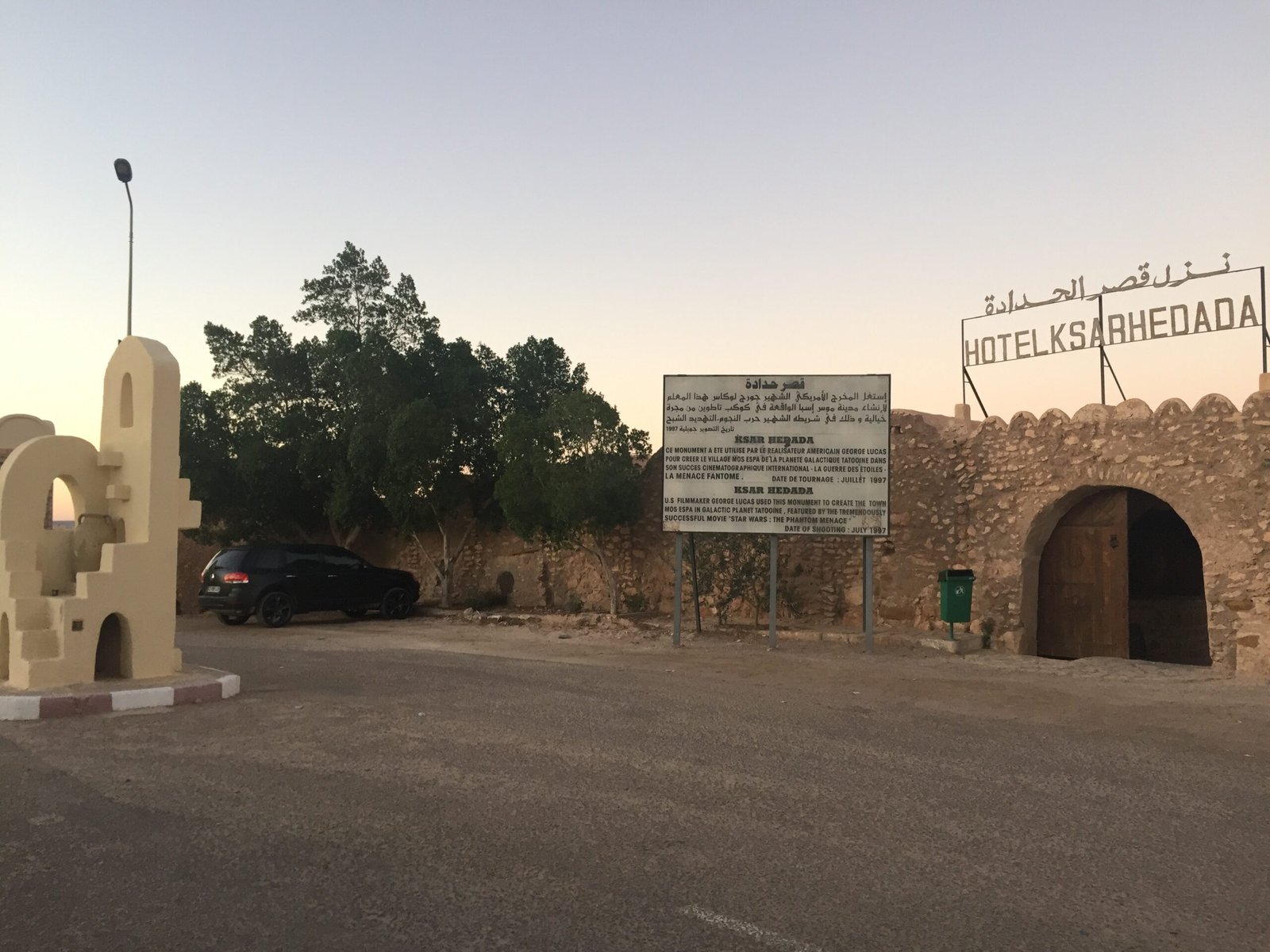
A fortified Berber grain storehouse in the hills of Tataouine whose tiered stone ghorfas became the slave quarters of Mos Espa in Star Wars Episode I: The Phantom Menace.
At a glance
Ksar Hadada is a ksar, a fortified collective granary built by the seminomadic Berber peoples of southeastern Tunisia, located approximately 20 km north of the town of Tataouine in the Tataouine Governorate. Its tiered ghorfas (storage chambers) are arranged around a central courtyard with arched stone doorways and ochre-coloured walls that have survived largely intact from the 18th and 19th centuries. The ksar gained international recognition when George Lucas used its courtyard and exterior for the slave quarters of Mos Espa, the desert city where young Anakin Skywalker lives with his mother in Star Wars Episode I: The Phantom Menace (1999). Since converted into a small hotel, Ksar Hadada remains one of the most intact ksour complexes in the region and a pilgrimage site for Star Wars fans worldwide.
Key facts
- Type: Ksar (fortified Berber granary complex)
- Period: c. 18th-19th century (Ottoman era)
- Location: Tataouine Governorate, southeastern Tunisia, c. 20 km north of Tataouine town
- Film use: Star Wars Episode I: The Phantom Menace (1999) slave quarters of Mos Espa exterior; Attack of the Clones (2002)
- Current use: Heritage hotel and tourist attraction
- Architecture: Multi-tiered ghorfas (stone-arched storage chambers) around a central pit courtyard
- Nearby: Ksar Ouled Soltane (finest surviving ksar, c. 20 km), Chenini fortified village
History
The ksour (plural of ksar) of southeastern Tunisia represent the most architecturally distinctive vernacular building tradition of the Berber-Amazigh peoples of the Tunisian south. Seminomadic Berber communities built these fortified collective granaries over several centuries, particularly during the Ottoman period (17th-19th centuries), as secure communal storage for grain, olive oil, dates, and other provisions during the seasons when the population moved with their herds. Ksar Hadada was constructed with ghorfas, individual barrel-vaulted stone chambers arranged in tiers of two or three storeys around a central courtyard, accessed by external stone staircases. Each ghorfa unit was allocated to a specific family or clan; the complex as a whole was defended by a single entrance gate and high outer walls.
The region around Tataouine contains some of the most concentrated and best-preserved ksar architecture in North Africa, with dozens of complexes within a 50-km radius. Ksar Ouled Soltane is generally considered the finest example, with four-storey ghorfas and two connected courtyards. Ksar Hadada was converted into a heritage hotel, a decision that paradoxically preserved its fabric during a period when many ksour were being abandoned. George Lucas chose its courtyard and ghorfas as the exterior of the slave quarters of Mos Espa in The Phantom Menace (1999), bringing international attention to this corner of the pre-Saharan south.
The connection to Star Wars has generated a persistent myth. The nearby provincial capital Tataouine is frequently cited as the origin of the planet name Tatooine, though Lucas has stated the name predates his scouting visit. What is certain is that in 1976 and again in 1999, his teams chose the ksour landscape of the Tataouine region as the visual vocabulary for the desert planet, and Ksar Hadada specifically provided the Mos Espa slave quarter exteriors seen in The Phantom Menace and in Attack of the Clones (2002).
What you see
Approaching from the Tataouine road, the complex presents a low exterior wall of rough-cut limestone with a single arched entrance gate. Once inside the courtyard, the architecture reveals itself: tiers of barrel-vaulted ghorfas in warm ochre stone, their arched doorways framed by slightly projecting stone surrounds, rise two and three storeys around the perimeter and are connected by steep stone staircases. The vaulted ceilings demonstrate sophisticated compressive stone construction; the chambers remain remarkably cool in summer without mechanical ventilation. The courtyard creates an acoustic environment of enclosed silence that stands in sharp contrast to the wind-scoured landscape outside.
The hotel conversion has preserved most of the ghorfa structure while adapting some chambers into guest rooms, a dining area, and reception. Interpretation panels in French and English explain the ksar building tradition. A modest display identifies the courtyard and specific ghorfa arches that appear in The Phantom Menace. Visitors arriving from Ksar Ouled Soltane find Hadada more intimate and accessible, with the hotel use giving the complex a lived-in atmosphere that purely archaeological sites lack.
Practical information
- Access: Open to visitors; small entry fee for non-hotel guests
- Accommodation: Hotel Ksar Hadada offers rooms within converted ghorfas
- Best time to visit: October to April; summer temperatures exceed 40 degrees C
- Language: French and Arabic on-site; basic English at hotel reception
- Photography: Permitted throughout; exterior and courtyard unrestricted
- Guided tours: Local guides available in Tataouine; self-guided with interpretation panels
Getting there
Ksar Hadada is located approximately 20 km north of Tataouine town on the route toward Ghomrassen, signposted from the GP19 road. Tataouine is served by louages (shared taxis) from Sfax, Gabes, and Medenine. The nearest airports are Sfax-Thyna (SFA, c. 280 km north) or Jerba-Zarzis International (DJE, c. 120 km east). A rental car is strongly recommended for exploring the multiple ksar sites of the region.
Nearby
- Ksar Ouled Soltane – The finest surviving ksar in Tunisia, c. 20 km south of Tataouine, with four-storey ghorfas and two connected courtyards
- Chenini – A fortified Berber village on a ridge top, c. 18 km west of Tataouine
- Matmata – The famous underground troglodyte dwellings, c. 90 km northwest, also a Star Wars location
- Douz – Gateway to the Grand Erg Oriental, c. 120 km northwest
Sources
- Wikipedia, Ksar Hadada
- Wikipedia, Ksar Ouled Soltane
- Wikipedia, Ksour of Tataouine
- IMDb, Star Wars Episode I: The Phantom Menace (1999) filming locations
- Tunisia Tourism Authority, ksour circuit documentation
Find it on the map
See this place and what’s around it →Historical events at this place (2)
📷 Become a Cultural Heritage Online photographer
Share your photos of places: they stay published under your name as the author. The more they're seen, the more you get noticed — and soon a contest will reward the most appreciated photos.
Log in or sign up free to add a photoIs this page about you?
This page is read by travellers and heritage enthusiasts who find it on Google. Tell us how you are connected to this place and we will take it from there.