

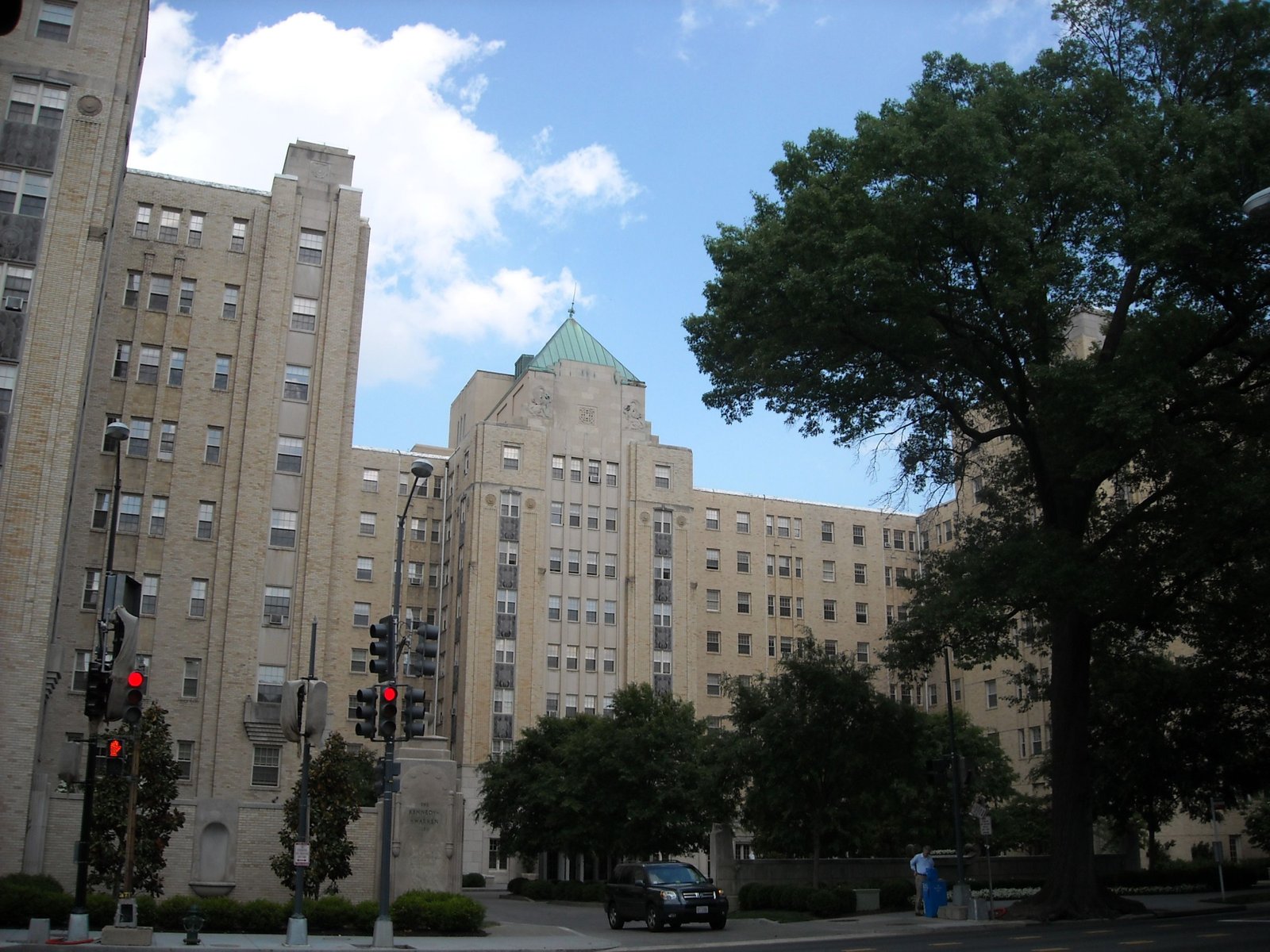
Considered the largest and finest Art Deco building in Washington D.C., the Kennedy-Warren rises over Connecticut Avenue with Aztec limestone carvings, burnished aluminum canopies, and gold-leaf ceilings — a luxury residential landmark that six decades of capital insiders have passed every day without quite getting used to.
At a glance
Completed in 1931 by architect Joseph Younger, the Kennedy-Warren brought luxury apartment living to the Cathedral Heights neighborhood at a time when Washington had no comparable building. Its eleven-story main section — clad in tan and orange variegated brick and trimmed with limestone Aztec Deco reliefs of griffins, eagles, elephants, and starbursts — set a residential Art Deco standard the city never quite matched. Younger died in 1932; Alexander H. Sonneman added the northeast wing in 1935, and a third wing by Hartman-Cox followed in 2002–2004, bringing the total to 425 apartments.
Key facts
- Built: 1930–1931 (main); northeast wing 1935; south wing 2002–2004
- Architects: Joseph Younger (1894–1932); Alexander H. Sonneman (NE wing); Hartman-Cox (south wing)
- Height: 11 stories; 425 apartments total (210 original)
- Style: Aztec Deco variant of Art Deco
- Address: 3131–3133 Connecticut Avenue NW, Washington, D.C. 20008
- Heritage: DC Historic Landmark (1989); NRHP #94001018 (September 7, 1994)
History
Development began in 1930 during the last sustained building boom before the Depression hit Washington’s luxury market. Developers chose Connecticut Avenue for its view over Rock Creek Park and proximity to the National Zoo. Joseph Younger brought Aztec and Pre-Columbian motifs to an Art Deco structural frame — distinguishing the building from the more Classical Deco work going up along 16th Street NW at the same time.
The building attracted prominent residents: Admiral Royal Eason Ingersoll, General Edwin “Pa” Watson (Franklin Roosevelt’s military aide), Harry Hopkins, and the young Lyndon B. Johnson with Lady Bird all lived here at various points, giving the Kennedy-Warren a reputation as the capital’s most discreet address. Sonneman’s 1935 northeast wing extended the original limestone-and-aluminum language convincingly; the 2002–2004 Hartman-Cox south wing followed the same palette, so the complex reads as a single composition from Connecticut Avenue.
What you see
The facade alternates courses of tan and orange brick that shift color with the angle of the light — a Deco device for giving mass the appearance of movement. At entrance level, an aluminum porch canopy detailed with goldsmith precision supports a barrel-vaulted gold-leaf ceiling. Limestone carvings around windows and spandrels run the full range of Aztec Deco imagery: paired griffins with heraldic shields, spread eagles above lintels, starbursts, and elephant heads at cornice level.
Inside, the original vocabulary continues: inlaid Art Deco elevator doors, art glass door knobs, brass hinges, and restored geometric beamed ceilings in the lobby. The ballroom and original dining room survive intact with the attenuated proportions and restrained ornament typical of 1930s Washington luxury.
Practical information
- Status: Active residential building — public access limited to exterior and lobby
- Best view: From the opposite side of Connecticut Avenue NW, looking south toward Rock Creek Park
- Photography: Exterior freely photographable from the public sidewalk
- Season: Any time; aluminum details catch low winter light particularly well
Getting there
Five-minute walk from Cleveland Park Metro station (Red Line). From the exit, head south on Connecticut Avenue NW; the building is on the left before the National Zoo entrance. Street parking is limited on Connecticut Avenue; residential streets east of the building have metered spaces.
Nearby
- Smithsonian’s National Zoo — immediately south on Connecticut Avenue
- Avalon Theatre (1938) — another Art Deco building further north on Connecticut Avenue
- Washington National Cathedral — one mile west via Woodley Road
- Rock Creek Park — green space immediately behind the building
Sources
- Wikipedia: Kennedy–Warren Apartment Building
- District of Columbia Inventory of Historic Sites, 1989 designation
- National Register of Historic Places, NRHP #94001018 (September 7, 1994)
- Library of Congress, HABS documentation of Connecticut Avenue NW
Find it on the map
See this place and what’s around it →Record researched and written by Luigi De Marchi for Cultural Heritage Online, 2026.
Historical events at this place (2)
📷 Become a Cultural Heritage Online photographer
Share your photos of places: they stay published under your name as the author. The more they're seen, the more you get noticed — and soon a contest will reward the most appreciated photos.
Log in or sign up free to add a photoIs this page about you?
This page is read by travellers and heritage enthusiasts who find it on Google. Tell us how you are connected to this place and we will take it from there.