
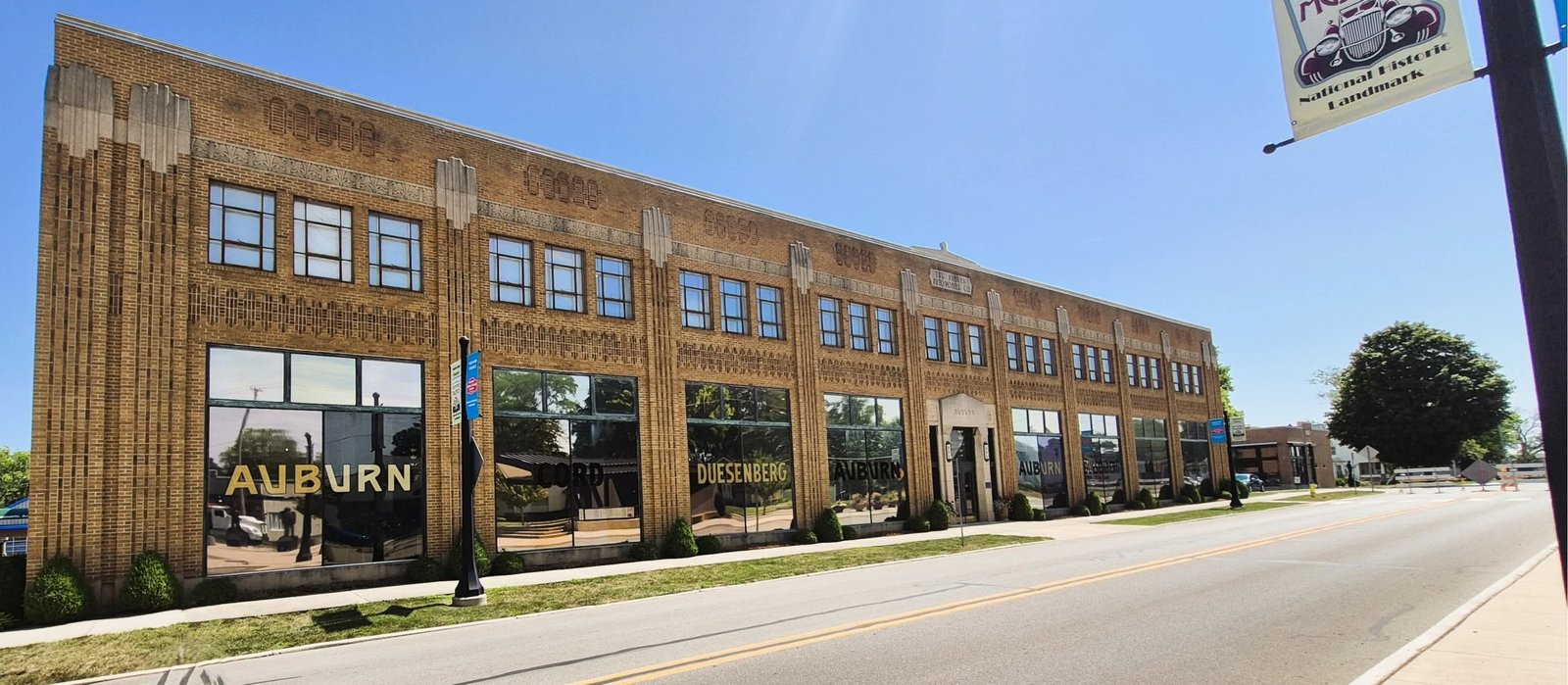
The 1930 Art Deco showroom and administration building of the Auburn Automobile Company — designed by Alvin M. Strauss and now a National Historic Landmark — is one of America’s best-preserved monuments to the golden age of luxury automobile design: a building as flamboyant as the cars it once sold.
At a glance
Architect Alvin M. Strauss (1895–1958) designed the Auburn Automobile Company Administration Building and Showroom in Art Deco style in 1930, at the height of the company’s ambition under Errett Lobban Cord’s control. The complex served as corporate headquarters and public showroom for the Auburn, Cord, and Duesenberg marques — three of the most celebrated American automobiles of their era. After the company’s 1937 closure, the building survived as a parts depot until automotive heritage advocates converted it into a museum in 1974. Designated a National Historic Landmark in 2005, it today houses more than 120 classic vehicles and stands as one of the best-preserved independent auto company complexes in the United States.
Key facts
- Built: 1930
- Architect: Alvin M. Strauss (1895–1958), Fort Wayne, Indiana
- Original use: Auburn Automobile Company Administration Building and Showroom
- Style: Art Deco
- Current use: Museum — Auburn Cord Duesenberg Automobile Museum (est. 1974)
- Collection: 120+ classic vehicles
- Heritage: NRHP (September 21, 1978, Ref. No. 78000029); National Historic Landmark (April 5, 2005)
- Accreditation: American Alliance of Museums
History
The Auburn Automobile Company traced its origins to 1903, when brothers Frank and Morris Eckhart converted their family carriage business into an automobile manufacturer. In 1925 industrialist Errett Lobban Cord took control and set about building an automotive empire that would also encompass the Cord and Duesenberg marques. The 1930 Art Deco administration and showroom complex was the architectural statement of this ambition — commissioned at exactly the moment before the Depression made such confidence untenable.
Architect Alvin M. Strauss, who had also designed Fort Wayne’s Lincoln Bank Tower and Embassy Theatre, brought the same Art Deco vocabulary to Auburn: clean horizontal massing, decorative terra cotta, and a showroom floor designed to present motorcars as luxury objects worthy of theatrical display. The building was completed in 1930, the same year the company introduced the celebrated Duesenberg Model J — the most expensive American production car of its era.
The Great Depression collapsed the luxury automobile market, and Auburn Automobile Company closed in 1937. The building served as a parts depot until 1960. Auburn Automotive Heritage Inc. opened the museum on July 6, 1974; NRHP listing followed in 1978. The 2005 National Historic Landmark designation recognized the complex as “one of the nation’s best-preserved examples of an independent auto company’s facilities.”
What you see
The 1930 administration building presents a confident Art Deco front to the street: horizontal banding, carefully modeled terra cotta ornament, and large ground-floor windows designed to make the showroom cars visible from the road — a retail logic executed in architectural language. Strauss had developed the vocabulary from his Fort Wayne commissions and applied it here at a scale appropriate to a corporate headquarters: imposing enough to convey stability, precise in its ornamental detail to convey craftsmanship.
The National Historic Landmark complex comprises four structures across more than 18 acres: the 1930 administration and showroom building, a service and parts building, the L-29 building (now the adjacent National Auto and Truck Museum), and associated structures. Together they represent the complete operational footprint of an American luxury automobile manufacturer at its peak, preserved with a completeness rare for industrial heritage of this era.
Practical information
- Status: Open museum — check current hours at the museum’s official website
- Collection: 120+ classic vehicles including Auburn, Cord, and Duesenberg models
- Annual event: Auburn Cord Duesenberg Festival (Labor Day weekend) draws 200,000+ visitors with concours events on the museum grounds
- Photography: Generally permitted inside; confirm current policy at admission
- Time needed: Allow 2–3 hours for the full complex
Getting there
Auburn is in DeKalb County, northeast Indiana, approximately 25 miles north of Fort Wayne. From I-69, take Exit 126 toward Auburn; the museum is at 1600 South Wayne Street, Auburn, Indiana 46706. The nearest commercial airport is Fort Wayne International (FWA), about 35 minutes south. No public transit serves Auburn; a car is necessary.
Nearby
- National Auto and Truck Museum — adjacent to the ACD Museum on the same NHL campus
- Embassy Theatre (1928), Fort Wayne — another Alvin M. Strauss Art Deco commission, 35 miles south
- Lincoln Bank Tower (1930), Fort Wayne — third major Strauss Art Deco building in the region
- Pokagon State Park — Indiana state park on Lake James, 30 miles northeast
Sources
- Wikipedia: Auburn Cord Duesenberg Automobile Museum
- Wikipedia: Auburn Automobile Company
- National Historic Landmark designation, April 5, 2005
- National Register of Historic Places, Ref. No. 78000029 (September 21, 1978)
Find it on the map
See this place and what’s around it →Record researched and written by Luigi De Marchi for Cultural Heritage Online, 2026.
Historical events at this place (2)
📷 Become a Cultural Heritage Online photographer
Share your photos of places: they stay published under your name as the author. The more they're seen, the more you get noticed — and soon a contest will reward the most appreciated photos.
Log in or sign up free to add a photo