
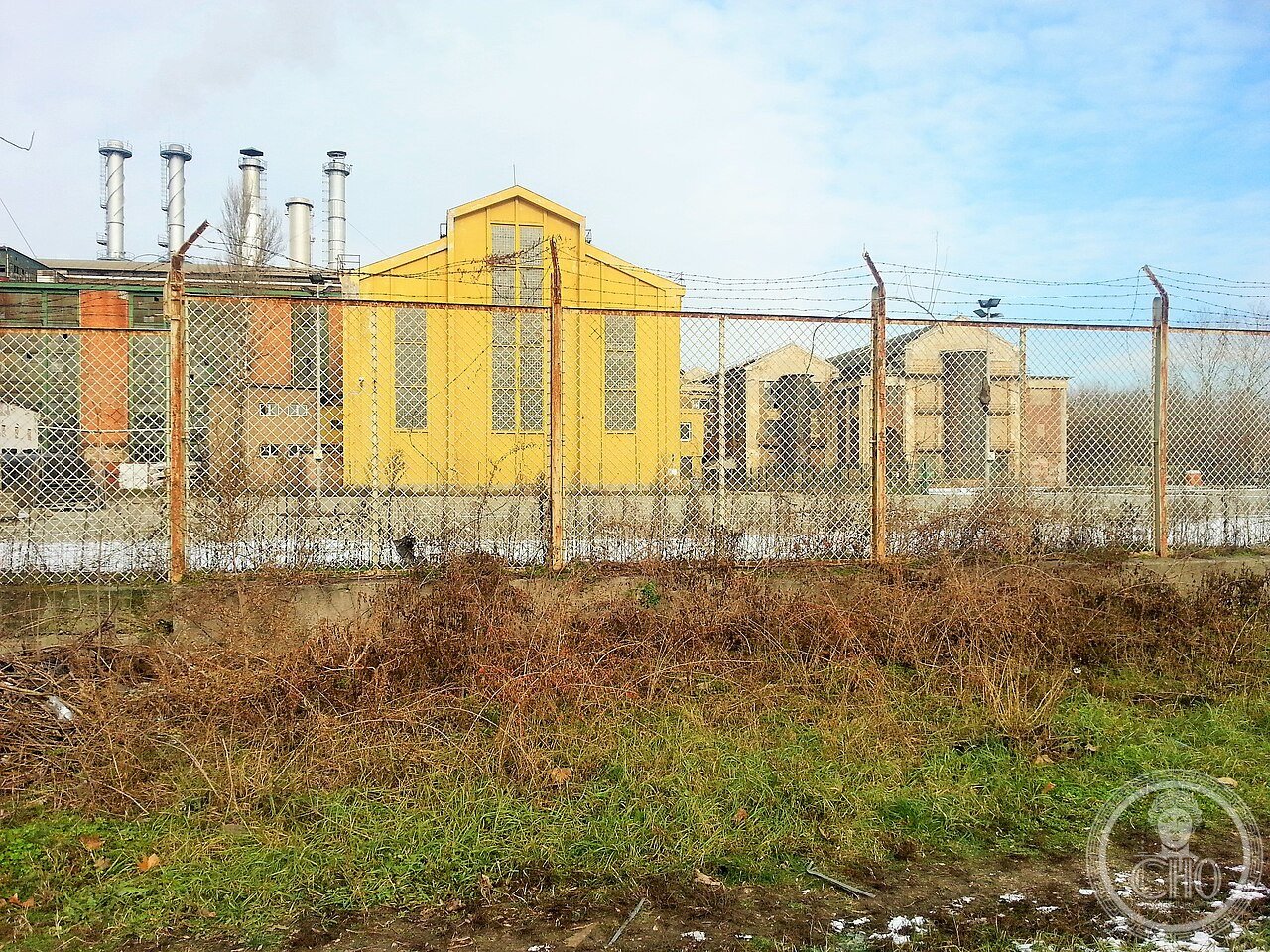
On the southwestern bank of the Danube in Budapest’s 11th district stands one of Central Europe’s most remarkable monuments to interwar industrial ambition. The Kelenföldi Power Station, completed in 1927 to designs by architect Kálmán Reichl, is a building that refuses the usual ugliness of utility infrastructure. Its massive brick facades are articulated with classical pilasters, rhythmic cornices, and arched window bays — the full vocabulary of monumental architecture applied to a coal-fired electricity generating plant. The 140-metre chimney stack dominated Budapest’s skyline for decades. Here, architecture was enlisted to dignify the industrial age, to make power generation look as noble as a palace or a bank. Decommissioned in the twenty-first century and now awaiting conversion, the station has been designated on Budapest’s Heritage A list and remains one of the most compelling examples of the Art Deco industrial aesthetic anywhere in Europe.
At a glance
- Type
- Industrial power station
- Period
- 1914–1927 (phased construction)
- Style
- Industrial Art Deco / Constructivism
- Location
- Hengermalom utca, Budapest XI district, Hungary
- Coordinates
- 47.4684° N, 19.0175° E
- Architect(s)
- Kálmán Reichl
Overview
The Kelenföldi Power Station was the principal electricity-generating facility for Budapest through much of the twentieth century. Unlike the bare utilitarian sheds that housed most industrial machinery of the era, Reichl’s design wrapped the turbine halls and boiler houses in a skin of classical Deco ornament — pilasters, string courses, arched bays — that gave the complex a civic gravitas. The scale is immense: the main hall is cathedral-like in proportion, its brick walls rising to clerestory windows that flood the interior with diffuse light. The 140-metre chimney, one of the tallest structures in interwar Budapest, served both as flue and as landmark. The station represents a strain of thought common in the 1920s: that beauty and utility were not opposites, that infrastructure could and should uplift the city it served.
History
The site on the Lágymányos embankment was chosen for its proximity to the Danube — essential for cooling water — and its rail access for coal delivery. Construction began before the First World War and resumed after the armistice; the main turbine hall was completed by 1927. Through the interwar decades the station supplied a growing fraction of Budapest’s electricity demand, expanding in stages as demand rose. During the Second World War the plant was damaged by bombing and hastily repaired. Under socialist rule the station continued to operate as a state utility, expanding through the 1950s and 1960s before newer and larger plants elsewhere reduced its load. Phased decommissioning began in the 1990s; the last turbines fell silent in the early 2000s. Conversion proposals — cultural venue, hotel, mixed-use — have circulated since then, though as of 2026 the building remains vacant and under protective designation.
Architecture & Design
Reichl’s design belongs to a distinctive interwar type: the monumentalised factory. The exterior uses red brick laid in precise Flemish bond, with giant-order pilasters dividing each elevation into bays. Arched window heads, classical cornices, and decorative brick detailing in geometric patterns draw on both the Vienna Secession and the emerging Art Deco idiom. Inside, the turbine hall is the showpiece: a vast nave-like space with iron-framed overhead cranes, tiled floors, and walls of pale glazed brick that amplify the light. The boiler house and associated buildings follow the same grammar, creating an ensemble of remarkable formal coherence. The chimney stack, though purely functional, is tapered and finely proportioned, serving as a vertical accent for the whole composition. The synthesis of classical structure and industrial purpose marks the building as a key example of the functionalist-classical tendency that shaped Central European architecture between the wars.
Cultural significance
The Kelenföldi Power Station occupies a particular place in the history of industrial heritage. It demonstrates that the interwar period, even in its most utilitarian programmes, maintained a commitment to architectural quality that later decades largely abandoned. For Budapest, it is also a social monument: the electricity it generated powered the tram network, the factories, and the apartments of a rapidly modernising capital. Its designation on the Budapest Heritage A list reflects recognition that industrial buildings of this quality are rare and irreplaceable. Internationally, it stands comparison with the Battersea Power Station in London or the Zollverein in Essen as an example of industrial architecture elevated to the level of art.
Visiting today
The Kelenföldi Power Station is not currently open to the public on a regular basis, though the exterior is freely visible from the surrounding streets and the Lágymányos Bay Park. The imposing brick facades and the chimney stack can be admired from Hengermalom utca and Budafoki út. Occasional open-heritage events and urban exploration tours have provided access to the interior in recent years; check Budapest heritage organisations and the Műemlékem platform for current access opportunities.
Getting there
The power station is located in Budapest’s 11th district (Újbuda), near the junction of Hengermalom utca and Budafoki út. The nearest metro station is Kelenföld vasútállomás (M4 green line), approximately 10 minutes on foot. Trams 18, 19, and 47 serve the area. By car, the site is accessible via Budafoki út from the city centre or via the M0 ring road.
Sources & resources
Do you know more?
On this page we have published what we were able to verify. If you know Kelenföldi Power Station first-hand — you work there, have studied it, or remember how it used to be — and can add a detail, a date, a story or an old photograph, write to Sofia, who looks after these pages. Photographs of the place are welcome too: you can send them with the form at the bottom of this page.
Write to Sofia
or send a message on WhatsApp
Please start your message with the title of this page, so it reaches the right file. Every contribution is checked against independent sources before it goes on the page, and we always say where a piece of information came from.
Find it on the map
See this place and what’s around it →Record researched and written by Luigi De Marchi for Cultural Heritage Online, 2026.
📷 Become a Cultural Heritage Online photographer
Share your photos of places: they stay published under your name as the author. The more they're seen, the more you get noticed — and soon a contest will reward the most appreciated photos.
Log in or sign up free to add a photoIs this page about you?
This page is read by travellers and heritage enthusiasts who find it on Google. Tell us how you are connected to this place and we will take it from there.