
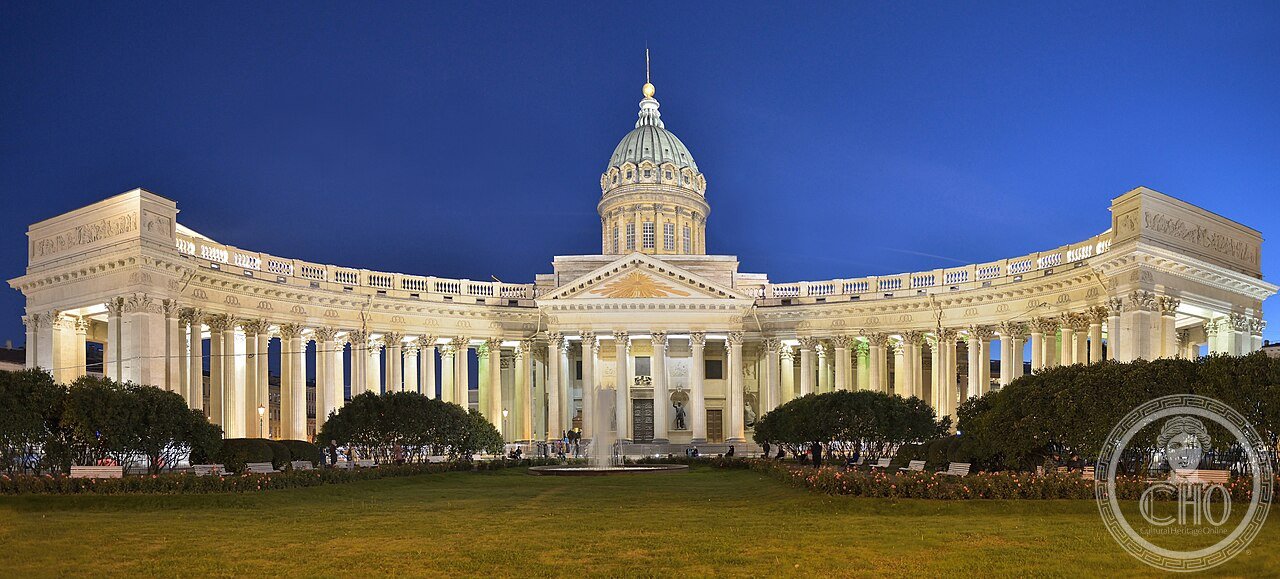
On the Nevsky Prospekt in Saint Petersburg, Kazan Cathedral was commissioned by Tsar Paul I with a decree of 1800. It launched an international design competition, entered by architects such as Charles Cameron, Pietro Gonzago and Thomas de Thomon. Count Alexander Stroganov, however, recommended Andrei Voronikhin, his own former serf, who had not even entered the competition, and Paul preferred him to the rest. Accounts of the time stressed that the cathedral was entirely Russian work — architects, materials and craftsmen — «without a single foreign master». The foundation stone was laid on 27 August 1801, a few months after the assassination of Tsar Paul I. The work went on under Stroganov’s supervision and the oversight of the new Tsar Alexander I, and was finished in 1811. The building is neoclassical, and famous for the semicircular colonnade that faces the Nevsky Prospekt, with about a hundred Corinthian columns in four rows according to the most widely cited sources. It is openly modelled on the colonnade Bernini built in St Peter’s Square in Rome. The reason is liturgical: Orthodox orientation puts the altar to the east and the main door to the west, so the side of the church faced the great avenue. Voronikhin answered by raising a monumental colonnade on that side, to give the street a grand front all the same. A twin colonnade on the south side was planned and never built. The cathedral was built to house the icon of Our Lady of Kazan, among the most venerated in Russian Orthodoxy and traditionally linked to victories in war. The original icon, however, was stolen on the night of 29 June 1904 from the convent of Kazan, not from this cathedral, and, by the thieves’ own account at their trial, burned. That fate is generally thought likely, but has never been established for certain, and the icon venerated in the Saint Petersburg cathedral today is a copy. After the Russian victory over Napoleon in 1812 the cathedral became a monument to the campaign. Field Marshal Mikhail Kutuzov, commander-in-chief of the victorious army, who died that same year in Prussia while pursuing the French, was buried here in 1813. Captured French banners and standards were kept here too, and were later moved in part to the Historical Museum in Moscow. The cathedral was closed in January 1932 and reopened the same year as the Museum of the History of Religion and Atheism. Services resumed in 1992, and in 1996 the building was formally returned to the Russian Orthodox Church.
About Kazan Cathedral
On St. Petersburg’s Nevsky Prospekt, Kazan Cathedral was commissioned by Tsar Paul I through an 1800 decree, which launched an international design competition attracting architects including Charles Cameron, Pietro Gonzago and Thomas de Thomon; Count Alexander Stroganov, however, recommended Andrei Voronikhin, his own former serf, who had not even entered the competition, and Paul preferred him over the others, so much so that contemporary accounts stressed the cathedral was entirely Russian work, in architects, materials and craftsmen, “without a single foreign master.” The foundation stone was laid on 27 August 1801, just months after Tsar Paul I’s assassination, and construction, continued under Stroganov’s supervision and the oversight of the new Tsar Alexander I, was completed in 1811. In Neoclassical style, the building is celebrated for its semicircular colonnade facing Nevsky Prospekt, with around a hundred Corinthian columns arranged in four rows according to the most widely cited sources, explicitly modeled on Bernini’s colonnade at St. Peter’s Square in Rome: the solution arose because, to respect Orthodox liturgical orientation, with the altar facing east and the main entrance west, the church’s side faced the great avenue, and Voronikhin solved the problem by building a monumental colonnade on that side to still give the street a grand facade; a matching colonnade on the south side was planned but never built. The cathedral was built to house the icon of Our Lady of Kazan, among the most venerated in Russian Orthodoxy, traditionally associated with military victories; the original icon, however, was stolen on the night of 29 June 1904 from the Kazan convent (not this cathedral) and, according to the thieves’ own account at trial, burned — a fate generally believed likely but never definitively confirmed; the icon venerated in the St. Petersburg cathedral today is therefore a copy, not the original. After Russia’s 1812 victory over Napoleon, the cathedral became a monument to the campaign: Field Marshal Mikhail Kutuzov, commander-in-chief of the victorious army, who died that same year in Prussia while pursuing French forces, was buried here in 1813, and captured French banners and standards were kept here, later partly transferred to Moscow’s Historical Museum. Closed in January 1932, the cathedral reopened that same year as the Museum of the History of Religion and Atheism during the Soviet era; religious services resumed in 1992, and the building was formally returned to the Russian Orthodox Church in 1996.
Key facts
- 1801-1811: built by architect Andrei Voronikhin, a former serf, under Tsars Paul I and Alexander I.
- Semicircular colonnade facing Nevsky Prospekt, modeled on Bernini’s St. Peter’s Square.
- Built to house the venerated icon of Our Lady of Kazan, stolen in 1904 and likely destroyed.
- 1813: Field Marshal Mikhail Kutuzov, hero of the 1812 campaign against Napoleon, buried here.
- 1932-1992: serves as the Soviet Museum of the History of Religion and Atheism.
- 1996: formally returned to the Russian Orthodox Church.
History
Kazan Cathedral’s transformation from an imperial commission modeled on Rome into Russia’s national monument to the defeat of Napoleon happened within a single decade of its completion, cementing Kutuzov’s tomb here as a site of state memory alongside its religious function. Its later decades as a Soviet museum of atheism, followed by full restoration to Orthodox worship only in 1996, trace the same arc of state control and religious continuity common to many of Russia’s grandest churches.
What you see
A sweeping semicircular colonnade of Corinthian columns curves toward Nevsky Prospekt, a deliberate architectural solution to an Orthodox liturgical orientation that placed the church’s side, not its entrance, facing the avenue. Inside, Kutuzov’s tomb and the remaining captured French banners commemorate the 1812 campaign, alongside the venerated copy of the Kazan icon at the heart of the cathedral’s devotional life.
Practical information
- Opening hours: generally open daily outside services; check current hours before visiting.
- Address: Kazanskaya Ploshchad 2, St. Petersburg, Russia.
Getting there
Kazan Cathedral stands on Nevsky Prospekt in central St. Petersburg, easily reached on foot or by metro. GPS: 59°56′03″N, 30°19′28″E.
Nearby
- Nevsky Prospekt — St. Petersburg’s main avenue.
- Church of the Savior on Spilled Blood — the onion-domed church a short walk away.
- St. Isaac’s Cathedral — another of St. Petersburg’s grand 19th-century cathedrals.
Sources
- Wikipedia — “Kazan Cathedral, Saint Petersburg” (en.wikipedia.org).
- Wikipedia — “Our Lady of Kazan” (en.wikipedia.org).
- Russia Beyond — “The Romanov court church: 10 facts about Kazan Cathedral” (rbth.com).
Find it on the map
See this place and what’s around it →📷 Become a Cultural Heritage Online photographer
Share your photos of places: they stay published under your name as the author. The more they're seen, the more you get noticed — and soon a contest will reward the most appreciated photos.
Log in or sign up free to add a photo