

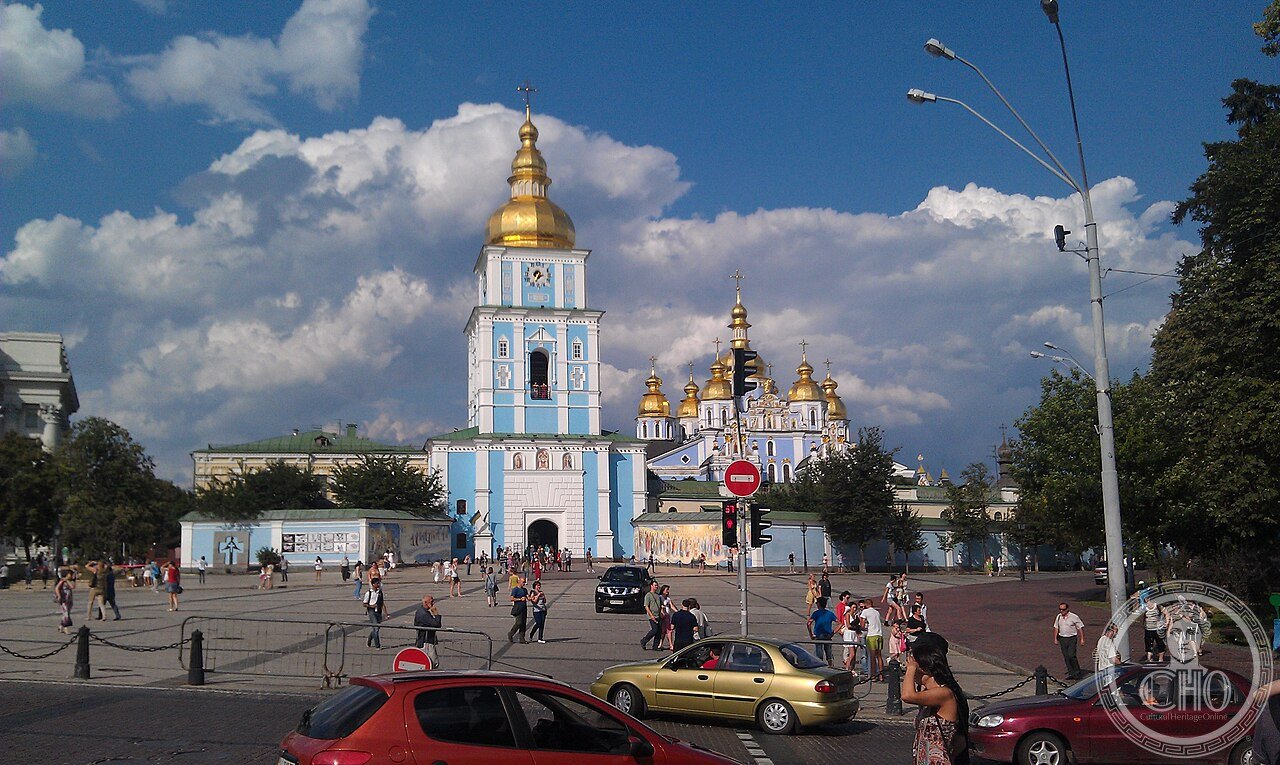
In Kyiv, St. Michael’s Golden-Domed Monastery was founded by Prince Sviatopolk II Iziaslavich, with a foundation date of 11 July 1108 recorded in the Laurentian Codex. Construction is generally dated between 1108 and 1113, the year Sviatopolk himself was buried there. It produced what sources describe as probably the first gilded dome in Kyivan Rus’, the origin of the “golden-domed” name, dedicated to the Archangel Michael. In 1934 a Soviet inspection, carried out 8 June to 9 July, controversially reclassified the building as later Ukrainian Baroque work rather than an original 12th-century structure, in order to justify its demolition. The demolition was planned as part of a scheme, announced in April 1934, to build a new Soviet government centre on the site; the scheme was later interrupted by the Second World War and never completed as envisioned. Removal of the mosaics began on 26 June 1934 under the direction of Vladimir Frolov of the Leningrad Academy of Fine Arts. The golden domes were pulled down in spring 1935, the bell tower destroyed between 1934 and 1935, the outer walls and the Economic Gate between 1936 and 1937, and finally the cathedral shell was dynamited on 14 August 1937. Roughly 45 square metres of 12th-century Byzantine mosaics survived the demolition. They were divided among three Russian institutions, the State Hermitage Museum, the Tretyakov Gallery and the State Russian Museum, where they remain today: a documented historical fact. After Ukrainian independence, large-scale reconstruction began on 24 May 1997, with the main phase of work between November 1998 and the end of 1999. It drew on archival drawings, historic photographs, among them 1851 architectural drawings by the Swedish artist Carl Peter Mazér, and surviving decorative fragments. The rebuilt cathedral officially reopened on 30 May 1999, with interior mosaics and frescoes completed only in 2000. Since December 2018 the monastery has served as the seat of the Orthodox Church of Ukraine (OCU), the jurisdiction that received canonical autocephaly in January 2019 following the December 2018 unification council.
About St. Michael’s Golden-Domed Monastery
In Kyiv, St. Michael’s Golden-Domed Monastery was founded by Prince Sviatopolk II Iziaslavich, with a foundation date of 11 July 1108 recorded in the Laurentian Codex. Construction is generally dated between 1108 and 1113, the year Sviatopolk himself was buried there. It produced what sources describe as probably the first gilded dome in Kyivan Rus’, the origin of the “golden-domed” name, dedicated to the Archangel Michael. In 1934 a Soviet inspection, carried out 8 June to 9 July, controversially reclassified the building as later Ukrainian Baroque work rather than an original 12th-century structure, in order to justify its demolition. The demolition was planned as part of a scheme, announced in April 1934, to build a new Soviet government centre on the site; the scheme was later interrupted by the Second World War and never completed as envisioned. Removal of the mosaics began on 26 June 1934 under the direction of Vladimir Frolov of the Leningrad Academy of Fine Arts. The golden domes were pulled down in spring 1935, the bell tower destroyed between 1934 and 1935, the outer walls and the Economic Gate between 1936 and 1937, and finally the cathedral shell was dynamited on 14 August 1937. Roughly 45 square metres of 12th-century Byzantine mosaics survived the demolition. They were divided among three Russian institutions, the State Hermitage Museum, the Tretyakov Gallery and the State Russian Museum, where they remain today: a documented historical fact. After Ukrainian independence, large-scale reconstruction began on 24 May 1997, with the main phase of work between November 1998 and the end of 1999. It drew on archival drawings, historic photographs, among them 1851 architectural drawings by the Swedish artist Carl Peter Mazér, and surviving decorative fragments. The rebuilt cathedral officially reopened on 30 May 1999, with interior mosaics and frescoes completed only in 2000. Since December 2018 the monastery has served as the seat of the Orthodox Church of Ukraine (OCU), the jurisdiction that received canonical autocephaly in January 2019 following the December 2018 unification council.
Key facts
- 1108-1113: founded by Prince Sviatopolk II Iziaslavich, with probably the first gilded dome in Kyivan Rus’.
- 1934-1937: demolished in stages by Soviet authorities, the cathedral shell dynamited on 14 August 1937.
- Roughly 45 m² of 12th-century mosaics survived, now held in three Russian museums.
- 1997-1999: rebuilt from historic photographs, drawings and surviving fragments.
- 30 May 1999: the reconstructed cathedral officially reopens.
- 2018: becomes the seat of the newly formed Orthodox Church of Ukraine (OCU).
History
The monastery’s demolition, justified by a Soviet-era reclassification of a genuinely 12th-century building as later and less significant, exemplifies the broader campaign against religious architecture across the USSR in the 1930s — a campaign that in this case aimed to clear ground for a government complex ultimately never built as planned. Its 1990s reconstruction, undertaken from photographs and surviving fragments rather than any original fabric, makes the standing building today an exact act of civic memory as much as an architectural monument, while its dispersed 12th-century mosaics remain, to this day, physically located in Russian museums.
What you see
Gold-domed towers rise above white walls in a faithful modern reconstruction of the 12th-century original, rebuilt using archival photographs, 19th-century architectural drawings and surviving decorative fragments after the Soviet-era demolition left nothing standing. Interior mosaics and frescoes, completed in 2000, recreate the Byzantine decorative scheme whose original 12th-century pieces remain today in Russian museum collections.
Practical information
- Opening hours: generally open daily outside services; check current hours before visiting.
- Address: Mykhailivska Square, Kyiv, Ukraine.
Getting there
The monastery stands on Mykhailivska Square in central Kyiv, easily reached on foot from the historic old town. GPS: 50°27′21″N, 30°31′22″E.
Nearby
- Saint Sophia Cathedral — the 11th-century UNESCO-listed cathedral a short walk away.
- Mykhailivska Square — the historic square framing the monastery.
- Kyiv Pechersk Lavra — the historic cave monastery elsewhere in the city.
Sources
- Wikipedia — “St. Michael’s Golden-Domed Monastery” (en.wikipedia.org).
- Wikipedia — “Demolition of St. Michael’s Golden-Domed Monastery” (en.wikipedia.org).
- Encyclopedia of Ukraine — “Saint Michael’s Golden-Domed Monastery” (encyclopediaofukraine.com).
Find it on the map
See this place and what’s around it →📷 Become a Cultural Heritage Online photographer
Share your photos of places: they stay published under your name as the author. The more they're seen, the more you get noticed — and soon a contest will reward the most appreciated photos.
Log in or sign up free to add a photo