
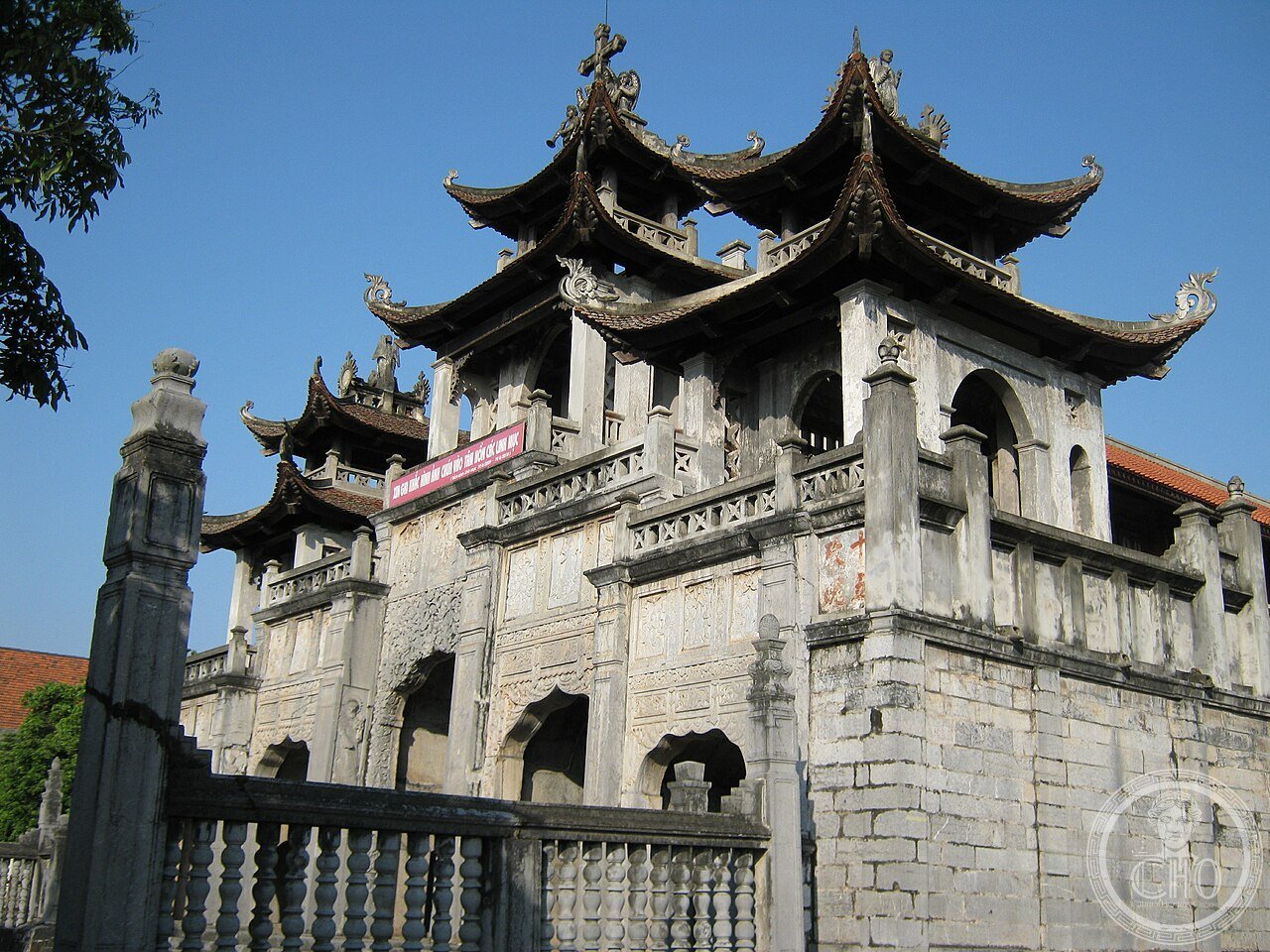
At Phát Diệm, in Ninh Bình province, Vietnam, the Vietnamese Catholic priest Trần Lục, known as “cụ Sáu” (the “Sixth”), led the building of the cathedral complex from 1875; the sources differ on the exact date of completion, placed between 1891 and 1899, with a building campaign that in any case spanned about a quarter of a century, carried out entirely by hand and with the help of water buffalo, without any modern machinery. The complex, of some 22 hectares, comprises the main church, five smaller chapels built between 1883 and 1896, an artificial lake of about 4 hectares, three stone grottoes and an old stone bridge, as well as the famous Phương Đình, the three-level bell tower and gateway, built not on the model of a European facade but on that of a đình, the Vietnamese communal house, with curved roofs covered in traditional tiles. The sources describe the building materials as stone, variously given as local sandstone or limestone depending on the source, and lim wood, a tropical hardwood, with 52 great columns, the tallest reaching 11 metres; no source attests the use of steel or cement in the original nineteenth-century construction, though later restorations, in particular after damage from a bombing on 15 August 1972 during the Vietnam War, may have introduced modern materials. The Phương Đình tower holds a bronze bell estimated at around two tonnes, cast about 1890; the sources do not agree on the exact year, nor do they confirm in any verifiable way that it was the largest bell in Vietnam at the time. The complex is considered a rare example of authentically indigenous Vietnamese Catholic architecture, adapting local religious forms — communal-house roofs, stone carving, a temple-like layout — rather than importing the European Gothic typical of colonial Vietnamese churches; the writer Graham Greene called it “more Buddhist than Christian”. The cathedral is still the active seat of the Diocese of Phát Diệm.
About Phát Diệm Cathedral
In Phát Diệm, in Vietnam’s Ninh Bình Province, the Vietnamese Catholic priest Trần Lục, known as “cụ Sáu” (“the Sixth”), directed construction of the cathedral complex starting in 1875; sources disagree on the exact completion date, placed variously between 1891 and 1899, though construction in any case spanned roughly a quarter century, carried out entirely by hand with the help of water buffalo and no modern machinery. The complex, covering roughly 22 hectares, includes the main church, five smaller chapels built between 1883 and 1896, an artificial lake of about 4 hectares, three stone grottoes and an old stone bridge, alongside the celebrated Phương Đình, the three-tiered bell tower and entrance gate, built not on the model of a European facade but of a đình, the Vietnamese communal house, with curved roofs covered in traditional-style tiles. Sources describe the building materials as stone, variously reported as sandstone or local limestone depending on the source, and lim wood, a tropical hardwood, with 52 large columns, the tallest reaching 11 metres; no source confirms the use of steel or cement in the original 19th-century construction, though later restorations, particularly after damage from a bombing on 15 August 1972 during the Vietnam War, may have introduced modern materials. The Phương Đình tower holds a bronze bell weighing an estimated two tonnes, cast around 1890; sources disagree on the exact year and do not verifiably confirm it was the largest bell in Vietnam at the time. The complex is considered a rare example of authentically indigenous Vietnamese Catholic architecture, adapting local religious forms — communal-house roofs, stone carving, temple-style layout — rather than importing the European Gothic style typical of colonial-era Vietnamese churches; the writer Graham Greene called it “more Buddhist than Christian.” The cathedral remains the active seat of the Diocese of Phát Diệm.
Key facts
- 1875-c.1899: built under Father Trần Lục, entirely by hand with water buffalo, no modern machinery
- Phương Đình: the three-tiered stone bell tower and gate, modeled on a Vietnamese communal house
- 52 lim-wood columns, the tallest reaching 11 metres, and stone construction with no steel or cement
- 22-hectare complex including five chapels, an artificial lake, three grottoes and a stone bridge
- 15 August 1972: damaged by bombing during the Vietnam War, later restored
- Still the active seat of the Roman Catholic Diocese of Phát Diệm
History
Phát Diệm stands apart from most colonial-era Catholic churches in Vietnam by design, not accident: rather than importing European Gothic form, Father Trần Lục directed a quarter-century construction project that reinterpreted Catholic worship space entirely through Vietnamese architectural vocabulary — a communal-house gate tower, temple-style curved roofs, stone carving traditions used elsewhere for pagodas. The result, damaged and repaired after a 1972 wartime bombing, remains one of the clearest built arguments that Catholicism in Vietnam could be expressed in a genuinely local architectural language rather than a transplanted one.
What you see
The three-tiered Phương Đình rises at the complex entrance, its curved, temple-style tiled roofs topped with Latin crosses — a striking visual fusion of Vietnamese communal-house form and Catholic symbolism. Behind it, the main church and five smaller chapels, framed by an artificial lake, stone grottoes and a historic stone bridge, rest on 52 massive lim-wood columns and stone masonry built without any modern reinforcement.
Practical information
- Opening hours: generally open daily outside Mass times; check current hours before visiting
- Address: Phát Diệm town, Kim Sơn District, Ninh Bình Province, Vietnam
Getting there
Phát Diệm Cathedral lies in Kim Sơn District, roughly 30 km southeast of Ninh Bình city, reachable by car or organized tour. GPS: 20°05′34″N, 106°04′46″E.
Nearby
- Ninh Bình city — the provincial capital and gateway to the Trang An landscape
- Kim Sơn District — the surrounding coastal district of Ninh Bình Province
Sources
- Wikipedia — “Phát Diệm Cathedral” (en.wikipedia.org)
- Discover Ninh Binh — visitor information on Phát Diệm Cathedral (discoverninhbinh.com)
- Vietnam Airlines travel guide — Phát Diệm Cathedral (vietnamairlines.com)
Find it on the map
See this place and what’s around it →📷 Become a Cultural Heritage Online photographer
Share your photos of places: they stay published under your name as the author. The more they're seen, the more you get noticed — and soon a contest will reward the most appreciated photos.
Log in or sign up free to add a photo