
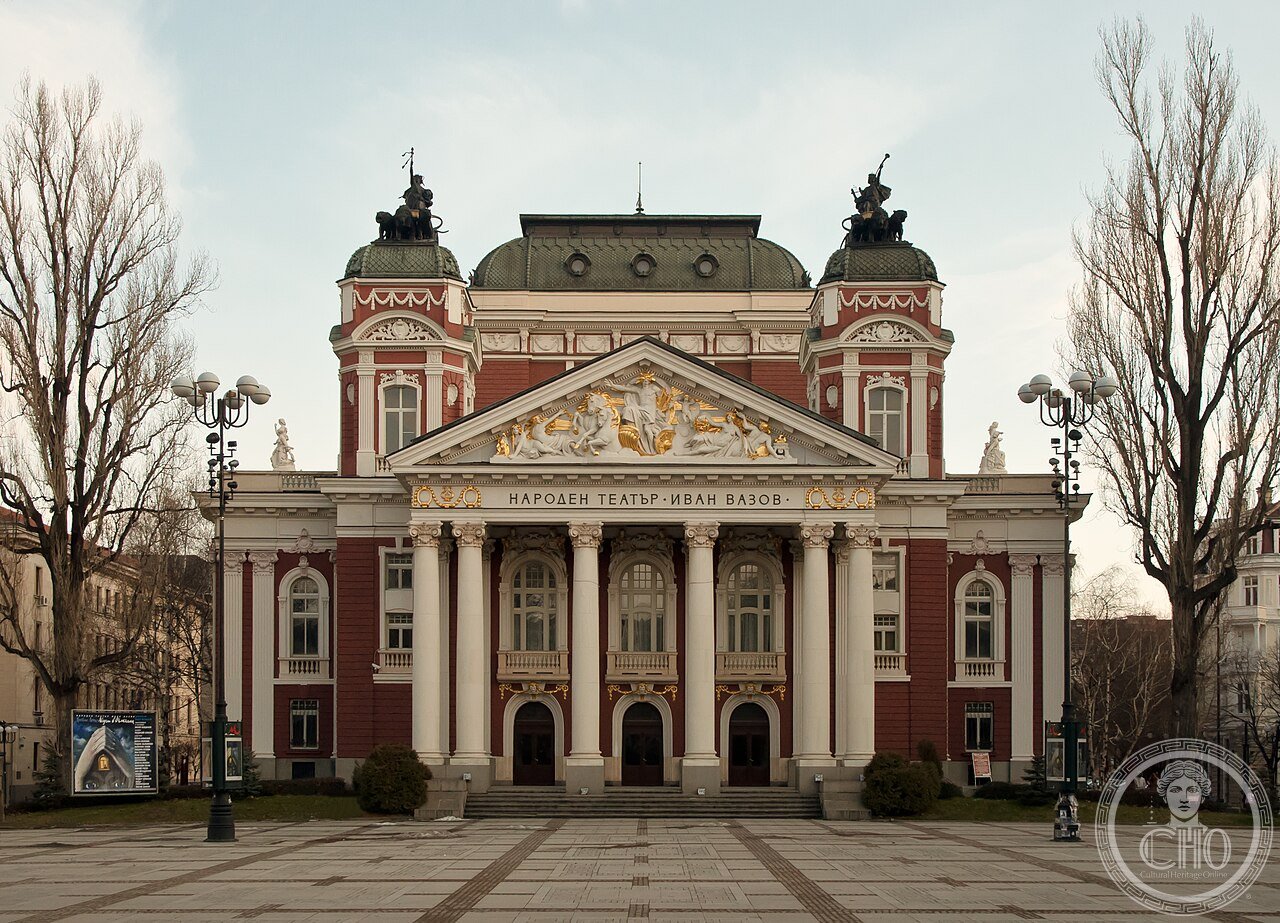
The Ivan Vazov National Theatre is Bulgaria’s most important and venerable theatrical institution, standing at the symbolic heart of Sofia since 1907. Designed by the celebrated Viennese duo Ferdinand Fellner and Hermann Helmer — whose portfolio of opera houses and theatres stretches from Vienna to Odessa — the building represents the pinnacle of Central European Neobaroque civic architecture transplanted to the Balkans. Named after Ivan Vazov, Bulgaria’s beloved national poet and author of Under the Yoke, the theatre embodies the cultural ambitions of a young nation asserting itself on the European stage. Its white pediment adorned with allegorical figures of the arts, its grand portico columns, and its opulent horseshoe auditorium make it one of the finest theatre buildings in southeastern Europe. Remarkably, the structure was almost entirely destroyed by Allied bombing in January 1944 and rebuilt to the original plans with extraordinary fidelity by 1946, a testament to the symbolic importance Bulgarians attached to this building.
At a glance
- Type
- National theatre
- Period
- Completed 1907; rebuilt 1944–1946
- Style
- Neobaroque / Viennese Classicism
- Location
- 1 Dyakon Ignatiy Street, Sofia, Bulgaria
- Coordinates
- 42.6942° N, 23.3264° E
- Architect(s)
- Ferdinand Fellner & Hermann Helmer
Overview
The theatre faces Sofia’s City Garden, a beloved urban park in the centre of the capital, its white neoclassical facade forming one of the city’s most recognisable landmarks. Fellner and Helmer were the dominant theatre architects of the Austro-Hungarian world, designing over 50 theatre buildings across Europe; the Sofia commission brought their expertise to the newly independent Bulgarian kingdom. The auditorium seats around 700 spectators in the classic horseshoe arrangement, with gilded balconies, painted ceiling medallions, and elaborate plasterwork throughout. The National Theatre produces the full spectrum of Bulgarian and international dramatic repertoire.
History
Bulgaria gained independence from the Ottoman Empire in 1878 and rapidly sought to build the institutions of a modern European nation-state. A permanent national theatre was commissioned in the early 1900s, with Fellner and Helmer selected for their reputation across Central Europe. The building opened in 1907 and was named after Ivan Vazov, Bulgaria’s most celebrated writer, who was himself present at the inauguration. It suffered catastrophic destruction during Allied bombing raids in January 1944, when the roof and much of the interior collapsed. In a remarkable act of national will, reconstruction began immediately and was completed by September 1946, with the building restored essentially to its original appearance. Further restorations have since updated technical systems while preserving the historic character.
Architecture & Design
Fellner and Helmer’s design follows the mature pattern they had refined across dozens of theatre commissions: a projecting central portico with Corinthian columns, a prominent pediment bearing allegorical sculptural groups representing Drama, Music, and the Arts, and flanking wings containing foyer spaces and subsidiary halls. The exterior is rendered in white and cream stucco that glows warmly in evening light, framed by the dark greenery of the City Garden. Inside, the auditorium follows the horseshoe plan favoured by European opera houses, with three tiers of gilded balconies and excellent sightlines from nearly every seat. The rebuilt interior retains the essential forms of the original while incorporating some mid-twentieth-century simplifications in ornamental detail.
Cultural significance
The Ivan Vazov National Theatre is to Bulgaria what the Comédie-Française is to France: the supreme institutional expression of the national dramatic tradition. Its namesake, Ivan Vazov, wrote the foundational works of modern Bulgarian literature, and the theatre has premiered countless productions that shaped Bulgarian cultural identity. The decision to rebuild the bombed structure immediately after World War II — rather than design something new — speaks to the depth of its symbolic importance. Today it continues to function as Bulgaria’s premier dramatic institution, staging premieres of new Bulgarian plays alongside the European and world repertoire.
Visiting today
The theatre operates year-round with a rich programme of Bulgarian and international productions. Tickets are available online and at the box office; performances are almost always in Bulgarian, though international touring productions sometimes bring subtitles. The building’s exterior and the surrounding City Garden are freely accessible at all hours. The theatre also offers guided group visits by appointment. The nearby Yellow Brick Road — Sofia’s famous pedestrian boulevard of yellow cobblestones — connects the theatre to many of the city’s other landmarks.
Getting there
The theatre is located in central Sofia, within easy walking distance of Serdika metro station (Lines 1 and 2, approximately 500 metres). Numerous tram and bus routes serve the City Garden area. Sofia Airport is about 10 km east of the city centre; the metro Line 1 connects directly from the airport to the centre in around 20 minutes. The theatre is best reached on foot from most central Sofia hotels.
Sources & resources
Find it on the map
See this place and what’s around it →Record researched and written by Luigi De Marchi for Cultural Heritage Online, 2026.
📷 Become a Cultural Heritage Online photographer
Share your photos of places: they stay published under your name as the author. The more they're seen, the more you get noticed — and soon a contest will reward the most appreciated photos.
Log in or sign up free to add a photoIs this page about you?
This page is read by travellers and heritage enthusiasts who find it on Google. Tell us how you are connected to this place and we will take it from there.