

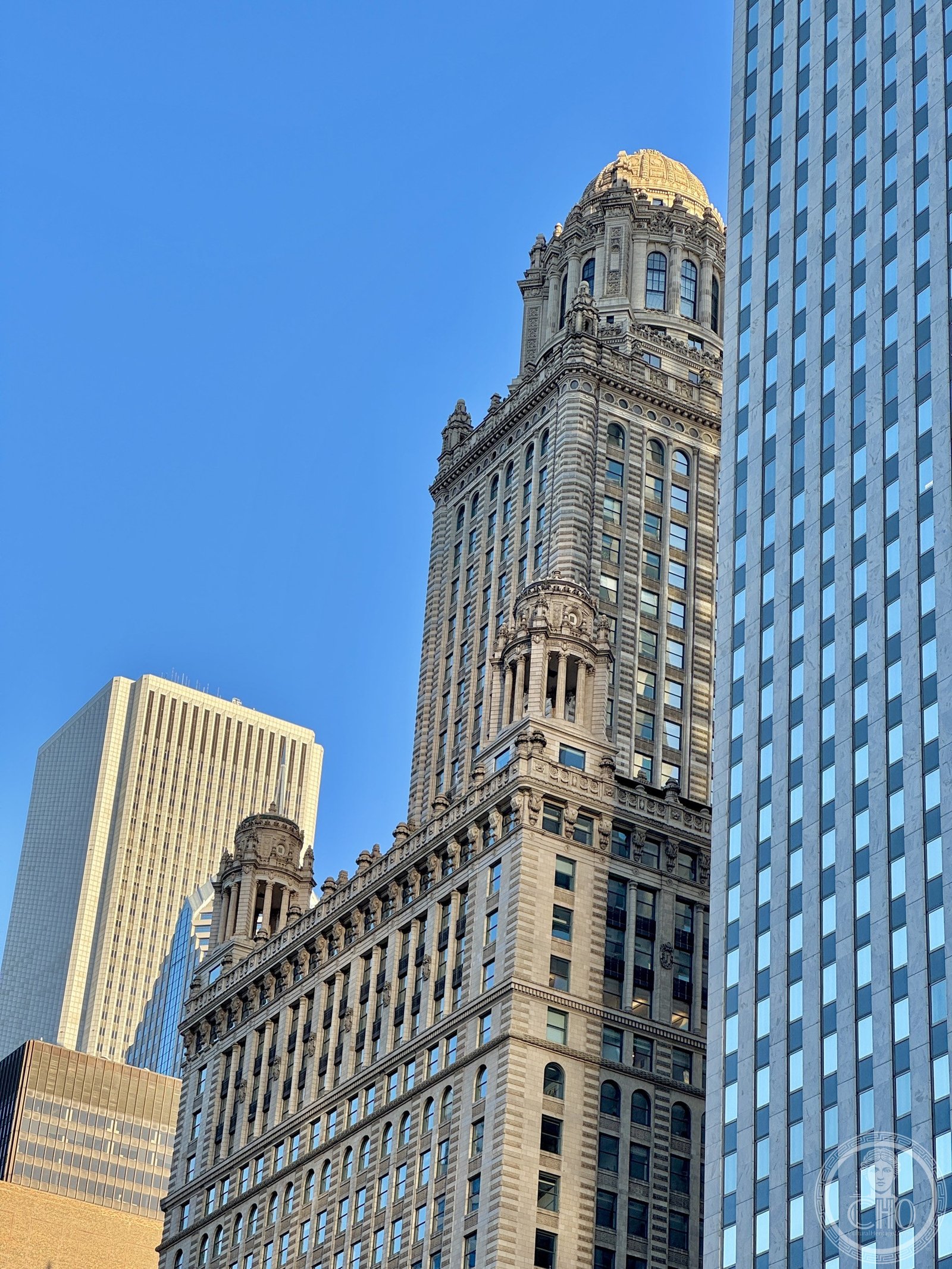
A 40-story Art Deco skyscraper completed in 1927, the Jewelers Building once served Chicago’s diamond and gem trade from offices reached by an automobile elevator that climbed to the twenty-second floor — commerce and technology wrapped in one of the Loop’s most ornate terra cotta towers.
At a glance
Standing at 35 East Wacker Drive on the Chicago Riverfront, the Jewelers Building is one of the most distinctive skyscrapers in the city’s Loop. Completed in 1927, it rises forty stories to an ornate Baroque dome and lantern that break the skyline in a style more Parisian than Chicagoan. The building’s original purpose was specific: to provide secure, purpose-built offices for Chicago’s jewelry trade, clustered in a single tower for mutual convenience and shared security. To serve dealers who transported inventory, an internal automobile elevator system allowed cars to ride up through the building’s core to the twenty-second floor — a mechanical innovation that matched the building’s commercial ambitions. The Jewelers Building is a Chicago Landmark and one of the defining Art Deco skyscrapers of the Illinois riverfront.
Key facts
- Address: 35 East Wacker Drive, Chicago Loop, Illinois
- Completed: 1927
- Height: 40 stories
- Style: Art Deco with Baroque dome
- Original tenants: Chicago jewelry trade
- Special feature: Internal automobile elevator to the 22nd floor
- Historic designation: Chicago Landmark (1996); National Register of Historic Places
History
The Jewelers Building was conceived as a vertical trade center for Chicago’s gem and jewelry industry. In the mid-1920s, Chicago was one of the country’s leading centers for the jewelry trade, and the industry’s merchants had practical reasons to cluster: shared security, proximity to buyers, and the need to transport valuable inventory safely between offices. The automobile elevator — a ramp system that rose through the building’s interior — was designed specifically to serve dealers who needed to bring stock-laden cars directly to their floors rather than risk street-level exposure. The system was an engineering novelty at its time and remained in use for years before ultimately being removed.
The building’s most storied occupant, however, was not in the jewelry trade. Al Capone reportedly operated from a suite in the Jewelers Building during the height of his influence in Chicago, using it as one of several bases of operations during the Prohibition era. Whether or not the specific details have accumulated folklore over the decades, Capone’s association with the building became part of its identity — the ornate tower above the Chicago River as both commercial monument and underworld address.
After the jewelry industry dispersed from the building in the mid-twentieth century, 35 East Wacker went through successive occupancies and eventually acquired its current address-based name in place of its original tenant identity. It was designated a Chicago Landmark in 1996 and listed on the National Register of Historic Places, recognizing both its architectural significance and its place in the commercial history of the Chicago Loop.
What you see
The Jewelers Building’s most immediately striking feature is its crown: above the main tower shaft, a colonnaded drum supports an elaborate Baroque dome, ringed by smaller turrets and topped by a lantern and cupola. The combination is unusual in the Chicago skyline — most Loop skyscrapers of the 1920s resolve in flat setbacks or simple parapets — and reads as a deliberate quotation from French or Italian Baroque tradition, transposed forty stories above the Chicago River. The effect from the river or from Wacker Drive is theatrical, a formal punchline in a city of straightforward architectural sentences.
Below the crown, the tower is faced in white and cream terra cotta with ornate panels at the spandrels, elaborate cornices at the intermediate setbacks, and richly decorated window surrounds on the lower floors. The terra cotta ornament integrates classical motifs — cartouches, garlands, keystones — with the verticalism and commercial confidence of Art Deco. The ground level, modified by successive renovations, was originally conceived as an elaborate entry sequence appropriate for a building of its pretensions.
Practical information
- Status: Active commercial building; lobby visible during business hours
- Exterior: Freely visible from Wacker Drive and the Chicago Riverwalk below
- Best views: From the Chicago River (river cruise or Riverwalk) for the full tower profile; from Wacker Drive pedestrian level for terra cotta detail
- Historic designation: Chicago Landmark (1996); National Register of Historic Places
Getting there
The Jewelers Building is in the heart of the Chicago Loop, at 35 East Wacker Drive near Wabash Avenue, directly on the Chicago Riverfront. Multiple CTA El lines serve the Loop, with several stations within a five-minute walk including State/Lake (Red, Brown, Green, Orange, Pink, Purple lines) and Clark/Lake or nearby elevated stops. The Chicago Riverwalk provides direct pedestrian access from the river level. The building is a few blocks from Millennium Park and one block from the Tribune Tower and the Magnificent Mile at Michigan Avenue.
Nearby
- Tribune Tower (1925) — the Gothic Revival skyscraper of the Chicago Tribune at Michigan Avenue, with its famous embedded stone fragments from world monuments
- Marina City (1963–1967) — Bertrand Goldberg’s circular “corncob” towers, a few blocks west on the Chicago River
- Chicago Architecture Center — river architecture boat tours departing from Wacker Drive, offering the best comprehensive views of the Jewelers Building and its neighbors
- Millennium Park — Anish Kapoor’s Cloud Gate and the Frank Gehry Pritzker Pavilion, about half a mile south on Michigan Avenue
Sources
- Wikipedia: 35 East Wacker Drive
- Chicago Landmarks designation report (1996)
- National Register of Historic Places documentation
- Chicago Architecture Foundation, building profiles
Find it on the map
See this place and what’s around it →Record researched and written by Luigi De Marchi for Cultural Heritage Online, 2026.
📷 Become a Cultural Heritage Online photographer
Share your photos of places: they stay published under your name as the author. The more they're seen, the more you get noticed — and soon a contest will reward the most appreciated photos.
Log in or sign up free to add a photoIs this page about you?
This page is read by travellers and heritage enthusiasts who find it on Google. Tell us how you are connected to this place and we will take it from there.