

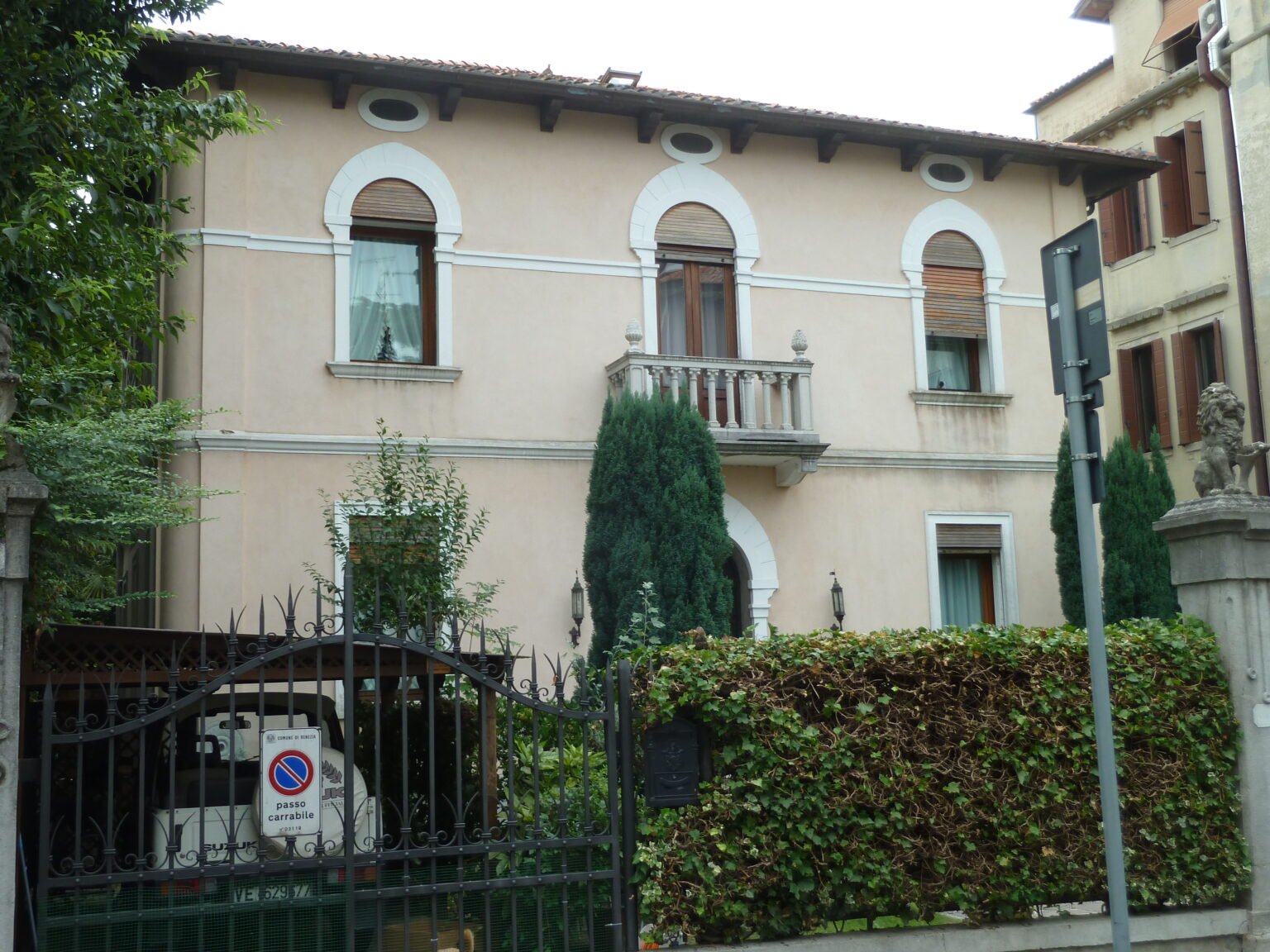
Two stone lions guard the gate of this modest villa on via Dandolo. The architect’s name is lost, but the house is a clear, characteristic example of the Lido’s early villas.
At a glance
The Villino Camuzzoni is a small single-family villa on via Enrico Dandolo, in the central grid of the Lido. It is square in plan and rises just two storeys to a tiled hip roof, set in its own garden. No designer is recorded for it — the heritage survey lists the architect as unknown — and the cadastral record places it among the houses documented on the island between the 1920s and the 1940s. Its character comes less from its plain walls than from the pair of carved lions that watch over its gate.
Key facts
- Architect: not recorded
- Documented: in the Italian cadastre, 1926–1945
- Client: the Camuzzoni family
- Plan: square, two storeys, about 186 m²
- Style: Lido villa architecture of the early 1900s
- Signature detail: gate pillars topped by two full-round stone lions
- Location: via Enrico Dandolo 18
History
Not every house on the Lido carries a famous name. The Villino Camuzzoni is one of the many built for private families as the island grew, and its designer has not come down to us: the city’s heritage survey records the architect simply as unknown, and dates the building from its appearance in the Italian land registry between 1926 and 1945.
That anonymity is part of the truth of the place. For every Mon Plaisir or Villa Romanelli, signed by a known architect, the Lido filled with comfortable villas like this one, repeating the decorative habits of the island without claiming to be art. The Camuzzoni belonged to the family whose name it still bears, and it remains a private home today.
What you see
The body of the house is plain. Its decoration is concentrated at the threshold and on the main front: the gate pillars carry two carved lions, full in the round, beside circles and linear motifs of the kind that recur across the island’s early villas. On the first floor a concrete balcony runs behind a balustrade of small columns with Ionic capitals, closed at each end by a sculpted pine-cone.
The windows mark the two floors apart. Those at ground level are rectangular, framed in painted white; those above are round-arched, their centres drawn up to a slight point and edged in white marble, springing from the line of the floor-band. Under the eaves, carried on shaped wooden brackets, three small oval windows in white stone light the attic.
Practical information
- Access: private residence — it can be admired only from the street, not visited inside.
- Best seen: from the via Dandolo gate, where the two stone lions face the street.
- Time needed: a few minutes; it sits close to Villa Romanelli on the same street.
- Setting: a residential stretch of via Dandolo, inland from the seafront.
Getting there
From central Venice, take a vaporetto to the Lido Santa Maria Elisabetta landing, then walk toward via Enrico Dandolo, a few minutes inland from the seafront. From Marco Polo Airport, the Alilaguna water bus reaches the Lido directly, or a land transfer to Tronchetto connects with the lagoon vaporetti.
Nearby
- Villa Romanelli — Domenico Rupolo’s 1906 villa, a few doors along via Dandolo.
- Villino Mon Plaisir — Guido Sullam’s 1904 villa near the Gran Viale.
- Villino Thea — Sullam again, of 1905, on via Lepanto.
- Liberty and Rationalist Architecture in Venice Lido — a walking route through the island.
Sources
- Comune di Venezia, L’architettura del Lido — synthetic record and building description for Villino Camuzzoni.
- Hero photograph: Wikimedia Commons (author Abxbay), CC BY-SA 4.0.
Find it on the map
See this place and what’s around it →📷 Become a Cultural Heritage Online photographer
Share your photos of places: they stay published under your name as the author. The more they're seen, the more you get noticed — and soon a contest will reward the most appreciated photos.
Log in or sign up free to add a photoIs this page about you?
This page is read by travellers and heritage enthusiasts who find it on Google. Tell us how you are connected to this place and we will take it from there.