
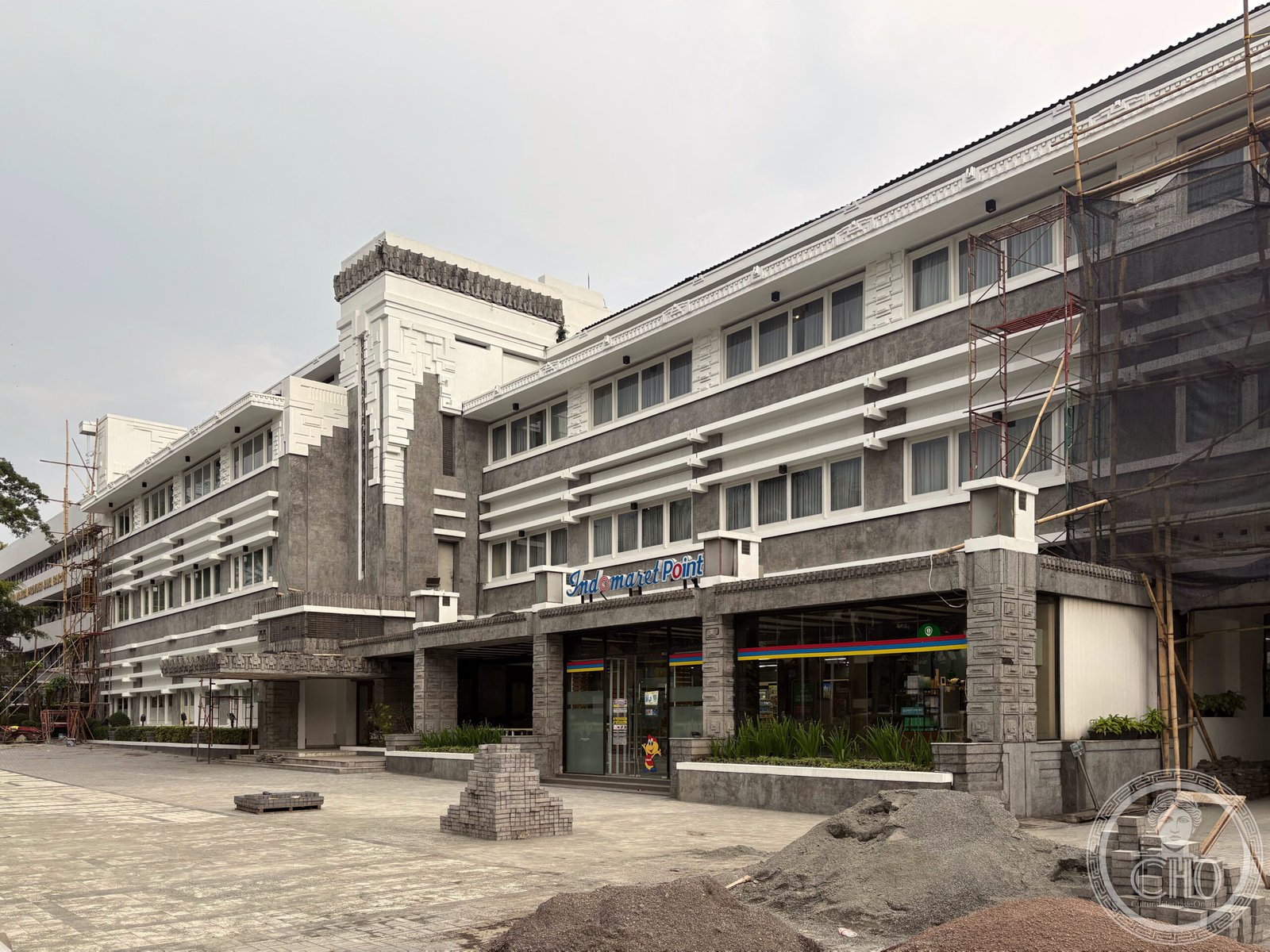
Rising above the wide boulevard of Jalan Asia Afrika in central Bandung, Hotel Preanger stands as one of the finest Art Deco hotels in Southeast Asia. Completed in 1929, the building was designed by Charles Prosper Wolff Schoemaker — a Dutch architect celebrated as “the Frank Lloyd Wright of Indonesia” — and later extended and refined by Soekarno, who would go on to become the first President of the Republic of Indonesia. The hotel blends the bold geometries of Western Art Deco with tropical colonial sensibilities: clean horizontal banding, ornamental friezes, and generous verandas suited to Bandung’s highland climate. It anchors the heritage streetscape of a city once called “Paris van Java” by Dutch colonists, and its guest register across the decades reads as a who’s who of twentieth-century Asia. Today, restored and operating under the Grand Hotel Preanger name, it remains a landmark of colonial-era grandeur and living heritage in West Java.
At a glance
- Type
- Historic hotel
- Period
- Completed 1929; extended mid-20th century
- Style
- Dutch Colonial Art Deco
- Location
- 81 Jalan Asia Afrika, Sumur Bandung, Bandung, West Java, Indonesia
- Coordinates
- 6.9213° S, 107.6117° E
- Architect(s)
- Charles Prosper Wolff Schoemaker (original, 1929); Soekarno (extension)
Overview
Hotel Preanger occupies a commanding position on Jalan Asia Afrika, Bandung’s principal colonial boulevard and one of the most architecturally significant streets in Indonesia. Built in 1929 to accommodate the growing number of European business travelers and plantation owners visiting the Preanger highlands, the hotel was the showpiece of a city undergoing rapid modernisation under the Dutch East Indies colonial administration. Its Art Deco façade — characterised by strong vertical piers, horizontal string courses, and restrained ornamental detail — made it an instant landmark. The building was later extended under the supervision of Soekarno before independence, lending it an additional layer of historical significance as a site where Indonesian national identity intersected with colonial architecture.
History
The Preanger highlands of West Java had attracted Dutch colonial interest since the seventeenth century, prized for their coffee, tea, and quinine plantations. By the late nineteenth century Bandung had grown into a prosperous administrative and commercial city. Hotel Preanger was constructed in 1929 as the city’s prestige address for colonial elites and international visitors, designed by Charles Prosper Wolff Schoemaker, whose earlier work at Villa Isola had already established him as Bandung’s foremost modernist architect. During the 1930s and into the Japanese occupation of 1942–1945, the hotel served successive waves of guests, including military officers and colonial officials. In the post-war years, the future President Soekarno — himself a trained architect — was involved in extending and renovating the building. Independent Indonesia inherited the hotel as a tangible symbol of the colonial built environment that the new nation chose to preserve rather than demolish.
Architecture & Design
Wolff Schoemaker’s design for Hotel Preanger exemplifies the tropical Art Deco idiom that flourished in the Dutch East Indies between the wars. The main façade deploys the characteristic Art Deco vocabulary of the period — flat roofline, pronounced horizontal banding, and a central entrance block that projects slightly from the main mass — while adapting it to the Bandung highland climate through deep-set windows and shaded colonnades. Wolff Schoemaker had been deeply influenced by Frank Lloyd Wright’s Prairie Style emphasis on horizontal line and organic integration with setting, and these influences are visible in the layered composition of the building’s street front. The interiors originally featured terrazzo floors, geometric tilework, and custom ironwork grilles typical of the Streamline Moderne vocabulary. Soekarno’s later interventions maintained stylistic coherence while expanding the guest accommodation.
Cultural significance
Hotel Preanger is a key node in Bandung’s identity as one of the world’s richest concentrations of colonial-era Art Deco architecture — a status that has led urban historians to place Bandung alongside Miami Beach and Napier as exceptional Art Deco cities. The hotel’s connection to Soekarno, who trained as an architect before leading the independence movement, gives it a dual resonance: it is simultaneously a monument to Dutch colonial ambition and a site touched by the founding generation of independent Indonesia. Jalan Asia Afrika, on which the hotel stands, was renamed after the 1955 Bandung Conference — a defining moment in Third World solidarity — cementing the street’s symbolic importance in global post-colonial history.
Visiting today
Hotel Preanger, now operating as Grand Hotel Preanger, continues as a functioning hotel and can be visited by non-guests for dining and lobby access. The building’s Art Deco public spaces — lobby, main dining room, and terrace — are the key areas of architectural interest. Bandung’s Jalan Asia Afrika heritage corridor, which also includes Gedung Merdeka (site of the 1955 Bandung Conference), Gedung Sate, and several other colonial-era landmarks, rewards a half-day walking tour. The hotel is best visited in the morning before the boulevard fills with traffic.
Getting there
Bandung is served by Husein Sastranegara International Airport and by frequent Argo Parahyangan and Argo Wilis intercity trains from Jakarta Gambir station (approximately three hours). From Bandung Railway Station (Stasiun Bandung), Hotel Preanger is reachable on foot in about twenty minutes along Jalan Asia Afrika, or by short taxi or ride-hail (Gojek/Grab). The hotel is in the historic city centre, within easy walking distance of the main colonial heritage sites.
Sources & resources
Find it on the map
See this place and what’s around it →Record researched and written by Luigi De Marchi for Cultural Heritage Online, 2026.
📷 Become a Cultural Heritage Online photographer
Share your photos of places: they stay published under your name as the author. The more they're seen, the more you get noticed — and soon a contest will reward the most appreciated photos.
Log in or sign up free to add a photoIs this page about you?
This page is read by travellers and heritage enthusiasts who find it on Google. Tell us how you are connected to this place and we will take it from there.