

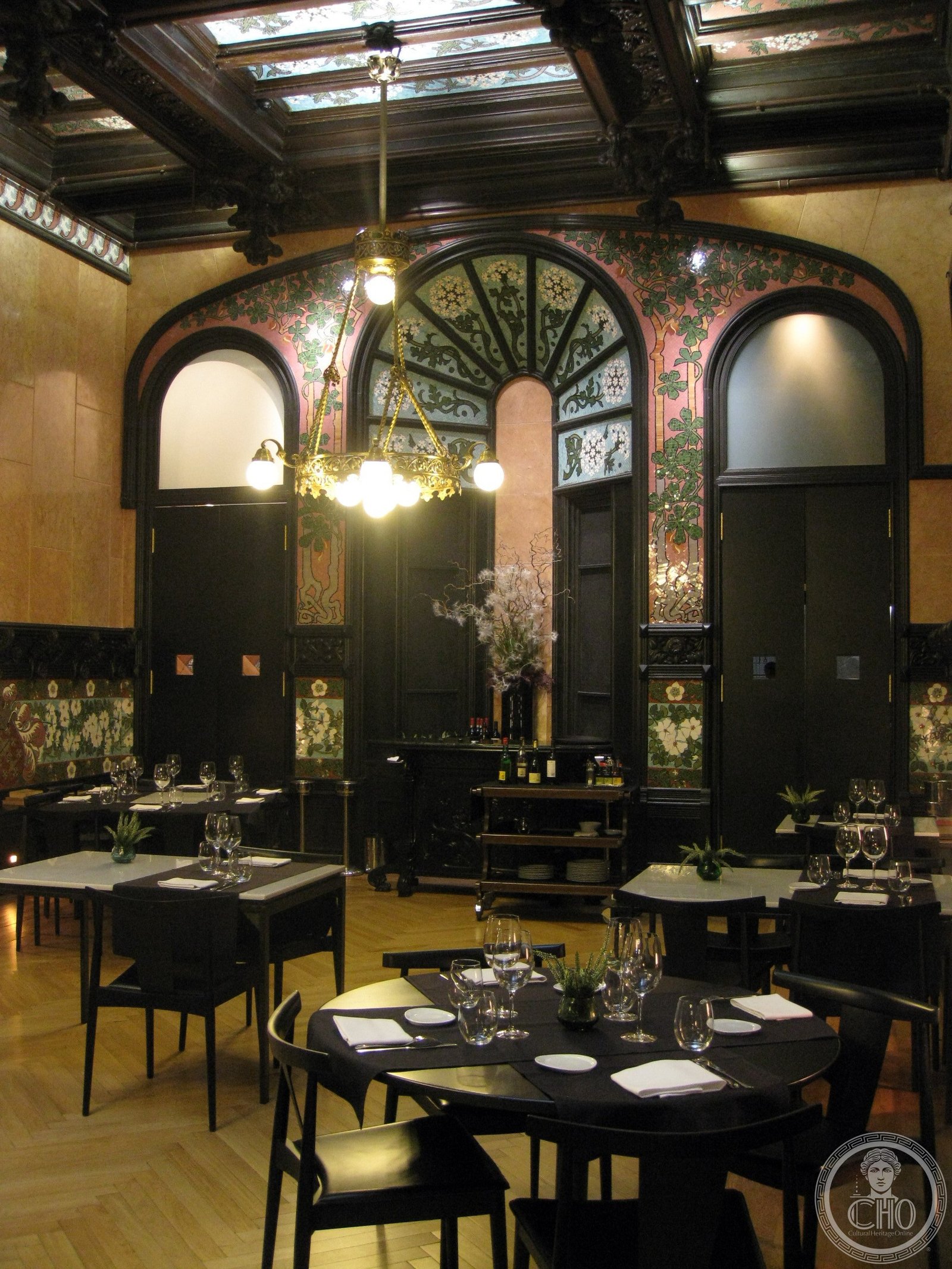
In the Raval district, a few steps from the Ramblas, Hotel España conceals one of Barcelona’s most extraordinary Art Nouveau interiors behind a discreet street-level façade.
At a glance
Lluís Domènech i Montaner (1849–1923) transformed the ground floor of a mid-19th-century inn into a showpiece of Catalan Modernisme in 1902–1903. Working alongside sculptor Eusebi Arnau and painter Ramon Casas, he created two dining rooms that remain intact: a mermaids’ hall shimmering with marine sgraffito and a salon anchored by a monumental alabaster fireplace. The hotel operates today as a four-star property with the Fonda España restaurant directed by chef Martín Berasategui, and it is catalogued in the Catalan Architectural Heritage Inventory (IPAC) as a Cultural Asset of Local Interest.
Key facts
- Built: Original building 1850; Modernista renovation 1902–1903 by Lluís Domènech i Montaner
- Style: Catalan Modernisme (Art Nouveau)
- Status: Operating four-star hotel and restaurant
- Address: Carrer de Sant Pau, 9–11, 08001 Barcelona, Spain
- GPS: 41.3800, 2.1728 — Open in Google Maps
- UNESCO/Listed: Bien Cultural de Interès Local (Catalan Architectural Heritage Inventory, IPAC); not UNESCO-listed individually, though Domènech i Montaner’s Palau de la Música Catalana and Hospital de Sant Pau are UNESCO World Heritage Sites
History
The building dates to 1850, when Joan and Pau Riba constructed it as rental housing. By 1859 it had been converted into a fonda — a traditional Catalan inn — and by 1863 it had become a recognised stop for travellers passing through Barcelona. The establishment adopted the designation “Hotel” in 1888, the year of Barcelona’s Universal Exposition.
In 1902, the owners commissioned Lluís Domènech i Montaner to redesign the ground floor. The work was completed in 1903. That same year, Barcelona City Council awarded the hotel its prize for best commercial establishment of the year for architecture and decoration. Decades later, a major rehabilitation carried out between 2007 and 2011 by architects Carlos Bassó and Tote Moreno restored the Modernista interiors while updating the hotel’s facilities.
Today the hotel is operated under the OD Hotels group and its restaurant, Fonda España, has become a culinary destination in its own right, overseen by twelve-Michelin-star chef Martín Berasategui.
What you see
The street façade on Carrer de Sant Pau is understated: a five-storey early-20th-century Barcelona block with modest ironwork balconies. The drama begins at the threshold. Inside, Domènech i Montaner divided the ground floor into two principal rooms distinguished by their decorative programmes. The Saló de les Sirenes — the Mermaids’ Room — is the former guest dining room, its upper walls covered in marine sgraffito by Ramon Casas: writhing sea creatures and mythological figures rendered in swirling ochre and cream tones. The heraldic tile wainscot runs at shoulder height, its geometric logic a counterpoint to the organic energy above.
The Arnau Room takes its name from sculptor Eusebi Arnau, who carved the five-metre alabaster fireplace that dominates one wall. The relief depicts allegorical figures representing the ages of man, flanked by heraldic emblems. A coffered skylight overhead floods the space with diffused natural light. Original period fixtures survive throughout both rooms, making the ensemble one of the best-preserved Modernista interiors in Barcelona.
Practical information
- Open to hotel guests and restaurant diners; the Modernista rooms are accessible to diners at Fonda España
- Best visited in spring or autumn to avoid peak-season crowds in the Raval
- Guided architectural tours: Monday–Friday at 12:15 and 16:30; Saturday at 17:00 (approx. 40 minutes)
- Estimated visit time: 30–60 minutes for the interiors; longer with a meal
Getting there
Barcelona–El Prat Airport is 15 km from the city centre; the Aerobus or L9 Sud metro line connect to central Barcelona. From Plaça de Catalunya, Carrer de Sant Pau runs southwest from the Ramblas — the hotel is less than 300 metres from La Rambla, between the Liceu opera house and the Hospital de Sant Pau. The nearest metro station is Liceu (L3, green line), a five-minute walk.
Nearby
- Gran Teatre del Liceu (200 m) — Barcelona’s main opera house, rebuilt in 1999 after a fire; a cultural landmark on La Rambla.
- Palau Güell (350 m) — Antoni Gaudí’s first major commission (1886–1890), a UNESCO World Heritage Site a short walk into the Raval.
- Hospital de Sant Pau (1 km) — Domènech i Montaner’s masterpiece (1905–1930), a UNESCO World Heritage Site and the architect’s largest surviving work.
- Palau de la Música Catalana (1.2 km) — Domènech i Montaner’s concert hall (1905–1908), UNESCO-listed, in the Sant Pere district.
Sources
Find it on the map
See this place and what’s around it →Historical events at this place (1)
📷 Become a Cultural Heritage Online photographer
Share your photos of places: they stay published under your name as the author. The more they're seen, the more you get noticed — and soon a contest will reward the most appreciated photos.
Log in or sign up free to add a photoIs this page about you?
This page is read by travellers and heritage enthusiasts who find it on Google. Tell us how you are connected to this place and we will take it from there.