
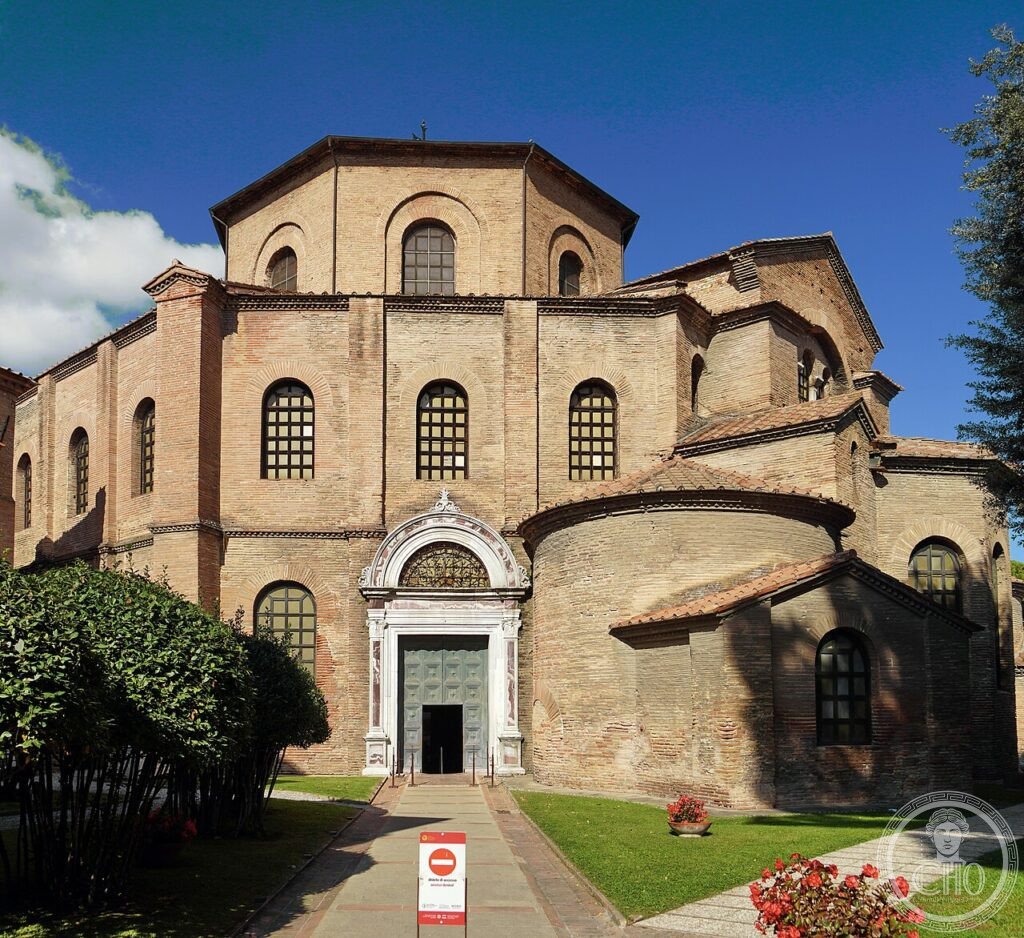
Eight buildings from the fifth and sixth centuries CE — churches, mausoleums, and baptisteries — containing the largest and finest surviving cycle of early Christian mosaic art anywhere in the world: the gold-ground compositions of Ravenna defined what Byzantine art looks like in Western eyes, and influenced every subsequent tradition of sacred representation from Romanesque fresco to the Venice School.
At a glance
The UNESCO inscription “Early Christian Monuments of Ravenna” (1996, ref. 788) covers eight buildings constructed between 430 CE and 549 CE, when Ravenna was successively the capital of the Western Roman Empire (402–476), the Ostrogothic kingdom of Theodoric the Great (476–540), and the Byzantine Exarchate of Ravenna (540–751). These three successive regimes — Roman, Germanic, and Byzantine — all poured resources into the construction of church buildings decorated with floor-to-ceiling mosaic cycles; the result is a concentration of fifth and sixth century mosaic art with no parallel anywhere in the world.
The eight inscribed monuments are: the Mausoleum of Galla Placidia (c. 430 CE); the Neonian Baptistery / Baptistery of the Orthodox (c. 450 CE); the Basilica of Sant’Apollinare Nuovo (504 CE, Theodoric); the Arian Baptistery (c. 500 CE, Theodoric); the Archbishop’s Chapel (c. 500 CE); the Mausoleum of Theodoric (520 CE); the Basilica of San Vitale (526–548 CE, Byzantine); and the Basilica of Sant’Apollinare in Classe (532–549 CE, Byzantine), 5 km south of the city at the former Roman port of Classis.
Key facts
- Mausoleo di Galla Placidia: c. 430 CE; cross-shaped cruciform; earliest mosaics in the inscription; stars, deer, Good Shepherd
- Battistero degli Ortodossi (Neoniano): c. 450 CE; octagonal; Baptism of Christ dome mosaic
- Basilica di Sant’Apollinare Nuovo: 504 CE (Theodoric); nave procession mosaics (virgins, martyrs, Magi), 26 scenes of Christ’s life in the clerestory
- Battistero degli Ariani: c. 500 CE (Theodoric); dome mosaic of the Baptism, Arian iconographic tradition
- Cappella Arcivescovile: c. 500 CE; private chapel, only surviving Arian oratory; Christ-warrior mosaic
- Mausoleo di Teodorico: 520 CE; monolithic stone dome, 10-sided; unique in Western late antique architecture
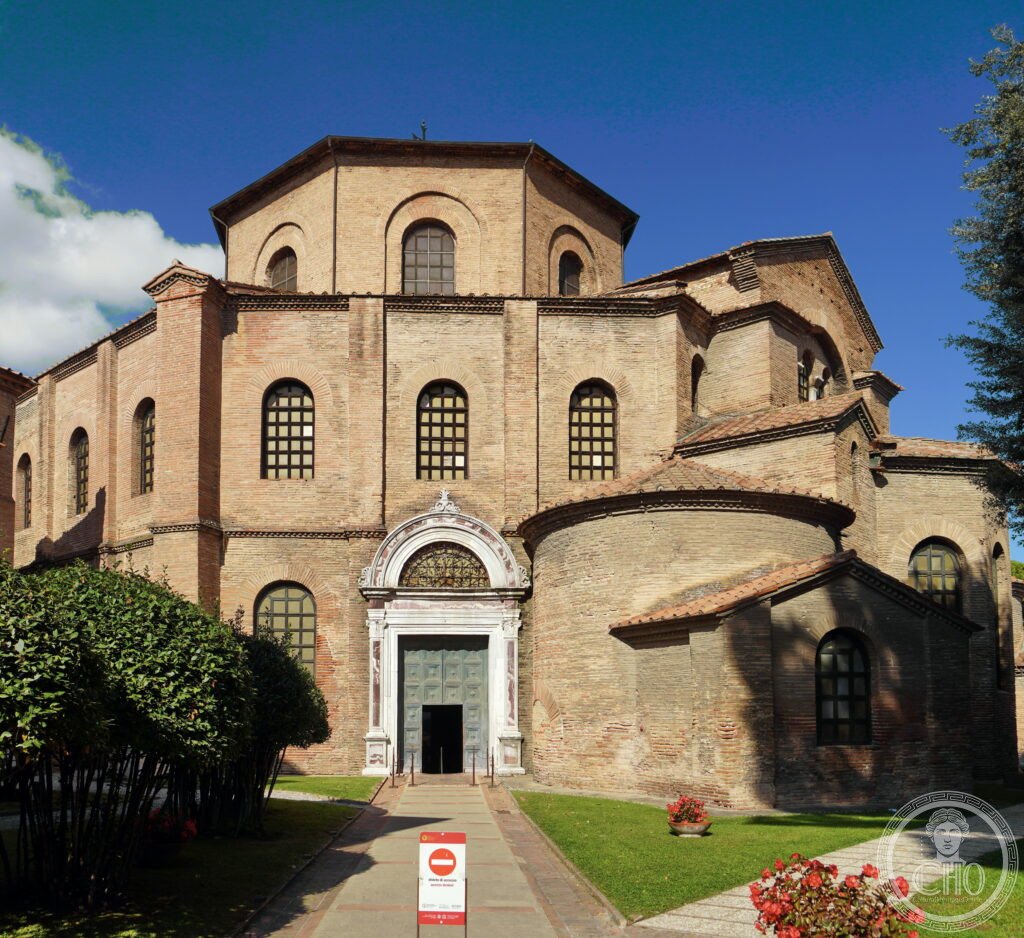
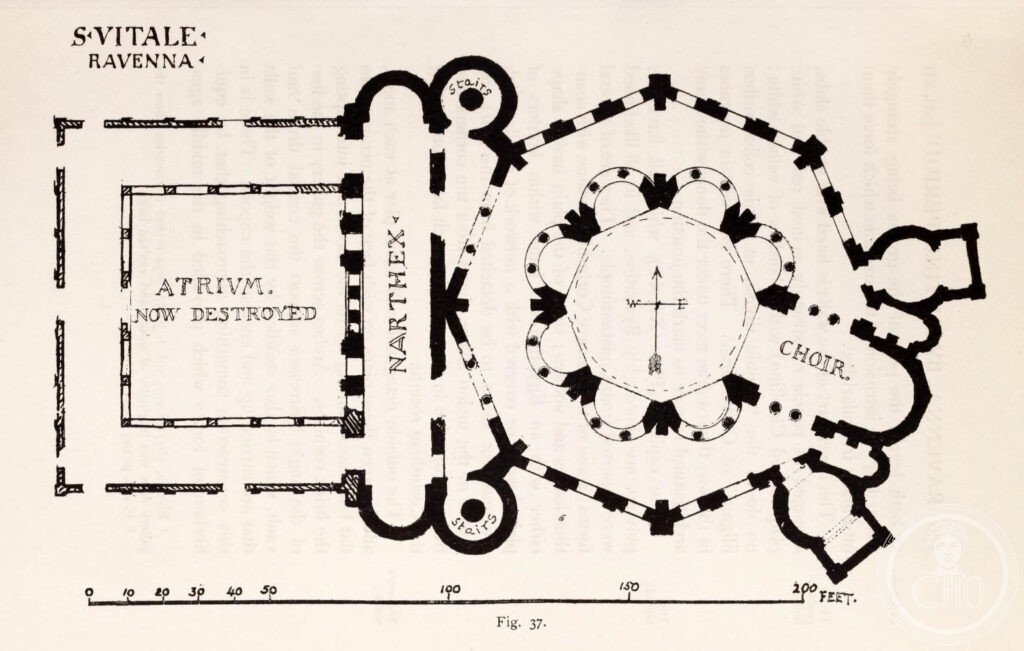
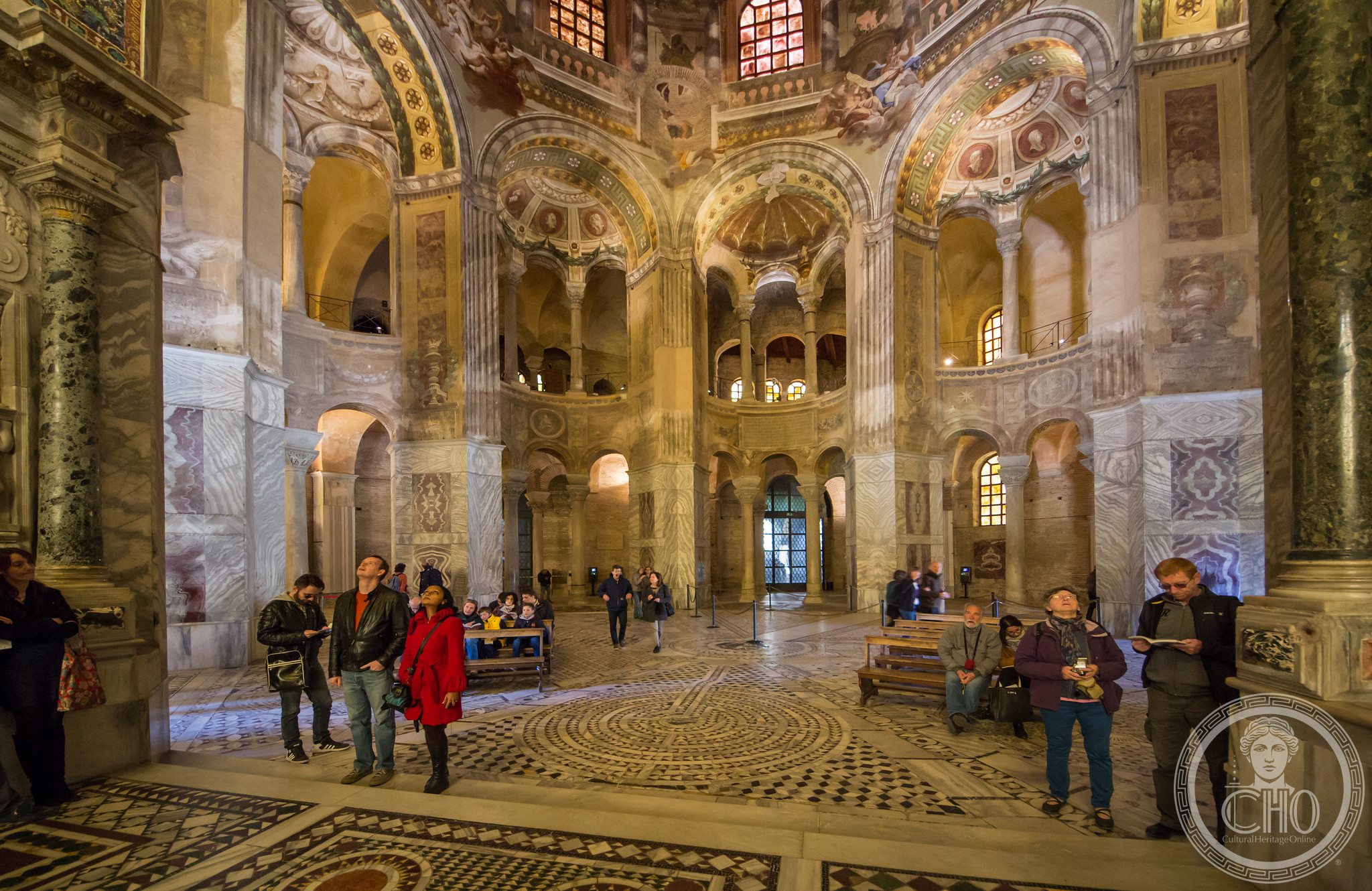
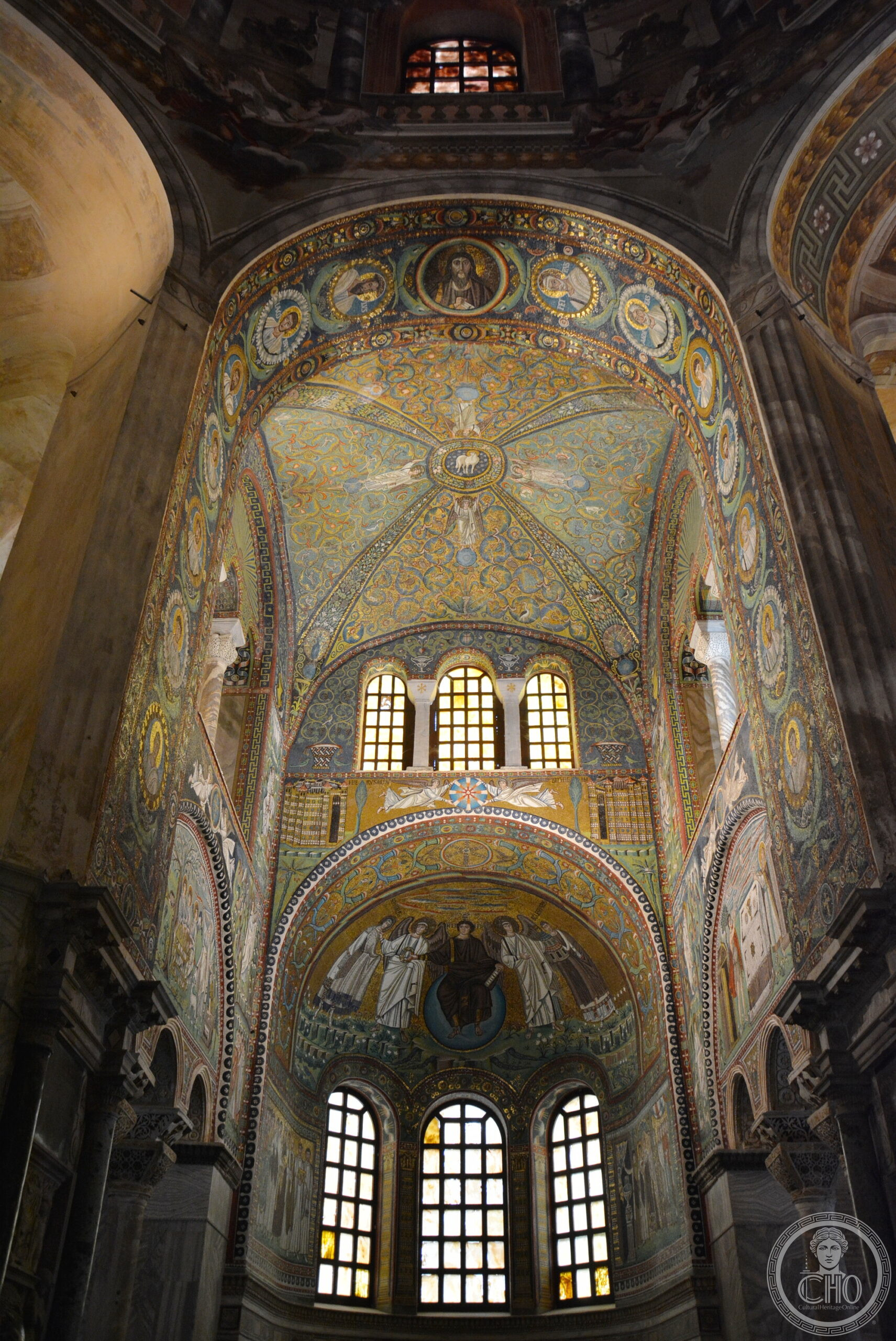
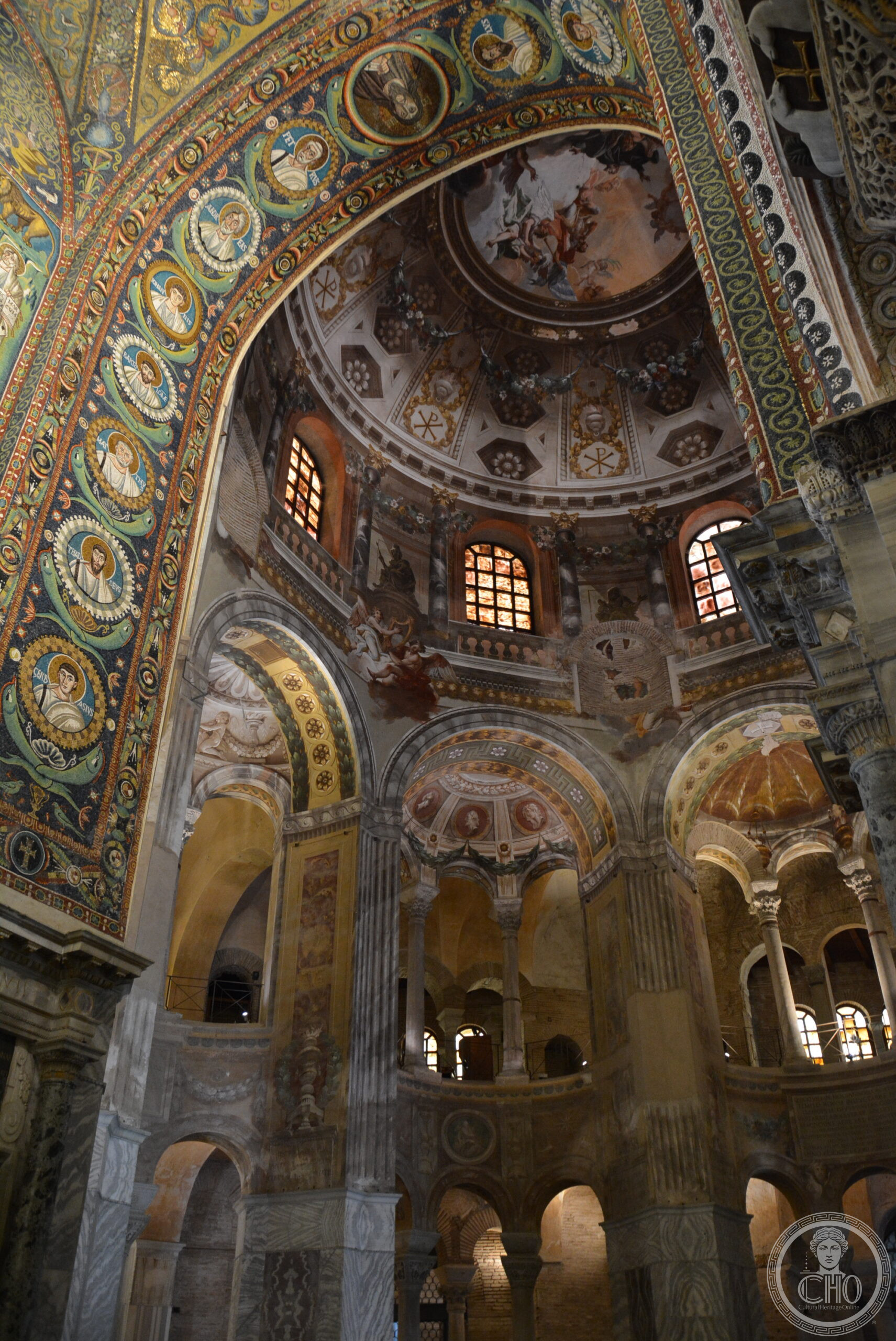
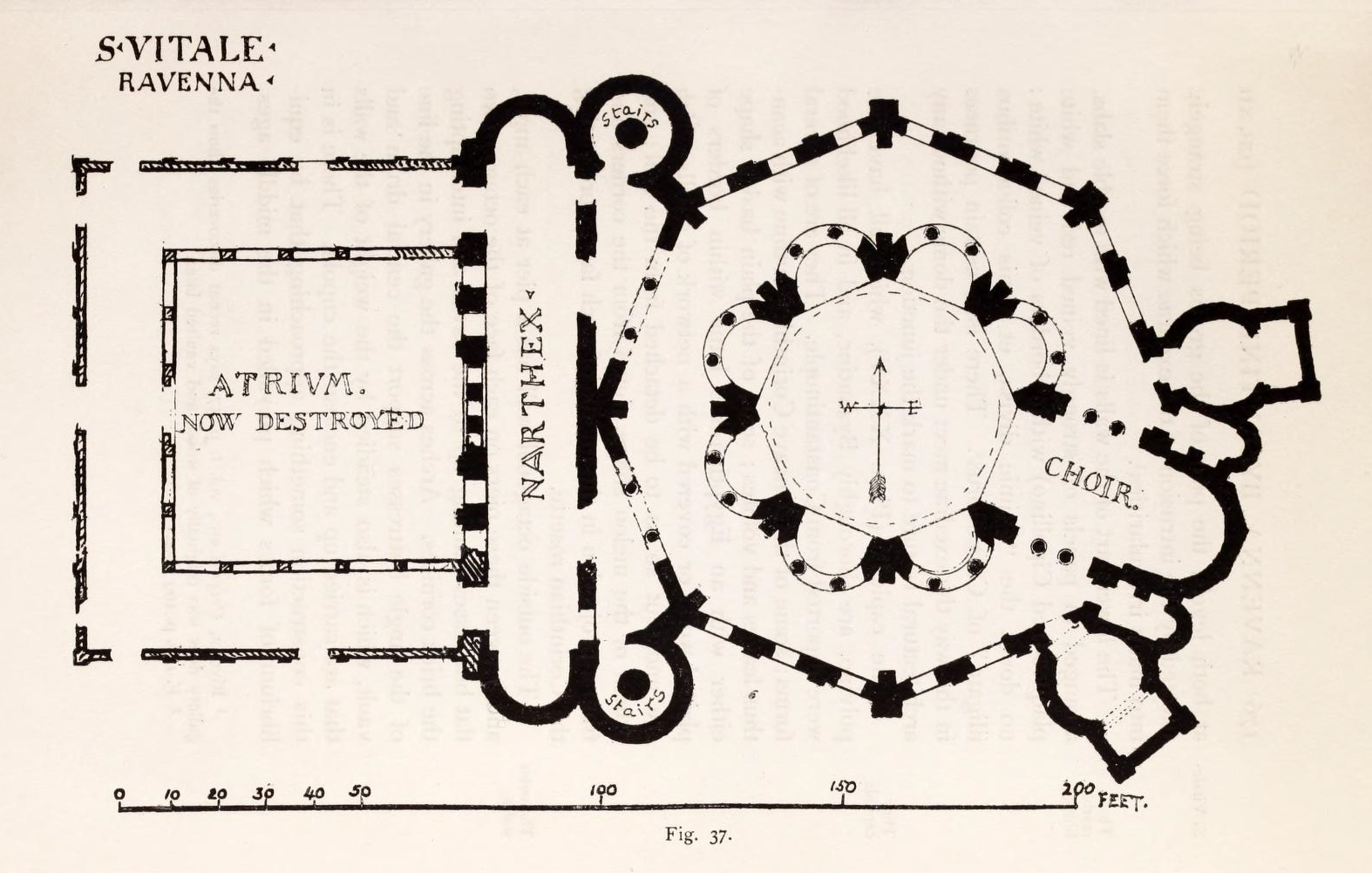
- Basilica di San Vitale: 526–548 CE (Byzantine); octagonal; Justinian and Theodora court panels in apse
- Basilica di Sant’Apollinare in Classe: 532–549 CE; nave with 22 columns; apse mosaic of Sant’Apollinare in Paradise
- UNESCO inscription: 1996, ref. 788 — “Early Christian Monuments of Ravenna”
- GPS (San Vitale): 44.4184, 12.1965 — Google Maps
History
Ravenna’s moment in world history was an accident of military geography: in 402 CE, the Emperor Honorius moved the capital of the Western Roman Empire from Milan to Ravenna, because the city was surrounded by marshes and lagoons and therefore easy to defend. From that date until 751 CE — when the Lombards captured the city — Ravenna was the seat of whoever held power in Italy, and the construction of monumental church buildings expressed that power in the most durable medium available: mosaic on gold ground.
The earliest mosaics (the Mausoleum of Galla Placidia, c. 430 CE) are still in the tradition of the late antique symbolic art of Rome and Milan — abstract, hieratic, with a strong emphasis on the symbolic rather than the narrative. The mosaics of the Ostrogothic period (Sant’Apollinare Nuovo, c. 504 CE) show the emergence of a more elongated, stylized figure type. The Byzantine mosaics of San Vitale (526–548 CE) represent the mature Byzantine idiom: frontal, gold-ground, with a formal rigidity that conveys divine remoteness rather than human approachability. The Justinian and Theodora panels in the apse of San Vitale — the Emperor and Empress shown in ceremonial procession with their courts — are the most famous secular mosaic portraits of the ancient world and the model for all subsequent representations of royal ceremony in Byzantine art.
The Exarchate of Ravenna remained part of the Byzantine world for 200 years after the Western Roman Empire fell, giving the city a character quite unlike any other in northern Italy: Byzantine art, architecture, and culture survived here while the rest of northern Italy was going through the disruptions of the Lombard and Frankish periods.
What you see
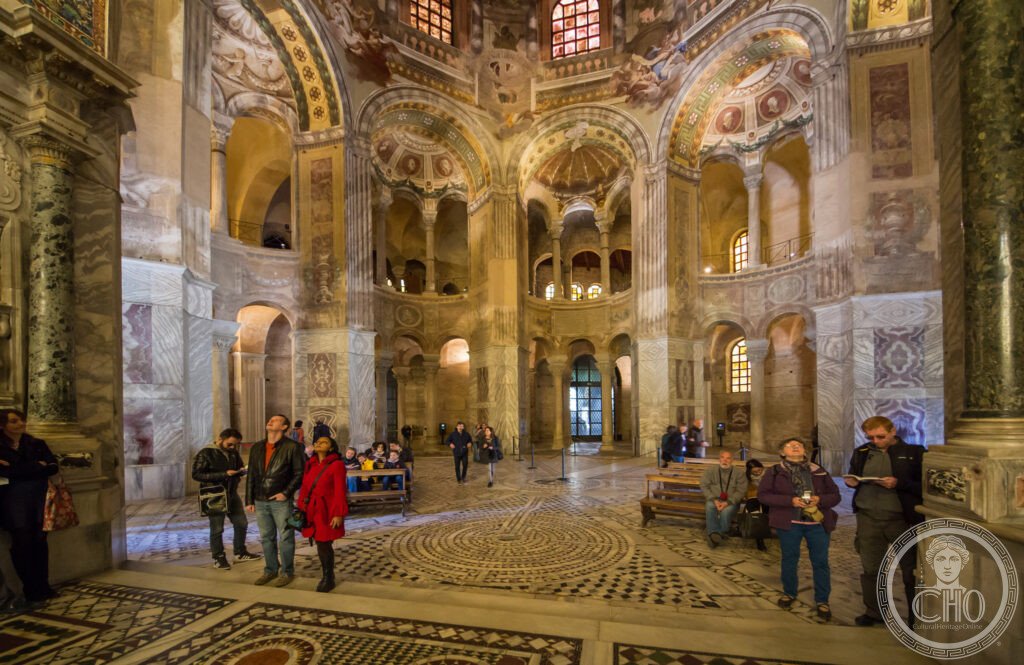
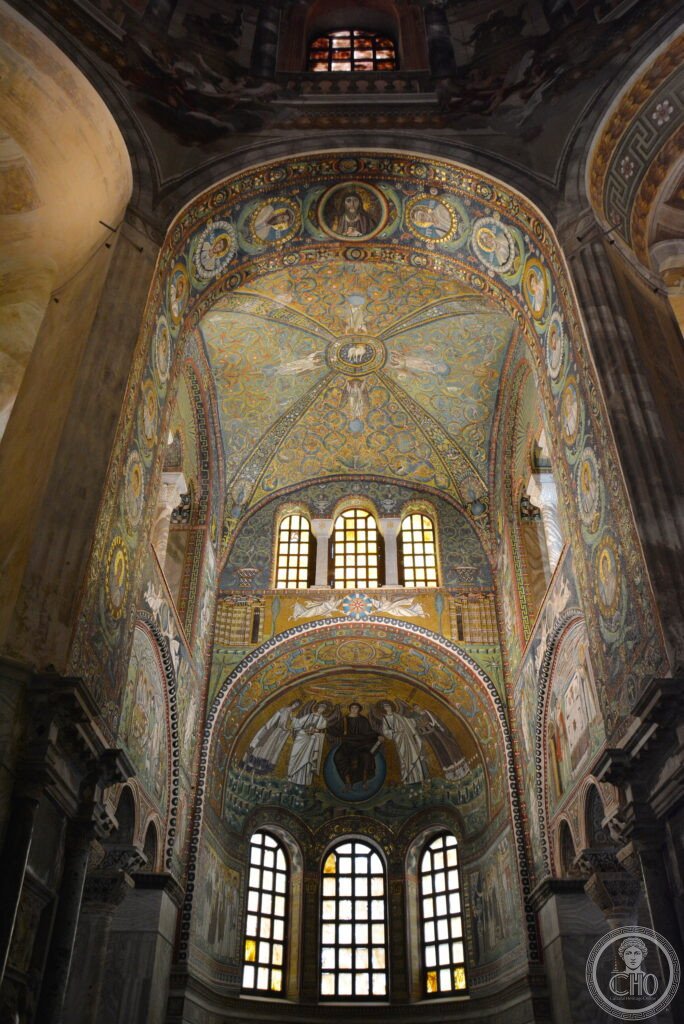
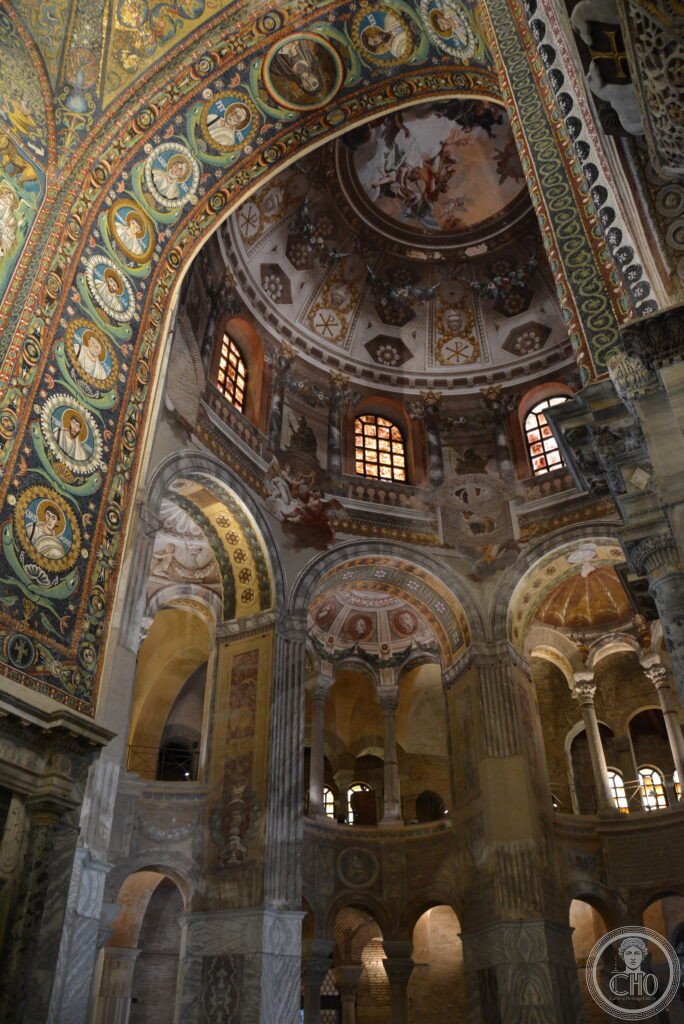
San Vitale (the most important building in the group): the octagonal exterior prepares you for nothing that happens inside. The interior is a spatial and chromatic experience unlike any other building in the West: eight piers support the central dome, between which the mosaics begin at a height of about 8 metres and run continuously across the vault surfaces of the apse, the lunettes, and the sanctuary. The Justinian and Theodora panels (the Emperor with his court officials and Bishop Maximian on the left; the Empress with her ladies-in-waiting on the right) are at eye level in the apse. The gold ground is not a background: it is a field of luminous, undifferentiated space in which the figures exist, dematerialised, in a divine realm beyond time.
Mausoleo di Galla Placidia (5 minutes from San Vitale): the smallest of the eight buildings and the most intimate. The exterior is a plain brick cruciform structure, windowless and unremarkable; the interior is entirely covered in mosaic from floor to lunette, including the night sky in the barrel vault of the central crossing — deep blue, scattered with gold stars — and the Good Shepherd with his flock in the lunette facing the entrance. In the right light (morning is best, using the small windows above the lunette level), the blue and gold of the interior glow with an intensity that is not replicated by any photograph.
Gallery
Practical information
- Combined ticket: A single ticket covers the 5 monuments managed by Opera di Religione (Mausoleo di Galla Placidia, Battistero Neoniano, Sant’Apollinare Nuovo, Battistero Ariano, Cappella Arcivescovile). ~€11.50. Book online at ravennamosaici.it to avoid queues at Galla Placidia in particular.
- San Vitale: Separate ticket (~€9.50); managed by the same Opera di Religione; combined ticket includes it.
- Sant’Apollinare in Classe: 5 km south of Ravenna by bus or bicycle; separate ticket ~€5.
- Mausoleo di Teodorico: Free (exterior); managed by MiC. The interior is sometimes closed.
- Time needed: Half a day for the 5 city-centre monuments; full day including Sant’Apollinare in Classe.
Getting there
Ravenna is 75 km south-east of Bologna and 90 km north of Rimini. By train: Bologna–Ravenna (~1h15) and Rimini–Ravenna (~1h) are frequent services; the railway station is 15 minutes on foot from San Vitale. By car: A14 (Bologna–Rimini) + exit Castel San Pietro, then SS9/SS16 to Ravenna; or A14 Rimini Nord + SS16 north. Parking at Parcheggio Classense (near the centre) or Parcheggio Teodorico (Mausoleo di Teodorico). From Bologna: 75 km, 1h by car or train. By bicycle: Ravenna is flat and all 8 monuments are within 5 km of each other; the tourist office rents bicycles.
Nearby
- Basilica di Sant’Apollinare in Classe — 5 km south; the largest of the 8 inscribed buildings (532–549 CE), with one of the most complete and best-preserved early Byzantine apse mosaics in existence — Sant’Apollinare standing in a Paradise landscape
- Porta Aurea e Palazzo di Teodorico — centre of Ravenna; the grid of the Roman and Ostrogothic city, with fragments of the palace of Theodoric visible in the substructures of the Via d’Azeglio
- Museo Nazionale di Ravenna — in the former Benedictine convent next to San Vitale; early Christian sarcophagi, ivories, and the 6th-century cross of the Exarchs
Sources
- UNESCO: whc.unesco.org/en/list/788
- Wikipedia EN: Early Christian Monuments of Ravenna
- Deliyannis, Deborah: Ravenna in Late Antiquity, Cambridge UP, 2010
- Lazaridis, Fotis: The Mosaics of Ravenna, Lund Humphries, 2020
Gallery
Find it on the map
See this place and what’s around it →📷 Become a Cultural Heritage Online photographer
Share your photos of places: they stay published under your name as the author. The more they're seen, the more you get noticed — and soon a contest will reward the most appreciated photos.
Log in or sign up free to add a photo