
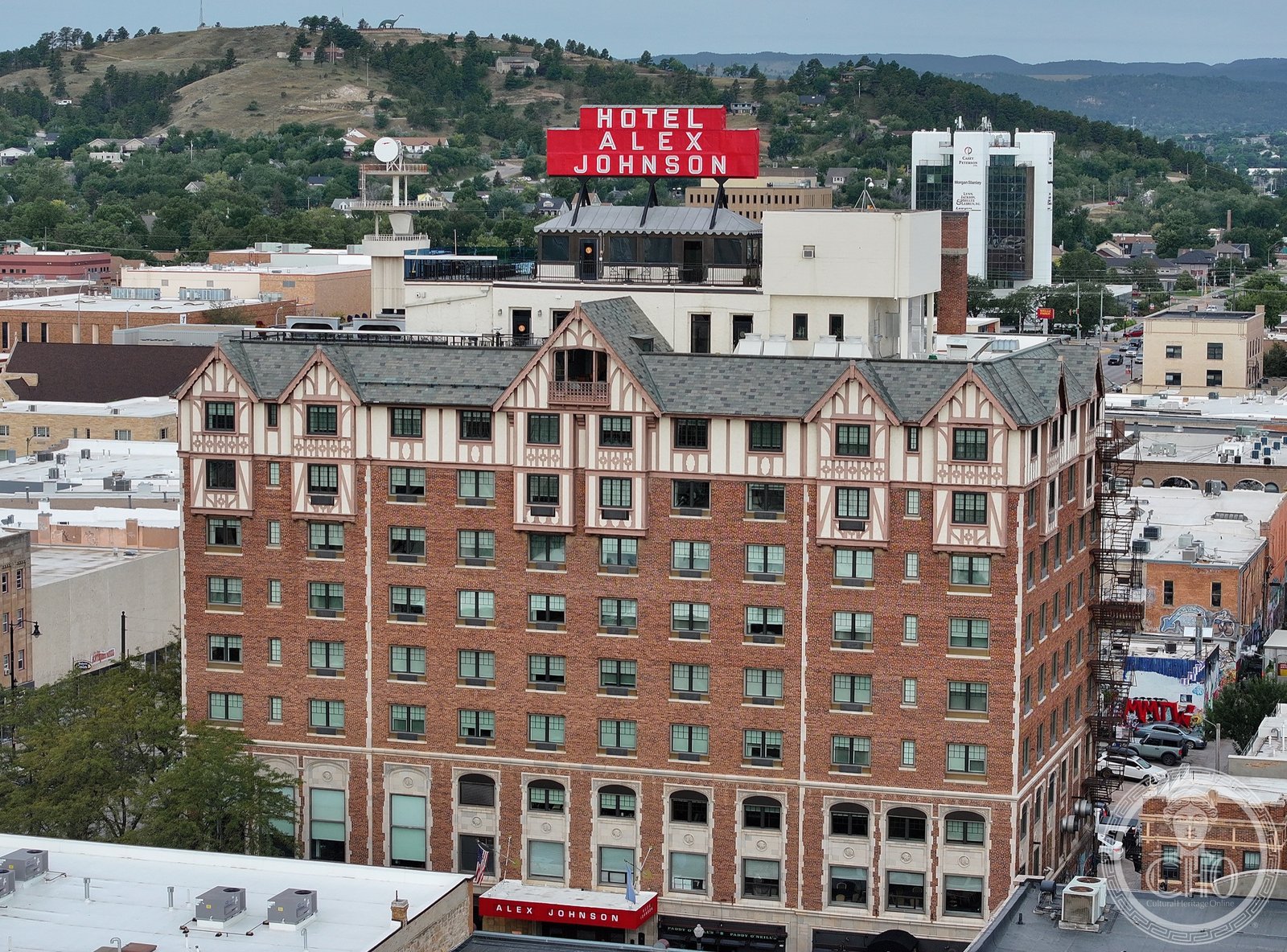
At the edge of the Black Hills, where the Great Plains meet one of America’s most dramatically carved landscapes, the Hotel Alex Johnson has stood since 1928 as Rapid City’s landmark of architectural ambition — its lobby woven with Sioux iconography, its silhouette a conversation between Art Deco and Tudor Gothic above the South Dakota plain.
At a glance
The Hotel Alex Johnson at 523 6th Street is the most architecturally distinctive building in Rapid City and one of the most evocative historic hotels in the American West. Opened in 1928 — the year after President Calvin Coolidge established his summer White House in the nearby Black Hills, drawing national attention to the region — the hotel was built to serve the growing tourist trade to the Black Hills and to announce that Rapid City was a city of permanent ambitions. Its exterior combines Art Deco detailing with Tudor Gothic elements, while its interior lobby features one of the most unusual decorative programs in American hotel design: a synthesis of Art Deco geometry and Sioux Lakota iconography, with geometric patterns derived from Native American visual traditions woven throughout the architectural ornament. The Alex Johnson remains an operating hotel — still the finest address in Rapid City after nearly a century.
Key facts
- Address: 523 6th Street, Rapid City, SD 57701
- Completed: 1928
- Named after: Alex C. Johnson, vice president of the Chicago and North Western Railway
- Style: Art Deco with Tudor Gothic elements; interior with Lakota Sioux iconographic program
- Current use: Active luxury hotel, part of the Curio Collection by Hilton
- Designation: National Register of Historic Places
History
The summer of 1927 changed Rapid City. President Calvin Coolidge declared the Black Hills his summer White House, moving the executive branch of the United States government to a camp on the Game Lodge Creek in Custer State Park. For the summer, Rapid City was the de facto national capital — journalists, diplomats, businessmen, and tourists flooded the region. The Chicago and North Western Railway, which connected Rapid City to the national rail network, saw an opportunity. Alex C. Johnson, the railway’s vice president and the region’s most ambitious booster, moved to capitalize on the moment by backing a hotel that would give Rapid City a permanent landmark worthy of the attention it had received.
The hotel opened in 1928, designed with a deliberate visual ambition that set it apart from the functional storefronts of South Dakota’s frontier towns. The exterior combined the period’s fashionable Art Deco vocabulary with Tudor Gothic elements, producing a silhouette recognizable from a distance across the flat blocks of the downtown grid. But the most distinctive element was the lobby’s decorative program: a synthesis of the Art Deco geometric ornament then dominating American commercial interiors with Lakota Sioux iconography — patterns derived from Native American beadwork, quillwork, and ledger art integrated into the architectural detailing. The effect was singular: a building that proclaimed modernity while acknowledging the specific cultural landscape in which it stood.
The Alex Johnson hosted every American president who visited the Black Hills through the twentieth century and became the essential social center of Rapid City for decades. Restored and operating as part of the Curio Collection by Hilton, it retains the essential character of its 1928 construction while meeting contemporary expectations for a luxury hotel.
What you see
The exterior facade on 6th Street presents a layered composition: the lower floors carry the clean geometric vocabulary of Art Deco in the window surrounds, entrance canopy, and decorative panels, while the upper floors introduce the half-timbered elements and pointed Gothic detailing of the Tudor Revival tradition. The combination is unusual but resolved — the two registers coexist as a single composition rather than competing. The building’s vertical emphasis and relative height define the downtown skyline.
The lobby is the building’s most remarkable interior: geometric Art Deco detailing in the woodwork, plasterwork, and hardware runs continuously throughout, but the pattern vocabulary is drawn from Lakota Sioux traditional art rather than the European-derived motifs typical of the period. The integration is thorough — not superficial decoration but a reconsideration of what ornament in a building at the edge of the Black Hills should look like. The result is a lobby unlike any other in American hotel design.
Practical information
- Hotel: The Alex Johnson operates as an active hotel; rooms and suites are available for booking through the Curio Collection by Hilton or directly through the hotel
- Non-guests: The lobby is accessible to visitors during daytime hours; the bar and restaurant are open to the public
- Best time to visit: Summer (June–August) for Black Hills access; the hotel books up during peak season — reserve well in advance
- Lobby self-guided: The Sioux iconographic program throughout the lobby is the primary architectural experience; allow time to observe the pattern integration in detail
Getting there
Rapid City Regional Airport (RAP) serves the city with connections to Denver, Chicago, Dallas, and Minneapolis. The hotel is seven miles from the airport, ten minutes by car. From Denver, the drive north on Interstate 25 and then west on Interstate 90 takes approximately seven hours. The hotel sits in the center of downtown Rapid City, walking distance from restaurants, shops, and the Presidents Park sculptures on the downtown sidewalks.
Nearby
- Mount Rushmore National Memorial — 25 miles southwest; the four presidential faces carved by Gutzon Borglum between 1927 and 1941 are the defining landmark of the Black Hills; the nearby Crazy Horse Memorial continues carving the largest mountain sculpture in the world
- Badlands National Park — 50 miles east via Interstate 90; eroded buttes and spires of the White River Badlands, with one of the world’s richest fossil beds and a substantial bison herd
- Custer State Park — 30 miles south; 71,000 acres of Black Hills landscape with free-roaming bison herds, the scenic Needles Highway, and the Game Lodge where Coolidge spent his 1927 summer
- Crazy Horse Memorial — 17 miles southwest; the ongoing mountain carving of Lakota leader Crazy Horse, begun in 1948 by Korczak Zołkowski and still in progress, rises above the Black Hills granite
Sources
- National Register of Historic Places, Hotel Alex Johnson nomination
- South Dakota State Historical Society records
- Curio Collection by Hilton, Hotel Alex Johnson property history
- Rapid City Journal historical archives
- Smithsonian Institution, American Indian design in commercial architecture
Find it on the map
See this place and what’s around it →Record researched and written by Luigi De Marchi for Cultural Heritage Online, 2026.
📷 Become a Cultural Heritage Online photographer
Share your photos of places: they stay published under your name as the author. The more they're seen, the more you get noticed — and soon a contest will reward the most appreciated photos.
Log in or sign up free to add a photoIs this page about you?
This page is read by travellers and heritage enthusiasts who find it on Google. Tell us how you are connected to this place and we will take it from there.