
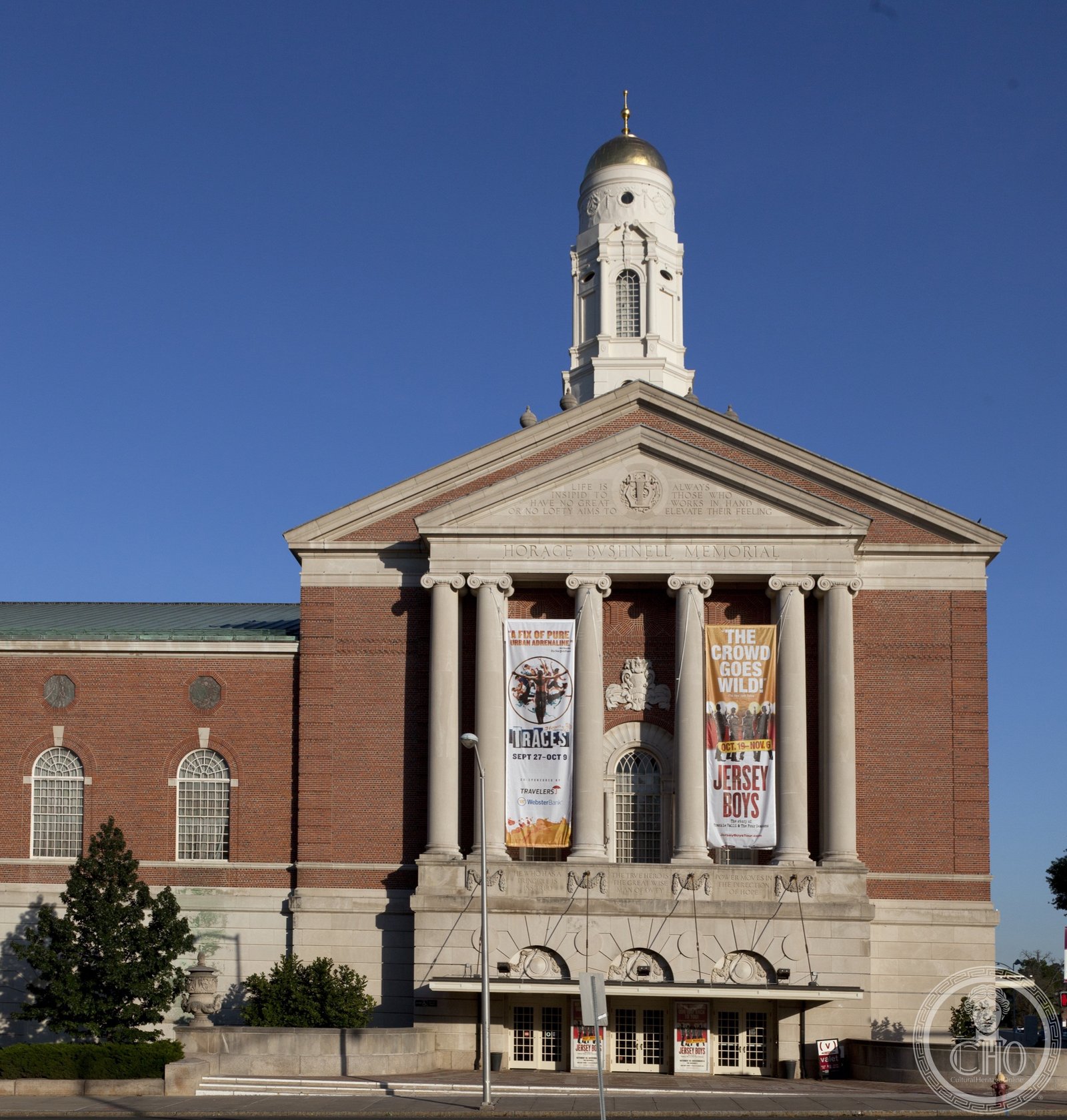
On Capitol Avenue across from the Connecticut State Capitol, the Bushnell Center has been Hartford’s primary cultural institution since 1930 — a gift to the city that brought Art Deco architecture and serious performing arts to a New England city long proud of its literary and intellectual heritage.
At a glance
The Bushnell Center for the Performing Arts at 166 Capitol Avenue is the premier performing arts venue in Connecticut and one of the finest Art Deco concert halls in New England. Opened in 1930 as the Horace Bushnell Memorial Hall — named in honor of Hartford’s most influential nineteenth-century minister and theologian — it was conceived as a gift to the city of Hartford, a gesture of civic culture by the donors who felt that Hartford’s long tradition of intellectual life deserved a building equal to it. Its Art Deco exterior and richly detailed auditorium have housed the Hartford Symphony Orchestra, Broadway touring productions, and the full range of performing arts programming for nearly a century. The building stands as one of the defining architectural statements of Hartford’s civic center district.
Key facts
- Address: 166 Capitol Avenue, Hartford, CT 06106
- Completed: 1930
- Original name: Horace Bushnell Memorial Hall
- Named for: Horace Bushnell (1802–1876), Hartford theologian and minister
- Style: Art Deco
- Resident companies: Hartford Symphony Orchestra, Connecticut Opera
- Designation: National Register of Historic Places
History
Hartford in 1930 was a city with a cultural pedigree that far exceeded its size. Mark Twain had lived and written here; Harriet Beecher Stowe had too. The Hartford Courant, the oldest continuously published newspaper in the United States, dated its history to 1764. The city’s insurance industry had generated one of the highest per-capita incomes in the nation. And Horace Bushnell, the nineteenth-century Congregationalist minister whose theological writings had shaped American Protestant thought for generations, had made Hartford one of the intellectual centers of New England.
The Bushnell Memorial Hall was built as a testament to that heritage. A group of Hartford citizens, led by wealthy industrialists and community leaders, organized the project to create a venue worthy of the city’s ambitions — one that could host major orchestral concerts, theatrical productions, and civic gatherings in an architectural setting appropriate to the occasion. The building they funded, completed in 1930, brought the refined ornamental language of Art Deco to Hartford’s civic center, complementing the domed Connecticut State Capitol that faces it across Capitol Avenue.
The hall has served as the home of the Hartford Symphony Orchestra since its founding and has hosted virtually every major performing arts organization that has toured New England in the past century. It was renamed the Bushnell Center for the Performing Arts in recent decades to reflect its expanded programming, though the building’s essential character as Hartford’s primary cultural institution has never changed.
What you see
The Capitol Avenue facade presents the Bushnell’s architectural ambitions clearly: a symmetrical composition in limestone with Art Deco ornamental panels, a central entrance portico, and vertical detailing that gives the building a dignified presence appropriate to its civic-center setting. The composition reads in dialogue with the State Capitol across the street — formal, serious, and scaled to the street without overwhelming it.
The main auditorium interior is the building’s primary architectural experience: ornate plasterwork in the Art Deco idiom covers the walls and ceiling; the proscenium arch frames the stage with carefully designed proportions for both acoustic performance and visual spectacle; and the multi-tiered balconies bring audiences close to the action across the house. The acoustic design reflects the knowledge and ambitions of 1930, with subsequent refinements that preserve the character of the original while improving the listening experience.
Practical information
- Events: Check thebushnell.org for the Hartford Symphony schedule, Broadway touring season, and special events
- Location context: The Bushnell is in Hartford’s civic center district, directly across from the Connecticut State Capitol and its Bushnell Park; the park is a pleasant walk before or after a performance
- Parking: Garage parking is available adjacent to the building; the Capitol district is easily walkable from downtown hotels
Getting there
Hartford is the capital of Connecticut, midway between New York (115 miles) and Boston (100 miles). Bradley International Airport is 13 miles north; Peter Pan and Greyhound buses serve the city from New York and Boston. The Bushnell is on Capitol Avenue in the civic center district, a ten-minute walk from the Amtrak station on Union Place. Connecticut Transit city buses run frequently along the corridor.
Nearby
- Connecticut State Capitol (1879) — the gold-domed Gothic Revival state capitol building across Capitol Avenue; the Bushnell Park at its base is a Victorian public park with a historic carousel and the Soldiers and Sailors Memorial Arch
- Mark Twain House and Museum — Samuel Clemens’ flamboyant Victorian Gothic home in the Nook Farm neighborhood, where he wrote Adventures of Huckleberry Finn and The Adventures of Tom Sawyer; two miles west
- Harriet Beecher Stowe Center — the Victorian cottage next door to the Twain House where Stowe wrote Uncle Tom’s Cabin adaptations and spent her later years; open for tours
- Wadsworth Atheneum — the oldest continuously operating public art museum in the United States, founded 1842, with a collection spanning 5,000 years of art history; a ten-minute walk east of the Bushnell along Capitol Avenue
Sources
- National Register of Historic Places, Bushnell Memorial Hall nomination
- Bushnell Center for the Performing Arts, institutional history
- Connecticut Historical Society records
- Hartford Symphony Orchestra, institutional archives
- Connecticut State Library, Hartford architectural history
Find it on the map
See this place and what’s around it →Record researched and written by Luigi De Marchi for Cultural Heritage Online, 2026.
📷 Become a Cultural Heritage Online photographer
Share your photos of places: they stay published under your name as the author. The more they're seen, the more you get noticed — and soon a contest will reward the most appreciated photos.
Log in or sign up free to add a photoIs this page about you?
This page is read by travellers and heritage enthusiasts who find it on Google. Tell us how you are connected to this place and we will take it from there.