
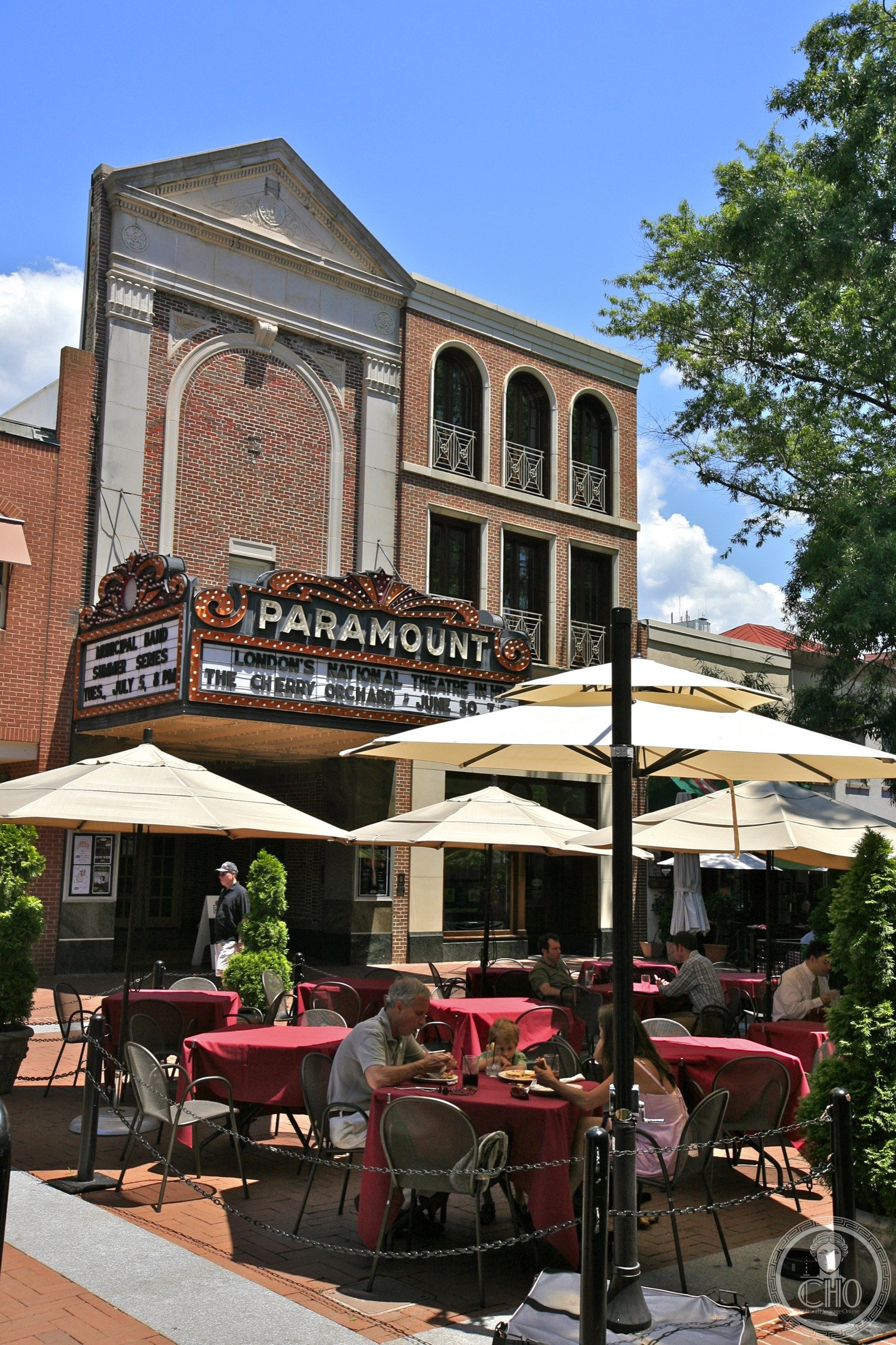
On the Downtown Mall that Thomas Jefferson could not have imagined, the Paramount Theatre has stood since 1931 as Charlottesville’s gathering place for film and live performance — an Art Deco facade and a restored auditorium that bring twentieth-century spectacle to a city defined by an eighteenth-century mind.
At a glance
The Paramount Theatre on East Main Street is Charlottesville’s finest surviving Art Deco building and one of Virginia’s best-preserved early sound-era movie palaces. Opened in 1931, it served the city and the University of Virginia community for four decades before declining and eventually closing as multiplex cinemas drew audiences away from the downtown core. A sustained community preservation effort led to a comprehensive restoration, completed in the early 2000s, that returned the theater to active use as a live performance venue. The Paramount now anchors the cultural life of Charlottesville’s pedestrian Downtown Mall, presenting music, theater, film, and community events in an auditorium that reads much as it did when it opened.
Key facts
- Address: 215 East Main Street, Charlottesville, VA 22902
- Completed: 1931
- Style: Art Deco
- Current use: Active performing arts venue; concerts, theater, film
- Restoration: Completed early 2000s
- Designation: National Register of Historic Places; contributing structure, Charlottesville Downtown Historic District
History
Charlottesville in 1931 was a small but intellectually lively city shaped by its relationship with the University of Virginia, founded by Thomas Jefferson in 1825 and operating under Jefferson’s original Academical Village — a UNESCO World Heritage Site. The city’s cultural life revolved around the university, but the Paramount offered something the campus did not: affordable, democratic entertainment available to everyone. The theater opened as part of the national Paramount Pictures exhibition network, bringing first-run sound films to Charlottesville audiences.
The theater operated through the classic studio system era, presenting Paramount films and occasional live stage shows to audiences from the city and surrounding Albemarle County. Like many neighborhood theaters, it struggled through the 1960s and 1970s as suburban development and the multiplex era changed American cinema-going habits. The Paramount eventually closed, standing vacant until preservation advocates in Charlottesville organized a campaign to restore it.
The restoration, funded through a combination of public support, private philanthropy, and historic tax credits, reopened the theater in the early 2000s. The Paramount Theatre Foundation took over operation, programming the venue as a presenting organization for national touring acts, local performing arts groups, and community events. The theater now operates as one of Charlottesville’s principal cultural venues and a defining element of the Downtown Mall’s identity.
What you see
The Paramount’s facade on East Main Street presents the compact but emphatic composition of a small-city Art Deco movie palace: a vertical marquee and sign tower rising above a broad entrance canopy, framed by geometric ornament in the Deco vocabulary. The scale is appropriate to a pedestrian downtown — not the overwhelming presence of a major metropolitan theater, but clearly more significant than an ordinary commercial storefront. The facade announces the theater’s function and era without reticence.
Inside, the restored auditorium preserves the period atmosphere of the original 1931 construction: plasterwork ornamentation, a clearly defined proscenium arch, and a seating configuration that puts the audience in direct relationship with the stage. The restoration prioritized the decorative fabric over technical upgrading wherever possible, with modern sound and lighting systems integrated without obliterating the 1930s character. The effect is of a working theater that also functions as an artifact of its period.
Practical information
- Events: Check theparamount.net for the full programming calendar
- Seating: The restored auditorium holds approximately 1,000 seats; intimate enough for a clear view from any position
- Downtown Mall: The theater is in the middle of the Downtown Mall, a seven-block pedestrian zone lined with restaurants, independent shops, and other cultural venues; plan extra time to explore
- Parking: Municipal parking garages are accessible from Main Street; the Downtown Mall itself is pedestrian-only
Getting there
Charlottesville is in central Virginia, about 120 miles southwest of Washington, DC and 70 miles west of Richmond. Amtrak’s Cardinal and Crescent services stop at Charlottesville’s station, a half-mile walk from the Downtown Mall. From DC, the drive on Interstate 66 and then Route 29 takes about two hours. Charlottesville Albemarle Airport provides regional connections. The university, Monticello, and Montpelier are all within 15 miles of the theater.
Nearby
- University of Virginia Academical Village — Thomas Jefferson’s original campus (1825), a UNESCO World Heritage Site: the Rotunda, the Lawn, and the colonnaded pavilions constitute one of the finest examples of neoclassical architecture in the United States; one mile west
- Monticello — Jefferson’s private home and plantation, a UNESCO World Heritage Site, with exhibitions on Jefferson’s life, the architectural evolution of the house, and the enslaved people who built and maintained it; three miles southeast
- Virginia Discovery Museum — interactive science and history museum for children, on the east end of the Downtown Mall
- Shenandoah National Park — the Blue Ridge Mountains and Skyline Drive begin roughly 25 miles west; the park’s Skyline Drive runs 105 miles along the crest of the mountains
Sources
- National Register of Historic Places, Charlottesville Downtown Historic District
- Paramount Theatre Foundation, institutional history
- Virginia Department of Historic Resources, architectural survey records
- Charlottesville Historic Resources Committee documentation
- University of Virginia, Library Special Collections — Charlottesville history
Find it on the map
See this place and what’s around it →Record researched and written by Luigi De Marchi for Cultural Heritage Online, 2026.
📷 Become a Cultural Heritage Online photographer
Share your photos of places: they stay published under your name as the author. The more they're seen, the more you get noticed — and soon a contest will reward the most appreciated photos.
Log in or sign up free to add a photoIs this page about you?
This page is read by travellers and heritage enthusiasts who find it on Google. Tell us how you are connected to this place and we will take it from there.