
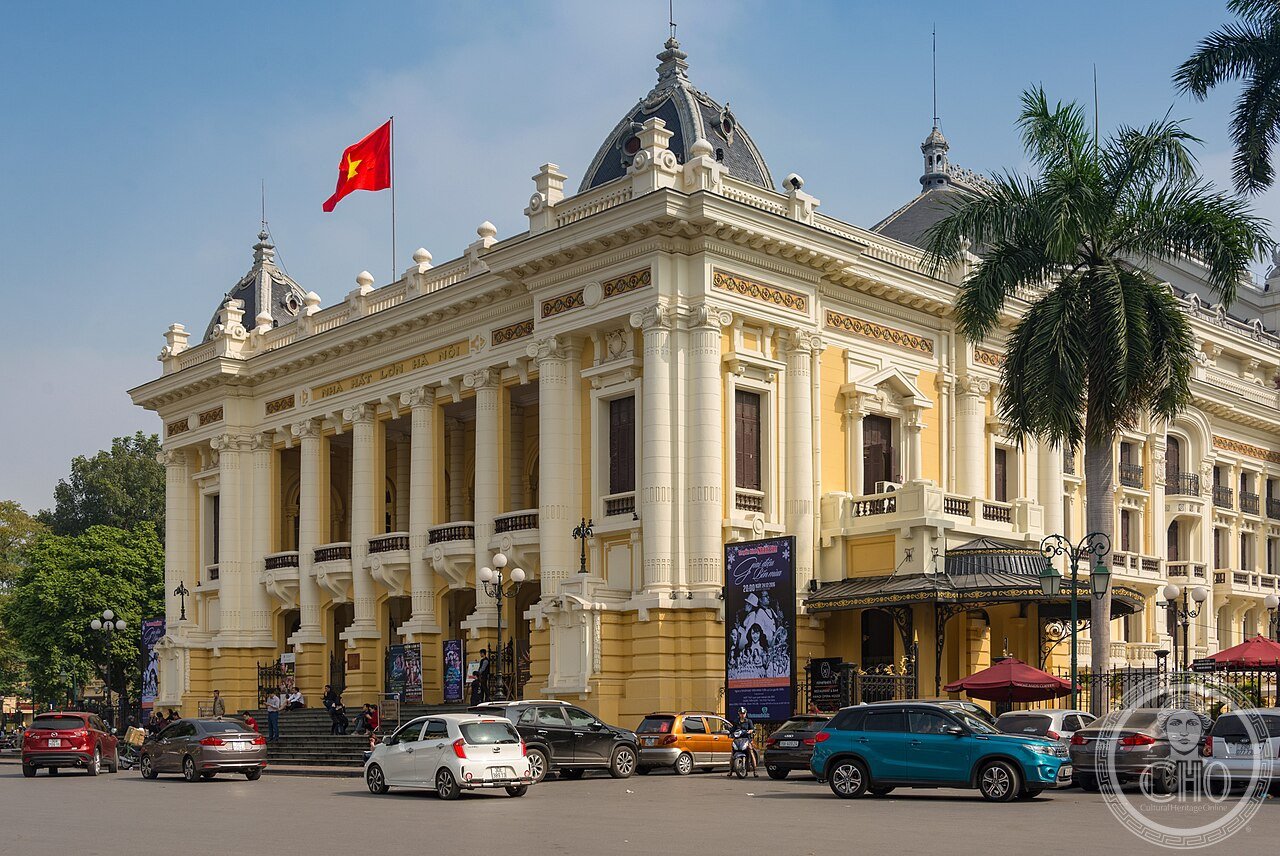
Rising above the tree-lined boulevards of central Hanoi, the Hanoi Opera House is the most ambitious monument of French colonial architecture in Indochina. Modelled directly on the Palais Garnier in Paris — though scaled to suit a tropical city — it was a decade in construction and opened on 9 December 1911. Its neoclassical facade of cream stucco and iron-wrought balconies, its tiled roof and colonnaded entrance, brought the grand European opera tradition to the heart of Southeast Asia. But the building did not remain a purely colonial symbol: in August 1945, as the Japanese surrender triggered a nationalist uprising, the Viet Minh called citizens to revolution from its balcony — a moment that sent political shockwaves across the country. Today the Opera House is a living cultural venue, hosting Vietnamese national opera, ballet and orchestral performances in a city that has made it the centrepiece of its modern identity.
At a glance
- Type
- Opera house / performing arts centre
- Period
- 1901–1911
- Style
- French Beaux-Arts / Neoclassical
- Location
- 1 Trang Tien Street, Hoan Kiem District, Hanoi, Vietnam
- Coordinates
- 21.0242° N, 105.8578° E
- Architect(s)
- Broyer, V. Harley, François Lagisquet
Overview
The Hanoi Opera House occupies a commanding position at the eastern end of Trang Tien Street, its neoclassical volume anchoring the French Quarter grid laid out in the late nineteenth century. Construction began on 7 June 1901 and the building opened ten years later with a seating capacity of 598. At 87 metres long, 30 metres wide and 34 metres tall, it remains a small theatre by European standards, yet its proportions feel generous within Hanoi’s low-rise streetscape. The three French architects drew their brief directly from the Palais Garnier but adapted materials to local availability, using Vietnamese laterite and tile alongside French ironwork. The result is a building at once familiar to colonial administrators and unmistakably rooted in its place.
History
Commissioned by the French colonial administration of Indochina as a prestige cultural project, the Opera House was intended to transplant Parisian bourgeois culture to the tropics. It hosted French opera companies, visiting orchestras and colonial social events throughout the first half of the twentieth century. Its political turning point came in August 1945: when news broke of Japan’s surrender, the Viet Minh organised a mass rally in front of the building, and a revolutionary flag was raised from the balcony — one of the founding gestures of Vietnamese independence. During the American War the building intermittently served non-performance functions. After 1975 it was gradually restored to its original purpose, and a major renovation in 1997 returned the interior to something close to its colonial-era state, retaining plasterwork, gilded mouldings and the original stage machinery.
Architecture & Design
The exterior is organised on a tripartite Beaux-Arts scheme: a rusticated base, a piano nobile of arched windows with wrought-iron balconies, and an attic storey crowned by a low-pitched tiled roof. The central portico carries six Corinthian columns supporting a sculptural pediment, while the corner pavilions add vertical emphasis. Locally fired terracotta tiles replaced the slate that would have been used in France, giving the roof a warmer ochre tone. Inside, the horseshoe-shaped auditorium follows Garnier’s plan, with three tiers of stalls and boxes, red-velvet seating and painted ceiling medallions. The renovation of the 1990s restored the ornamental plasterwork and reinstated period light fittings while updating the stage technology to contemporary standards.
Cultural significance
The Hanoi Opera House occupies a dual position in Vietnamese cultural memory: symbol of colonial power and site of anti-colonial resistance. The August 1945 balcony rally is taught in Vietnamese schools as a founding moment of the Democratic Republic. In the post-reform era (Doi Moi, from 1986), the building became a showcase for Vietnam’s opening to the world — a place where traditional chèo and cải lương theatre share a stage with Verdi and Tchaikovsky. It appears on postcards and tourist literature as the defining image of Hanoi’s French Quarter, and its illuminated facade is a nightly landmark for the millions of visitors who walk Hoan Kiem District.
Visiting today
The Opera House is an active performance venue; tickets for concerts, opera and ballet can be purchased at the box office or online at hanoioperahouse.org.vn. The building exterior is freely visible from the street at all hours. Guided tours of the interior are occasionally available on non-performance days. The adjacent August Revolution Square and the Sofitel Metropole hotel are a short walk away. Smart casual dress is expected for evening performances.
Getting there
The Opera House sits at the intersection of Trang Tien Street and Ngo Quyen Street in Hoan Kiem District. The most practical options are taxi (Grab app recommended) or cyclo from the Old Quarter, roughly 1–2 km away. Metered taxis from Noi Bai International Airport take approximately 30–40 minutes by road.
Sources & resources
Find it on the map
See this place and what’s around it →Record researched and written by Luigi De Marchi for Cultural Heritage Online, 2026.
📷 Become a Cultural Heritage Online photographer
Share your photos of places: they stay published under your name as the author. The more they're seen, the more you get noticed — and soon a contest will reward the most appreciated photos.
Log in or sign up free to add a photoIs this page about you?
This page is read by travellers and heritage enthusiasts who find it on Google. Tell us how you are connected to this place and we will take it from there.