

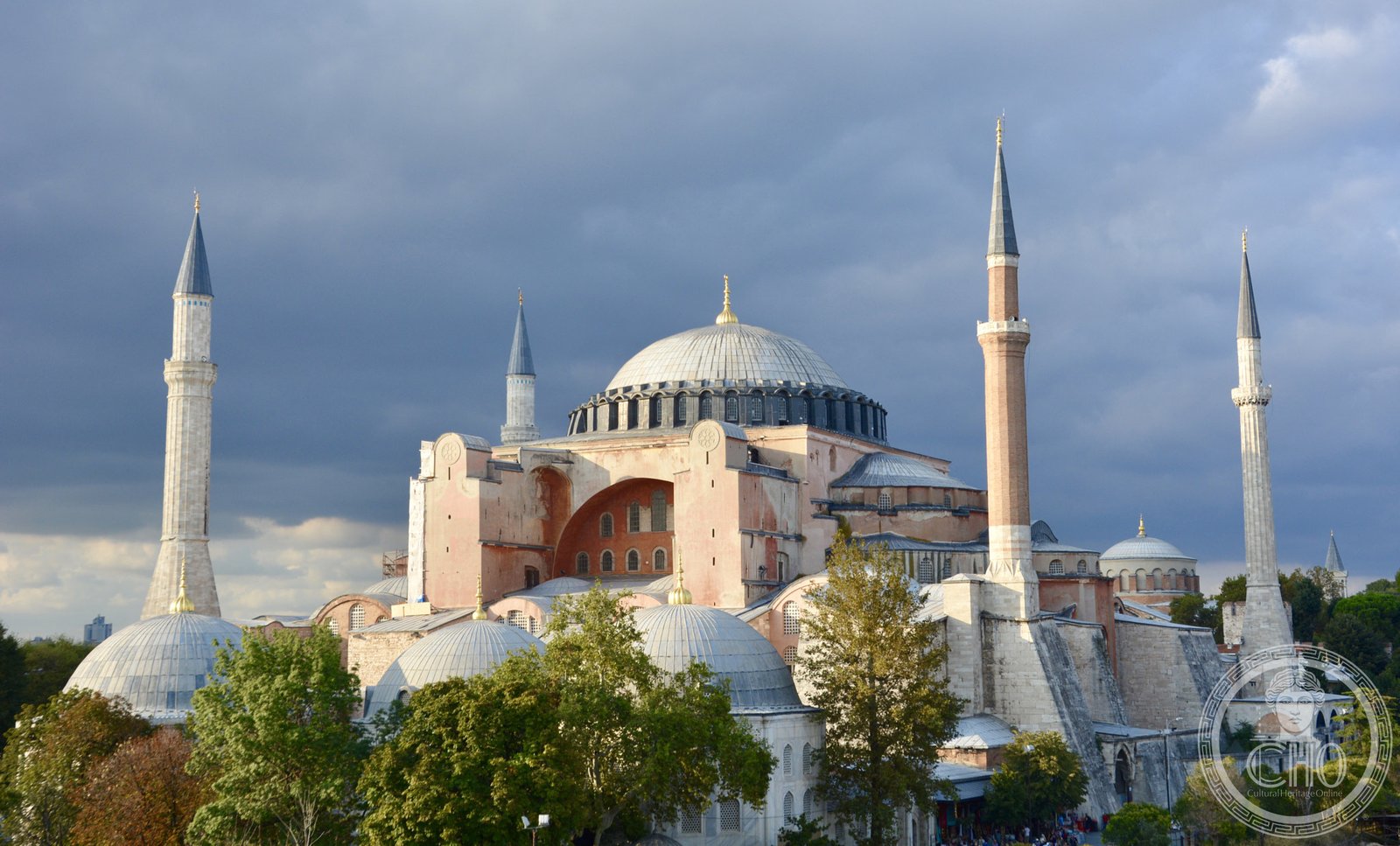
A masterpiece of Byzantine engineering completed in 537, Hagia Sophia stands as one of history’s most influential buildings. Its revolutionary pendentive dome created the world’s largest interior space and redefined sacred architecture across continents and centuries.
At a glance
Hagia Sophia is a mosque and museum in Istanbul, originally built as a church by Byzantine Emperor Justinian I between 532–537. Designed by Greek geometers Isidore of Miletus and Anthemius of Tralles, it remained the world’s largest church for over 500 years. The building served as Constantinople’s cathedral, then as an Ottoman mosque, and finally as a museum before being reclassified as a mosque in 2020.
History
The third church building on this site, Hagia Sophia was completed in AD 537 after its predecessor was destroyed in the Nika riots. From 360 to 1453, it served as the cathedral of Constantinople and the spiritual heart of the Eastern Orthodox Church for nearly a millennium.
In 1054, the church witnessed the official delivery of the excommunication of Patriarch Michael Cerularius by Pope Leo IX’s envoy, marking the beginning of the East–West Schism. During the Fourth Crusade in 1204, Latin Crusaders converted it to a Catholic cathedral until the Byzantine Empire’s restoration in 1261.
Following Constantinople’s fall in 1453, Mehmed the Conqueror converted Hagia Sophia into a mosque with the addition of minarets. It remained the city’s principal mosque until 1616. The building became a museum in 1935 under Turkey’s secular government and was reclassified as a mosque in 2020—a decision that drew international controversy.
What you see
Hagia Sophia exemplifies Byzantine architecture through its unprecedented use of a fully pendentive dome, which allows the circular dome to rest on a square base. This engineering innovation created an unobstructed interior space of revolutionary scale, earning the structure recognition as having “changed the history of architecture.”
The building’s interior was originally a Christian basilica dedicated to Holy Wisdom (Greek: Naòs tês Hagías toû Theoû Sophías). Ottoman modifications, including the addition of minarets, Islamic calligraphy, and buttresses, adapted the structure for Muslim worship while preserving its essential architectural form.
Cultural significance
As the religious and spiritual centre of Eastern Orthodox Christianity for nearly 1,000 years, Hagia Sophia is described as “holding a unique position in the Christian world” and remains “an architectural and cultural icon of Byzantine and Eastern Orthodox civilization.”
The building became the quintessential model for Eastern Orthodox church architecture and its influence extended far beyond Constantinople. Ottoman architects drew inspiration from it a thousand years later; the Hagia Sophia in Thessaloniki, the Şehzade Mosque, the Süleymaniye Mosque, the Rüstem Pasha Mosque, and the Kılıç Ali Pasha Complex all reflect its architectural legacy.
Key facts
- Country: Turkey
- City: Istanbul
- Completed: AD 537
- Coordinates: 41.0083°N, 28.98°E
- Architects: Isidore of Miletus and Anthemius of Tralles
- Patron: Emperor Justinian I
- Former uses: Church (360–1453), Museum (1935–2020), Mosque (1453–1935, 2020–present)
Practical information & getting there
Hagia Sophia is located in Istanbul’s Sultanahmet district, within walking distance of other major monuments. As of 2019, it was Turkey’s most visited tourist attraction. Current opening hours and visiting conditions should be confirmed before your visit, as the building’s status has changed in recent years.
Sources & resources
Find it on the map
See this place and what’s around it →Events here — now on & upcoming
- Death of Constantine the Great (337) — Hagia Sophia22 May 2027See the event →
- Born 27/02/0272 — Constantine the Great (1754th anniversary)27 Feb 2027See the event →
- Death of Justinian I (565) — Hagia Sophia14 Nov 2026See the event →
- Born 11/05/0482 — Justinian I (1544th anniversary)11 May 2027See the event →
Historical events at this place (9)
- Isidore of Miletus — died c. 537, exact day unknown — Hagia Sophia
- Isidore of Miletus — born c. 442, exact day unknown
- Anthemius of Tralles — died c. 534, exact day unknown — Hagia Sophia
- Anthemius of Tralles — born c. 474, exact day unknown
- Trdat the Architect — died c. 1020, exact day unknown — Hagia Sophia
- Trdat the Architect — born c. 950, exact day unknown
- 2026 Death of Mimar Sinan (1588) — Hagia Sophia
- Mimar Sinan — born c. 1490, exact day unknown
- 2016 Inferno — Film Location
📷 Become a Cultural Heritage Online photographer
Share your photos of places: they stay published under your name as the author. The more they're seen, the more you get noticed — and soon a contest will reward the most appreciated photos.
Log in or sign up free to add a photoIs this page about you?
This page is read by travellers and heritage enthusiasts who find it on Google. Tell us how you are connected to this place and we will take it from there.