
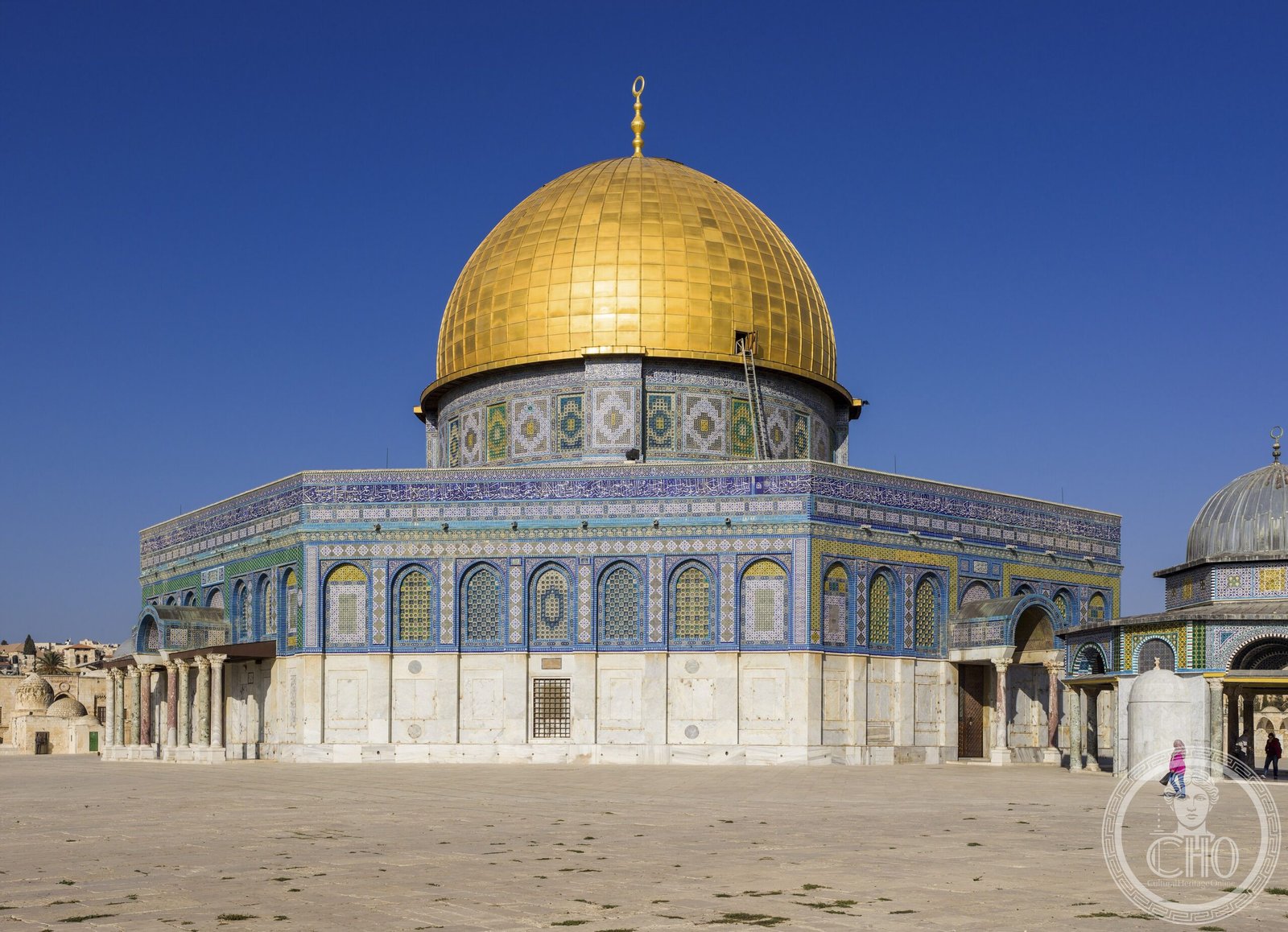
An octagonal Islamic shrine at the heart of the Al-Aqsa mosque compound, the world’s oldest surviving work of Islamic architecture and one of Islam’s most sacred sites.
At a glance
Built by the Umayyad Caliphate under Caliph Abd al-Malik in 691–692 CE, the Dome of the Rock stands atop the Foundation Stone (or Noble Rock) on Jerusalem’s Temple Mount. It is the earliest archaeologically-attested religious structure commissioned by a Muslim ruler and contains the earliest Islamic inscriptions proclaiming the faith and the prophet Muhammad. The shrine is venerated in Islam as the site from which Muhammad began his Night Journey to heaven, and is also sacred to Christians and Jews as the location of Abraham’s near-sacrifice of his son and the site of the Second Jewish Temple.
History
Abd al-Malik ordered construction during the Second Fitna, a period of civil conflict, to commemorate the Foundation Stone’s spiritual significance. The original dome collapsed in 1015 and was rebuilt in 1022–23. During the Early Ottoman period, the structure received a dramatic transformation: bright blue-and-white Iznik-style tiles were applied to the exterior. The modern era brought further changes, notably the addition of the gold-plated roof in 1959–61 and again in 1993, making it Jerusalem’s most recognizable landmark.
What you see
The octagonal plan may have been influenced by the Byzantine Church of the Seat of Mary (built 451–458), which stood between Jerusalem and Bethlehem. Its architecture and decorative mosaics follow the patterns of nearby Byzantine churches and palaces, creating a structure that bridges Islamic and Byzantine traditions. The exterior’s brilliant tilework and gleaming dome dominate the skyline of the Old City.
Cultural significance
The Dome of the Rock is a watershed in Islamic art and religious expression. Its Islamic inscriptions pioneered a practice that became standard in Islamic architecture worldwide—the integration of Quranic text and references to Muhammad. Art historian Oleg Grabar has called it a “unique monument of Islamic culture in almost all respects,” functioning simultaneously as a work of art, cultural statement, and pious document. UNESCO recognized its universal value as a World Heritage Site.
Key facts
- Location: Temple Mount, Old City of Jerusalem, Israel
- Coordinates: 31.778°N, 35.2354°E
- Built: 691–692 CE under Caliph Abd al-Malik
- UNESCO World Heritage Site: yes
- Oldest surviving work of Islamic architecture
Practical information & getting there
The Dome of the Rock is located on the Temple Mount in Jerusalem’s Old City. Access and visiting hours vary due to the site’s religious and political significance; visitors should check current conditions before planning a visit. The structure remains an active place of worship and pilgrimage for Muslims, Christians, and Jews.
Sources & resources
Find it on the map
See this place and what’s around it →Historical events at this place (2)
📷 Become a Cultural Heritage Online photographer
Share your photos of places: they stay published under your name as the author. The more they're seen, the more you get noticed — and soon a contest will reward the most appreciated photos.
Log in or sign up free to add a photoIs this page about you?
This page is read by travellers and heritage enthusiasts who find it on Google. Tell us how you are connected to this place and we will take it from there.