
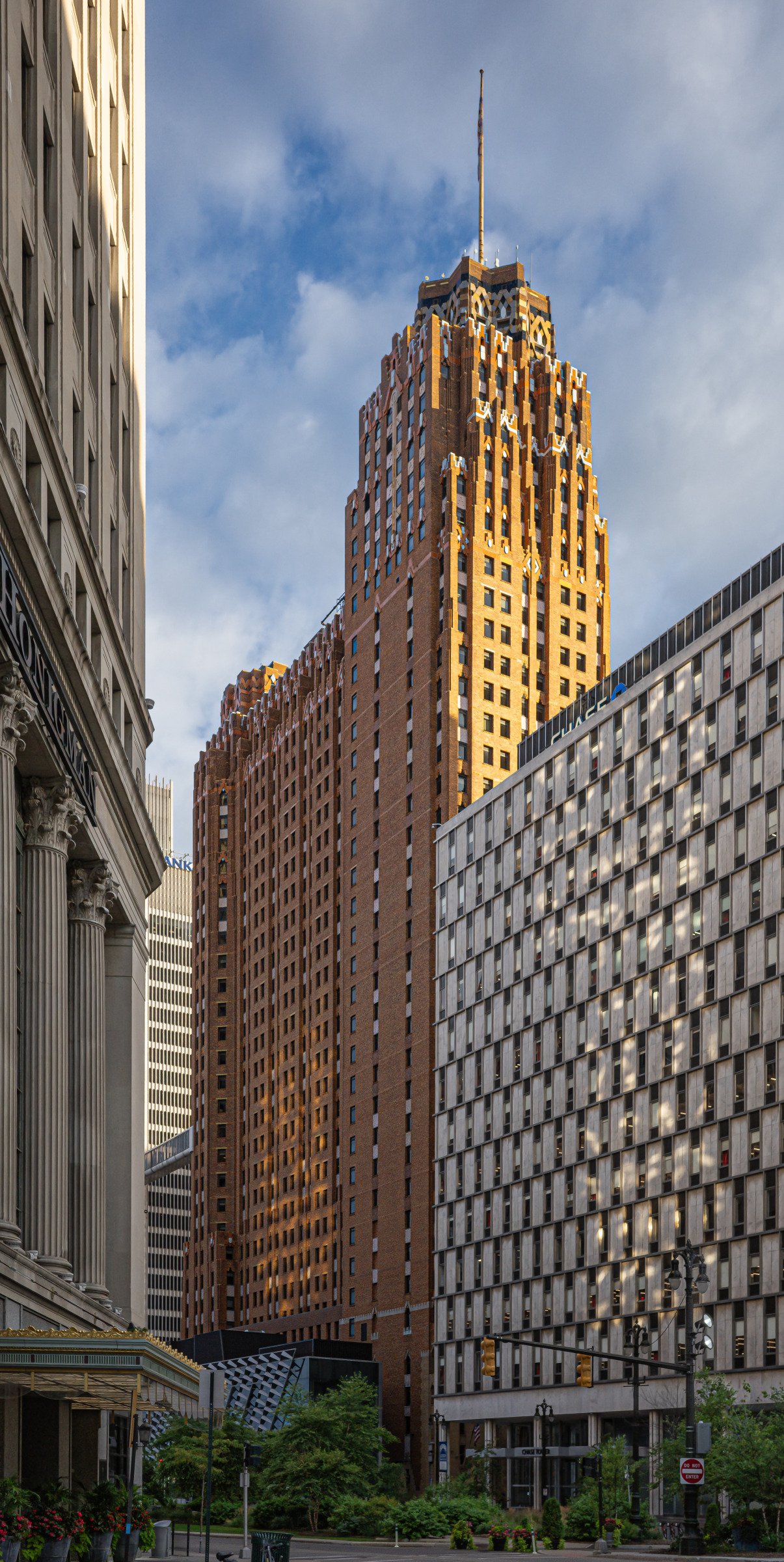
Detroit’s “Cathedral of Finance” — a 43-story Art Deco skyscraper at 500 Griswold Street completed in 1929 by architect Wirt C. Rowland, clad in a polychrome terra cotta exterior of orange brick and blue-green tile, its three-story banking hall vaulted in Pewabic and Rookwood pottery with a hand-painted canvas ceiling, and its entrance framing a Tiffany clock — the most colorful and ornate Art Deco skyscraper interior in the United States.
At a glance
The Guardian Building stands at 500 Griswold Street in downtown Detroit, Michigan. Completed in 1929 to the designs of architect Wirt C. Rowland of the Detroit firm Smith, Hinchman & Grylls, the 43-story, 496-foot Art Deco skyscraper was originally commissioned as the headquarters of Union Trust Company — one of Detroit’s largest banking institutions at the height of the city’s automotive-era prosperity — and became known informally as the “Cathedral of Finance” for the cathedral-like scale and splendor of its vaulted three-story banking hall. The building is one of the most intact and most extraordinary Art Deco interiors anywhere in the world: Pewabic and Rookwood pottery tiles cover the lobby vaults, the walls carry murals by artist Ezra Winter, and the hand-painted canvas ceiling of the banking hall remains largely intact from its 1929 installation. Listed on the National Register of Historic Places in 1989, the Guardian Building is now used for offices and has become one of Detroit’s most popular architectural destinations.
Key facts
- Built: 1928–1929
- Style: Art Deco with Art Moderne influences
- Architect: Wirt C. Rowland, Smith, Hinchman & Grylls, Detroit
- Stories: 43
- Height: 496 ft (151 m) to roof; 632 ft (193 m) to spire
- Original tenant: Union Trust Company (renamed Union Guardian Trust; then Guardian)
- Nickname: Cathedral of Finance
- Exterior: Orange brick with cream, white, blue-green terra cotta tile (Pewabic and Rookwood Potteries)
- Lobby: Three-story vaulted banking hall; Pewabic and Rookwood tile vaults; murals by Ezra Winter; hand-painted canvas ceiling; Tiffany clock at entrance; Corrado Parducci sculptures
- NRHP listed: June 29, 1989
- Address: 500 Griswold Street, Detroit, Michigan 48226
- GPS: 42.32972, −83.04583
History
Detroit in 1928 was the fourth-largest city in the United States and the center of the global automobile industry. Ford, General Motors, and Chrysler — the Big Three that dominated world automotive production — were all headquartered in the Detroit metropolitan area, and the banks that financed them were competing for the identity of the city’s dominant financial institution. Union Trust Company, one of the city’s largest banks, commissioned a new headquarters tower on Griswold Street that would visually assert its standing in the Detroit skyline. The commission went to Wirt C. Rowland, a senior designer at Smith, Hinchman & Grylls who had been developing an approach to Art Deco ornament centered on ceramic tile — specifically the handmade tiles of Pewabic Pottery and Rookwood Pottery — that had no precedent at skyscraper scale anywhere in America.
What Rowland built in 1928–1929 was the most ambitious use of ceramic tile as a primary architectural material in American skyscraper history. The exterior is clad in a polychrome combination of orange brick and blue-green, cream, and white Pewabic and Rookwood tiles that give the building a visual distinctiveness unmatched by any contemporaneous tower. The three-story banking hall in the lobby continues the ceramic program into the interior with a vaulted ceiling surfaced entirely in Pewabic tile — the largest single Pewabic tile commission ever executed — while the banking hall’s hand-painted canvas ceiling, murals by New York artist Ezra Winter, and entrance Tiffany clock complete an interior that the critics immediately recognized as something without precedent in American commercial architecture. The building opened in 1929, the year of the stock market crash; Union Trust merged to become Union Guardian Trust, and eventually the renamed Guardian Detroit Bank gave the building its permanent name.
What you see
The Guardian Building’s exterior presents the most colorful Art Deco skyscraper face in America: orange brick punctuated by the blue-green, cream, and white glazed ceramic tiles of Pewabic and Rookwood Potteries, with the ornamental program concentrated at the base, the setback shoulders, and the crown in a polychrome display that photographs can represent but cannot fully convey. The building’s setback massing follows the 1916 New York Zoning Resolution model that governed all major American skyscraper design in the late 1920s — the stepped-back ziggurat form — but the surface treatment is Rowland’s own: no other architect applied handmade ceramic tile at this scale to a major American tower.
The three-story vaulted lobby is the building’s interior masterpiece. The vault itself is surfaced in Pewabic Pottery tiles in a mosaic of geometric patterns and colors that create an effect analogous to the painted vault of a Gothic cathedral — the “Cathedral of Finance” nickname captures exactly what visitors experience entering this space. Above the vault, the banking hall ceiling was painted by canvas artists hired to extend the ceramic program into the upper surfaces of the hall. Corrado Parducci, the Detroit sculptor whose work appears in buildings throughout the city’s 1920s commercial core, contributed the figural sculptures at the building’s entrance. The Tiffany clock that marks the main entrance portal is one of the building’s most frequently photographed features.
Practical information
- The Guardian Building is open to visitors during regular business hours; the lobby and banking hall are among the most photographed Art Deco interiors in the United States.
- Tours of the building are available; check the Guardian Building’s official site for current tour schedule and rates.
- A restaurant operates in the lower levels of the building, accessible from Griswold Street.
- The exterior, lobby, and banking hall are ADA-accessible from the street-level entrance.
Getting there
The Guardian Building is at 500 Griswold Street in the Financial District of downtown Detroit, Michigan. Detroit Metropolitan Wayne County Airport (DTW) is approximately 18 miles southwest. The Detroit People Mover (elevated light rail) stops at the Cadillac Center station approximately two blocks north and the Financial District station one block east. The QLine streetcar runs along Woodward Avenue; the Campus Martius stop is three blocks east. By car, Interstate 75 (Fisher Freeway) passes through downtown Detroit; the Lafayette/Monroe exit provides access to the Griswold Street corridor.
Nearby
- Penobscot Building (1928) — another major Detroit Art Deco skyscraper two blocks north at 645 Griswold; designed by Wirt Rowland for the same ownership group; its lobby and elevator banks are among the finest Art Deco interiors in the city
- Detroit Institute of Arts — one of the great American art museums, in the Midtown neighborhood approximately 2 miles north; home to Diego Rivera’s Detroit Industry murals and one of the finest collections of European Old Masters in North America
- Campus Martius Park — the central public square of downtown Detroit, three blocks east of the Guardian Building; the site of the original Woodward Plan intersection from which the city’s distinctive radial street grid extends
Sources
- Wikipedia: “Guardian Building”
- National Register of Historic Places, listing June 29, 1989
- Gallagher, John: AIA Detroit: The American Institute of Architects Guide to Detroit Architecture (2003) — on the Guardian Building as the finest Art Deco interior in Michigan
- Pewabic Pottery archives: Guardian Building commission documentation
- Wikimedia Commons: Guardian_Building_2025.jpg, CC0 Public Domain, WMrapids
Find it on the map
See this place and what’s around it →Record researched and written by Luigi De Marchi for Cultural Heritage Online, 2026.
📷 Become a Cultural Heritage Online photographer
Share your photos of places: they stay published under your name as the author. The more they're seen, the more you get noticed — and soon a contest will reward the most appreciated photos.
Log in or sign up free to add a photoIs this page about you?
This page is read by travellers and heritage enthusiasts who find it on Google. Tell us how you are connected to this place and we will take it from there.