
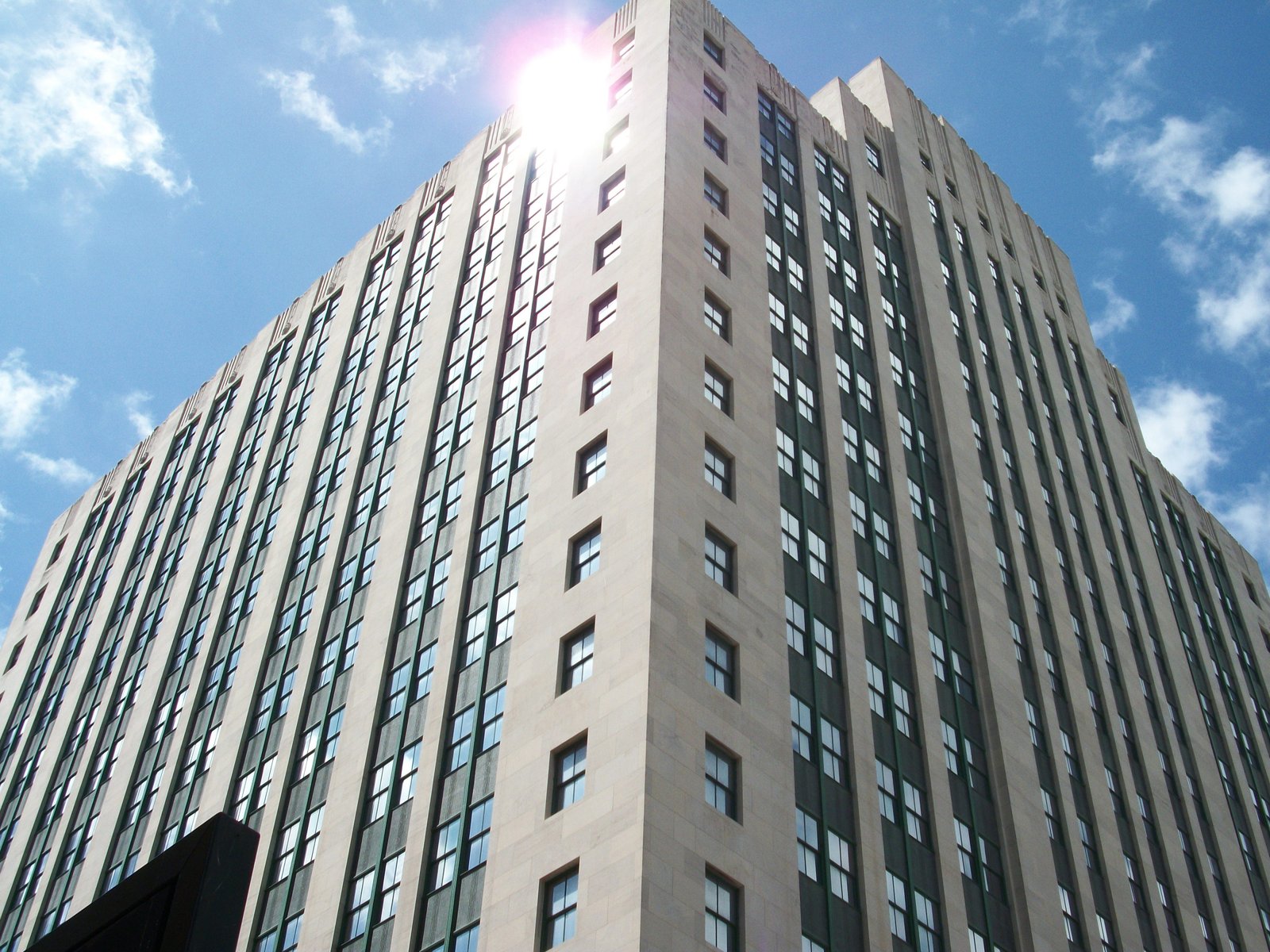
The first skyscraper built in Miami after the catastrophic 1928 hurricane and recession that ended the city’s 1920s boom, a 17-story building with Art Deco embellishments at 169 East Flagler Street designed by Marsh and Saxelbye and completed in 1939 — marking the resumption of large-scale commercial construction in downtown Miami after more than a decade of economic silence — listed on the National Register in 1989.
At a glance
The Alfred I. du Pont Building stands at 169 East Flagler Street in the heart of downtown Miami, Florida. Completed in 1939, the 17-story rectangular building in the Modern style with Art Deco embellishments was the first large-scale skyscraper built in Miami after the Okeechobee Hurricane of 1928 and the Depression-era collapse of the city’s real estate market effectively halted major construction for over a decade. Designed by Jacksonville architects Marsh and Saxelbye, the building was funded by the estate of Alfred I. du Pont — the Delaware chemical fortune heir who had moved to Florida in the 1920s and who died in 1935, leaving the building project to be completed by the executors of his estate. Listed on the National Register of Historic Places in 1989, the building remains a contributing element of Miami’s downtown historic streetscape.
Key facts
- Built: 1937–1939 (completed 1939).
- Style: Modern with Art Deco embellishments.
- Architects: Marsh and Saxelbye, Jacksonville, Florida.
- Stories: 17.
- Historic significance: First skyscraper built in Miami after the 1928 hurricane and Depression.
- Named for: Alfred I. du Pont (1864–1935; Delaware industrialist and Florida banking investor).
- Construction funded by: Alfred I. du Pont estate, managed by Jessie du Pont and Edward Ball.
- NRHP listed: January 4, 1989.
- Address: 169 East Flagler Street, Miami, Florida 33131.
- GPS: 25.77450, −80.19060.
History
Miami’s 1920s boom — one of the most intense real estate manias in American history — came to an abrupt end in 1926 when the Great Miami Hurricane caused catastrophic damage, and was definitively finished by the Okeechobee Hurricane of 1928, which killed over 2,500 people in southern Florida and destroyed property on a scale that preceded the broader national Depression by a full year. The city that emerged from this double catastrophe in the 1930s was fundamentally altered: major commercial construction essentially stopped for over a decade, and the skyline that had been projected by developers in 1925 remained unbuilt through the Depression years.
Alfred I. du Pont — great-nephew of the founder of the E.I. du Pont de Nemours chemical company, and himself a major investor in Florida banking and real estate — had moved to Jacksonville in 1926 and spent the last years of his life building a network of Florida state banks through his brother-in-law Edward Ball. When du Pont died in 1935, his estate — managed by his widow Jessie Ball du Pont and Edward Ball — continued this investment program, commissioning the building that now bears his name on Miami’s main commercial thoroughfare. Construction began in 1937 and was completed in 1939. The building’s completion at 17 stories was the clearest signal of Miami’s commercial recovery and remains so: no comparable structure had been built in the downtown core since before the 1928 hurricane, making the Alfred I. du Pont Building both a private investment and a public marker of the city’s return to financial confidence.
What you see
The Alfred I. du Pont Building presents a 17-story rectangular form on Flagler Street, its facade organized in the restrained Modern idiom of late-1930s commercial architecture with Art Deco embellishments at the principal ornamental moments — the entrance surround, the cornice treatment, and the spandrel panels between floor-line windows. The architects Marsh and Saxelbye, a Jacksonville firm active in Florida institutional and commercial work throughout the 1920s and 1930s, chose a vocabulary that was contemporary without being aggressively modernist: the building reads as belonging to the Art Deco tradition while incorporating the simplified surface treatment and reduced ornament that characterized the late-decade shift from the more exuberant Zig Zag Moderne of the early 1930s toward the cleaner Streamline Moderne and stripped modern of 1935–1945.
The building’s Flagler Street context amplifies its significance: East Flagler was Miami’s main commercial street throughout the 20th century, and the du Pont Building occupies a prominent position in the historic streetwall that defines this corridor. The building’s 17-story profile was the tallest in Miami when completed — a height that expressed both the estate’s financial ambition and the city’s newly restored capacity for commercial investment after a decade of near-stasis.
Practical information
- Commercial building on East Flagler Street; the exterior is freely visible from the street.
- Located in the heart of downtown Miami at the intersection of East Flagler Street and SE 2nd Avenue, two blocks east of Miami-Dade Cultural Center.
- The Metromover (free downtown circulator) stops at the First Street / Flagler Street station approximately one block west.
Getting there
The Alfred I. du Pont Building is at 169 East Flagler Street in downtown Miami, Florida. Miami International Airport (MIA) is approximately 7 miles west; the Miami International Airport Metrorail station connects directly to the downtown Brickell and Government Center Metrorail stations. Metromover — Miami’s free automated people mover — circulates through downtown and connects to Metrorail at Government Center. By car, Interstate 95 exits at NW 2nd Street; the Port of Miami tunnel connects Brickell to the MacArthur Causeway.
Nearby
- Miami-Dade Cultural Center — the Brutalist complex by Philip Johnson (1983) two blocks west at 101 West Flagler Street, housing the HistoryMiami Museum, the Miami Art Museum (now PAMM), and the Miami-Dade Public Library; the complex replaced the historic Federal Courthouse block that had been part of Flagler Street’s pre-war commercial core.
- Brickell district — Miami’s modern financial district immediately south of downtown across the Miami River, with the Brickell City Centre and the international banking headquarters that have made Miami one of the major financial centers of the Americas since the 1970s.
- Flagler Street Historic District — the commercial corridor of which the du Pont Building is a contributing element, with multiple early 20th-century commercial buildings preserved in the downtown Miami streetwall.
Sources
- Wikipedia: “Alfred I. du Pont Building”
- National Register of Historic Places, listing January 4, 1989.
- Bramson, Seth H.: Miami: The Magic City — on Miami’s 1920s boom, 1928 hurricanes, and Depression-era development halt.
- Wikimedia Commons: AlfredI.DuPontBuilding.jpg, CC BY-SA 3.0, SebasTorrente.
Find it on the map
See this place and what’s around it →Record researched and written by Luigi De Marchi for Cultural Heritage Online, 2026.
📷 Become a Cultural Heritage Online photographer
Share your photos of places: they stay published under your name as the author. The more they're seen, the more you get noticed — and soon a contest will reward the most appreciated photos.
Log in or sign up free to add a photoIs this page about you?
This page is read by travellers and heritage enthusiasts who find it on Google. Tell us how you are connected to this place and we will take it from there.