

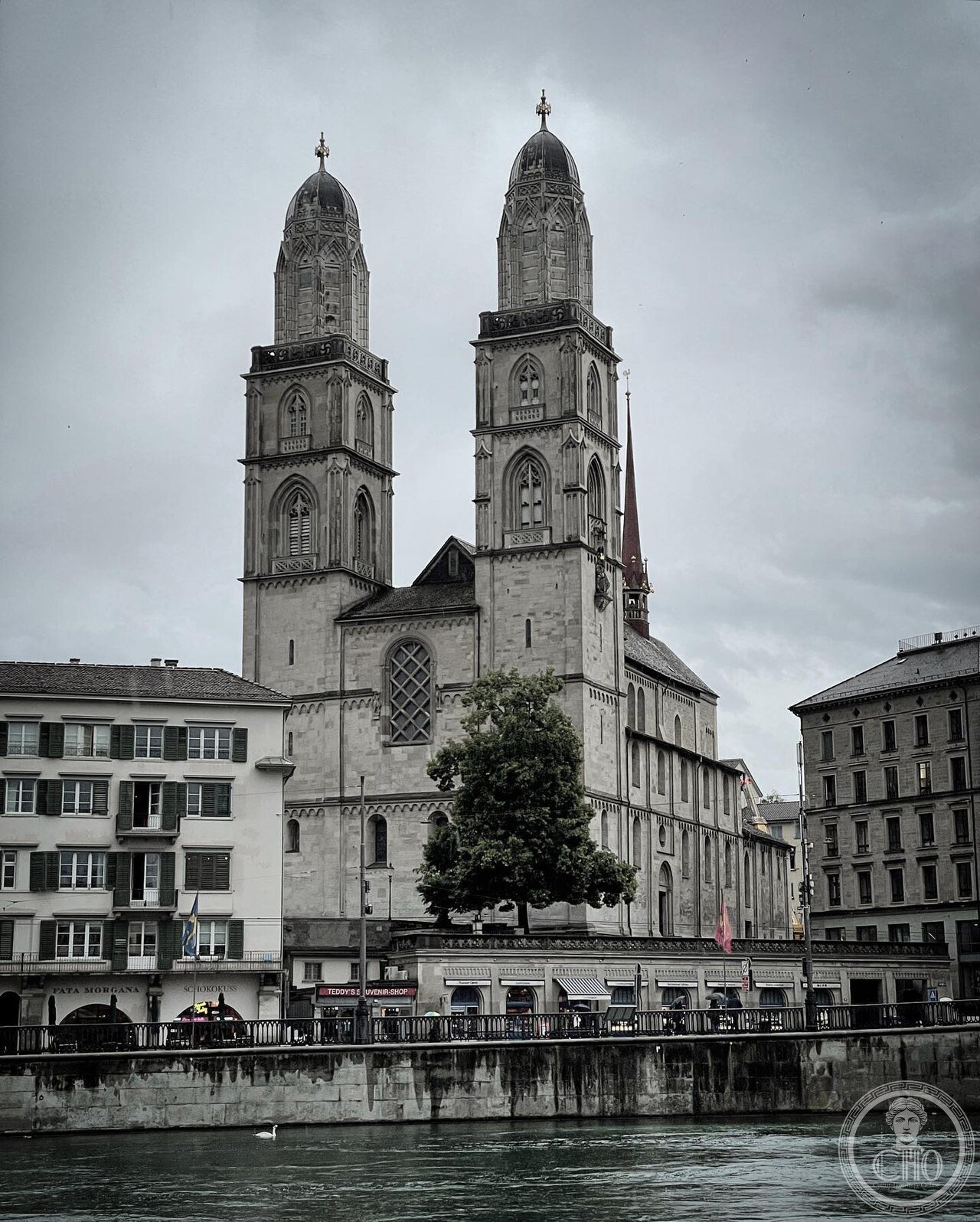
On the evening of 9 March 1522, the first Friday of Lent, a few workmen gathered in the house of the printer Christoph Froschauer shared a plate of smoked sausages — an act forbidden by the Lenten fast. Huldrych Zwingli, pastor of the Grossmünster, did not eat any, but publicly defended the freedom to do so in a sermon: it was the spark that lit the Protestant Reformation in Switzerland, an episode that has gone down in history as “the affair of the sausages”.
About the Grossmünster
According to legend, the Grossmünster traces its origins to around 810 CE, when Charlemagne, riding through the area, had his horse kneel over the burial site of Felix and Regula, Zurich’s patron saints and early Christian martyrs; interpreting this as a divine sign, the emperor is said to have founded a church on the spot to house their relics. The Romanesque church visible today, with its distinctive twin towers, was built over the course of roughly 120 years, from around 1100 until 1220, replacing the earlier Carolingian structure. In 1519, Huldrych Zwingli was appointed pastor of the Grossmünster, and from this position he launched the Swiss-German Reformation, breaking with Rome over issues including the veneration of saints and relics, the sale of indulgences, and clerical celibacy. On the evening of 9 March 1522, the first Friday of Lent, the printer Christoph Froschauer served a meal of smoked sausages to a group of workers exhausted from producing a new edition of the Epistles of Saint Paul — an act that directly violated the Lenten fasting rules. Zwingli himself abstained from eating the sausages but publicly defended Froschauer and his guests, preaching a sermon titled “Regarding the Choice and Freedom of Foods,” arguing from the Reformation principle of sola scriptura that Christians were free to fast or not, since the Bible contained no explicit prohibition on eating meat during Lent. The episode, known ever since as the Affair of the Sausages, is regarded as carrying an importance for the Swiss Reformation comparable to Martin Luther’s Ninety-Five Theses in Germany. Zwingli’s reforms, continued after his death by his successor Heinrich Bullinger, led to the removal of the church’s organ and religious statuary in 1524 and a broader stripping-down of ritual and decoration that left the Grossmünster’s interior in the plain, unadorned style still visible today.
Key facts
- c. 810 CE: legendary founding by Charlemagne over the graves of Felix and Regula
- 1100-1220: present Romanesque church built, with its twin towers
- 1519: Huldrych Zwingli appointed pastor of the Grossmünster
- 9 March 1522: the “Affair of the Sausages” sparks the Swiss Reformation
- 1524: organ and religious statuary removed under Zwingli’s reforms
- Patron saints: Felix and Regula, Zurich’s early Christian martyrs
- Successor: Heinrich Bullinger continues Zwingli’s Reformation after his death
History
The Affair of the Sausages, a seemingly minor dinner among tired printing workers, became one of the defining opening acts of the Swiss Reformation precisely because Zwingli chose to publicly defend the participants rather than remain silent — transforming an act of dietary defiance into a fully articulated theological argument for scriptural authority over ecclesiastical tradition. The Grossmünster’s subsequent stripping of its organ, statuary, and decorative elements under Zwingli and Bullinger’s continuing reforms physically embodies the Reformed principle of simplicity in worship, leaving the building’s plain interior as a lasting architectural record of that theological shift.
The church’s legendary Carolingian origin story, involving Charlemagne’s kneeling horse over the tombs of Felix and Regula, situates the Grossmünster within a broader medieval tradition of imperial founding legends attached to major European churches, later given lasting civic importance as the site from which one of the Reformation’s most consequential regional movements was launched.
What you see
The Grossmünster’s twin towers, rebuilt in their present form with distinctive octagonal upper stories in the 18th century after earlier spires burned down, remain the most recognisable feature of Zurich’s skyline. The Romanesque nave and crypt, dating largely to the 1100-1220 building campaign, retain their structural austerity, a plainness reinforced by the removal of decorative elements during the 16th-century Reformation. The church’s bronze doors, added in the 20th century, depict scenes from its own history, including the Reformation period.
Practical information
- Opening hours: generally open daily with seasonal variation; check current hours before visiting; free admission to the nave, fee for the tower climb
- Address: Grossmünsterplatz, 8001 Zürich, Switzerland
Getting there
The Grossmünster is located in Zurich’s old town, on the east bank of the Limmat river, easily reachable on foot from the city centre. GPS: 47.3701° N, 8.5439° E.
Nearby
- Fraumünster — the neighbouring church across the Limmat, famous for its Chagall windows
- Limmatquai — the riverside promenade adjacent to the church
- Zurich Old Town (Altstadt) — the surrounding historic district
Sources
- Wikipedia — “Grossmünster” and “Affair of the Sausages” (en.wikipedia.org)
- World History Encyclopedia — “Grossmunster” (worldhistory.org)
- SWI swissinfo.ch — “How a couple of sausages triggered the Swiss Reformation” (swissinfo.ch)
Find it on the map
See this place and what’s around it →📷 Become a Cultural Heritage Online photographer
Share your photos of places: they stay published under your name as the author. The more they're seen, the more you get noticed — and soon a contest will reward the most appreciated photos.
Log in or sign up free to add a photo