
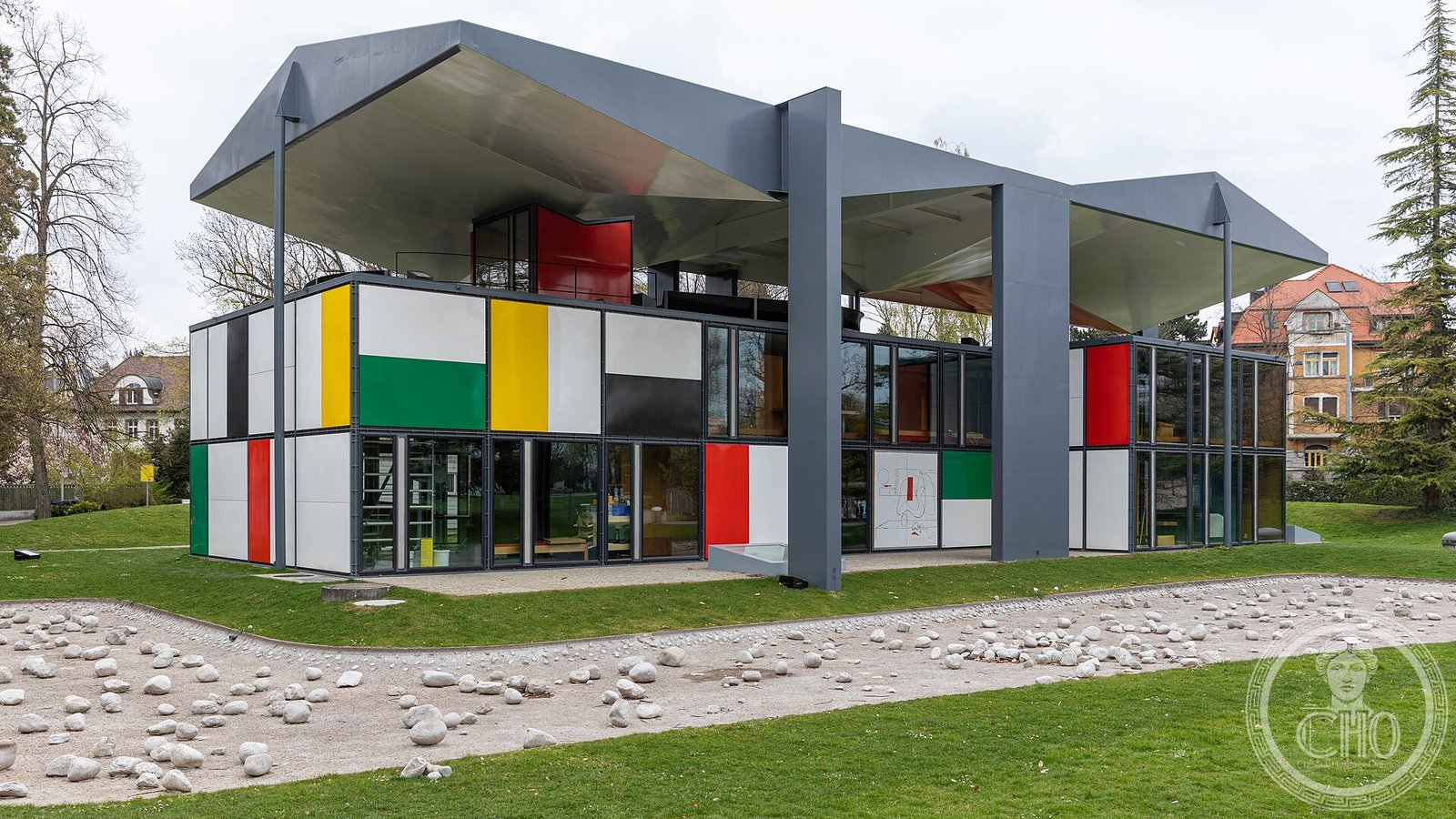
Zürich is not a Liberty city, but it bookends the modern movement with unusual precision. A Secession-style art museum opened in 1910; Le Corbusier’s very last building was inaugurated on its lakefront in 1967. Between those two dates runs the whole arc from Jugendstil to high modernism.
At a glance
Two buildings let Zürich tell the story of the modern movement from beginning to end. The Kunsthaus Zürich, the city’s main art museum, opened in 1910 in a restrained Secession idiom by Karl Moser and Robert Curjel — a Swiss echo of the Jugendstil and Secession currents then reshaping Vienna and Munich. Half a century later, on the lakeshore at the Zürichhorn, Le Corbusier built what would be his final work: the Pavillon Le Corbusier, a structure of prefabricated steel and brilliantly coloured enamel that he did not live to see opened. For visitors tracing the modern movement, Zürich offers its first chapter and its last in a single compact city.
Key facts
- Country: Switzerland
- Key period: 1910–1967 (Secession to the Modern Movement)
- Kunsthaus Zürich: Karl Moser and Robert Curjel; original building opened 1910, in a Neo-Grec version of the Secession style
- Pavillon Le Corbusier: Le Corbusier; commissioned 1960 by collector Heidi Weber, inaugurated 15 July 1967 — his last completed building
- Construction note: the pavilion is built of prefabricated steel and multi-coloured enamelled plates, with a free-floating roof of 12 × 12-metre sections; it is listed as a Class A object of national importance in Switzerland
- Where: the Kunsthaus in the city centre; the pavilion at Höschgasse 8, in the lakeside Seefeld quarter
History
The Kunsthaus Zürich opened in 1910 to designs by Karl Moser and Robert Curjel, in what Zürich knew as a Neo-Grec version of the Secession style — the same reform movement that, in Vienna, had broken with academic historicism a decade earlier. The original section preserves its early interiors and a facade carrying bas-reliefs by Oskar Kiefer, Moser’s longtime collaborator. The museum has been enlarged repeatedly since — in 1925, 1958 and 1976 — and most dramatically by David Chipperfield, whose extension opened on 9 October 2021 and increased the Kunsthaus by more than 80 per cent.
The Pavillon Le Corbusier came at the other end of the modern century. The Swiss collector Heidi Weber commissioned it in 1960 to house Le Corbusier’s art and ideas. His first drawings, in 1961, proposed concrete; by 1962 the design had shifted to a steel structure, and construction began in 1964. Le Corbusier died in 1965, two years before the building was completed; it was officially inaugurated on 15 July 1967. It was the last building he designed.
The pavilion marks a deliberate departure from the béton brut for which Le Corbusier had become famous. Assembled from prefabricated steel elements and panels of enamelled metal — more than twenty thousand bolts in all — it is sheltered by a free-floating roof carried clear of the glazed box below. Today it operates as a museum of Le Corbusier’s work and remains one of Zürich’s most distinctive buildings.
What you see
The pavilion is small and exact, and reads as pure colour and geometry against the lake. Square enamelled panels — each about 1.13 by 2.26 metres — are set into a steel frame in blocks of primary colour, while the great welded-steel roof hovers above on its own structure, detached from the glass volume it protects. After a lifetime of rough concrete, Le Corbusier here returned to the machine precision of his early manifestos, executed in industrial metal.
The Kunsthaus offers the opposite experience: a layered building where the calm 1910 Secession rooms sit alongside a century of additions, now anchored by Chipperfield’s austere stone extension across the Heimplatz. Walking from one to the other — from Moser’s reform classicism to Le Corbusier’s coloured steel — is itself a short course in the modern movement.
Practical information
- Pavillon Le Corbusier: open as a museum in season (typically spring to autumn); check current opening times before visiting
- Kunsthaus Zürich: open year-round, closed Mondays; the original 1910 rooms and the Chipperfield extension are both accessible on one ticket
- Best paired: the pavilion sits on the lakeside walk; combine it with a stroll along the Zürichhorn
- Time needed: an hour for the pavilion, half a day for the Kunsthaus
Getting there
Zürich Airport (ZRH) connects to the main station, Zürich HB, by train in about 10 minutes. The Kunsthaus is a short walk or tram ride from the station, on Heimplatz in the city centre. The Pavillon Le Corbusier stands on the eastern lakeshore at Höschgasse 8 in Seefeld, reached by tram and bus toward the Zürichhorn, or on foot along the lake promenade. The city’s trams, buses and trains run on a single integrated ZVV ticket.
Related in CHO
- Vienna — Capital of the Vienna Secession
- Helsinki — Alvar Aalto and Nordic Functionalism
- Copenhagen — Nordic Classicism and the Brick Expressionists
Sources
Find it on the map
See this place and what’s around it →📷 Become a Cultural Heritage Online photographer
Share your photos of places: they stay published under your name as the author. The more they're seen, the more you get noticed — and soon a contest will reward the most appreciated photos.
Log in or sign up free to add a photo