

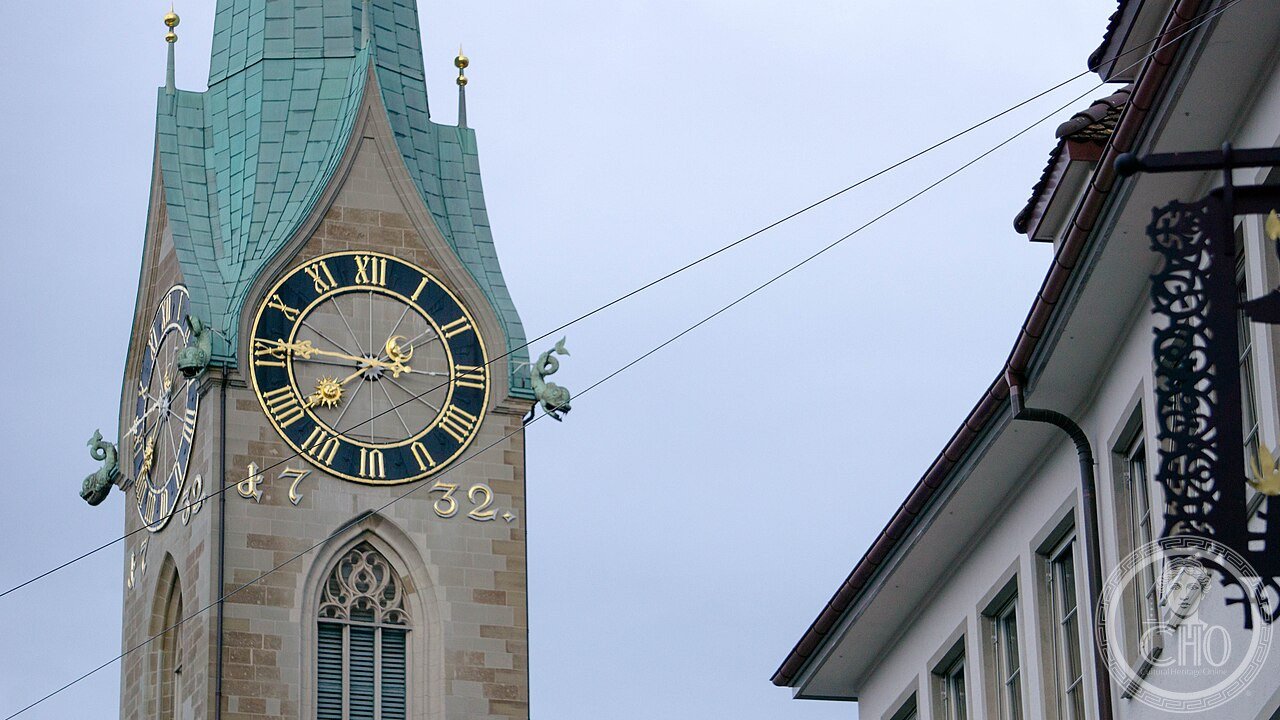
In 853 King Louis the German founded this convent for his daughter Hildegard, endowing it with the lands of Zurich, Uri and the Albis forest. In 1045 the emperor Henry III granted the abbess the right to hold markets, levy tolls and mint coin: in practice, for centuries, the abbess of the Fraumünster was the sovereign of the city. Today five windows designed by Marc Chagall in 1970, when the artist was 83, light the choir of that same church.
About the Fraumünster
The Fraumünster was founded in 853 by King Louis the German for his daughter Hildegard, who endowed the new Benedictine convent for aristocratic women with the lands of Zurich, Uri, and the Albis forest, and placed it under his own direct royal authority with a grant of immunity. Over the following two centuries, the convent’s abbesses accumulated substantial temporal power: in 1045, King Henry III granted the convent the right to hold markets, collect tolls, and mint coins, effectively making the abbess ruler of the city, and in 1218 Emperor Frederick II granted the abbey Reichsunmittelbarkeit — territorial independence from all authority except the Emperor himself — further expanding the abbess’s political power over Zurich. This remarkable arrangement of female monastic rule persisted until the Reformation: the abbey was formally dissolved on 30 November 1524 during Huldrych Zwingli’s reforms, a dissolution supported by the convent’s own last abbess, Katharina von Zimmern, who chose to hand over the abbey’s authority rather than resist the reformers. Centuries later, between 1967 and 1970, the church commissioned the artist Marc Chagall — then 83 years old — to design five stained-glass windows for the choir; each window, standing ten metres high, is built around its own dominant colour and depicts a distinct biblical theme, and the windows are considered among Chagall’s most significant late works in stained glass. The church’s north transept also holds an earlier rose window by the Swiss artist Augusto Giacometti, completed in 1945, adding a second major 20th-century artistic layer to the medieval building.
Key facts
- 853: convent founded by Louis the German for his daughter Hildegard
- 1045: Henry III grants the abbess market, toll, and minting rights over Zurich
- 1218: Frederick II grants the abbey full territorial independence (Reichsunmittelbarkeit)
- 30 November 1524: abbey dissolved during Zwingli’s Reformation, with the last abbess’s support
- 1945: Augusto Giacometti’s rose window installed in the north transept
- 1967-1970: Marc Chagall, aged 83, designs five choir windows, each ten metres high
History
The centuries-long temporal rule of the Fraumünster’s abbesses, extending from market and minting rights in 1045 to full imperial territorial independence in 1218, makes the convent one of medieval Europe’s clearest examples of female religious authority translating directly into civic and political power over a major city — a role only ended by the last abbess’s own decision to support Zwingli’s reforms in 1524 rather than resist the Reformation’s dissolution of the abbey. That same building’s transformation, roughly four and a half centuries later, into a showcase for two major 20th-century artists — Giacometti in 1945 and Chagall in 1970 — reflects a broader Swiss Reformed tradition of introducing significant contemporary art into stripped-down historic church interiors, rather than restoring pre-Reformation ornament.
Chagall’s decision to accept the commission at the age of 83 places the Fraumünster windows among the artist’s final major works, produced in the same late period as his other notable stained-glass commissions elsewhere in Europe and Israel.
What you see
The Fraumünster’s Gothic choir houses Chagall’s five stained-glass windows, each ten metres tall and organised around a single dominant colour — themes include the Prophets, Jacob, Christ, Zion, and the Law — best seen in the morning light that floods the eastern end of the church. The north transept holds Augusto Giacometti’s 1945 rose window, its abstract, luminous colour scheme predating Chagall’s commission by over two decades. The church’s Romanesque crypt, the oldest surviving part of the structure, preserves architectural elements from the original medieval convent.
Practical information
- Opening hours: generally open daily with seasonal variation; check current hours before visiting; admission fee applies
- Address: Münsterhof 2, 8001 Zürich, Switzerland
Getting there
The Fraumünster is located on the west bank of the Limmat river, in Zurich’s old town, a short walk from the Grossmünster across the Münsterbrücke bridge. GPS: 47.3697° N, 8.5412° E.
Nearby
- Grossmünster — the twin-towered church across the Limmat, associated with Zwingli
- Münsterhof square — the historic square in front of the church
- Bahnhofstrasse — Zurich’s famous shopping street, nearby
Sources
- Wikipedia — “Fraumünster” (en.wikipedia.org)
- Zürich Tourism — “Fraumünster – art, history and divine stained glass windows” (zuerich.com)
- World History Encyclopedia — “Fraumunster” (worldhistory.org)
Find it on the map
See this place and what’s around it →📷 Become a Cultural Heritage Online photographer
Share your photos of places: they stay published under your name as the author. The more they're seen, the more you get noticed — and soon a contest will reward the most appreciated photos.
Log in or sign up free to add a photo