
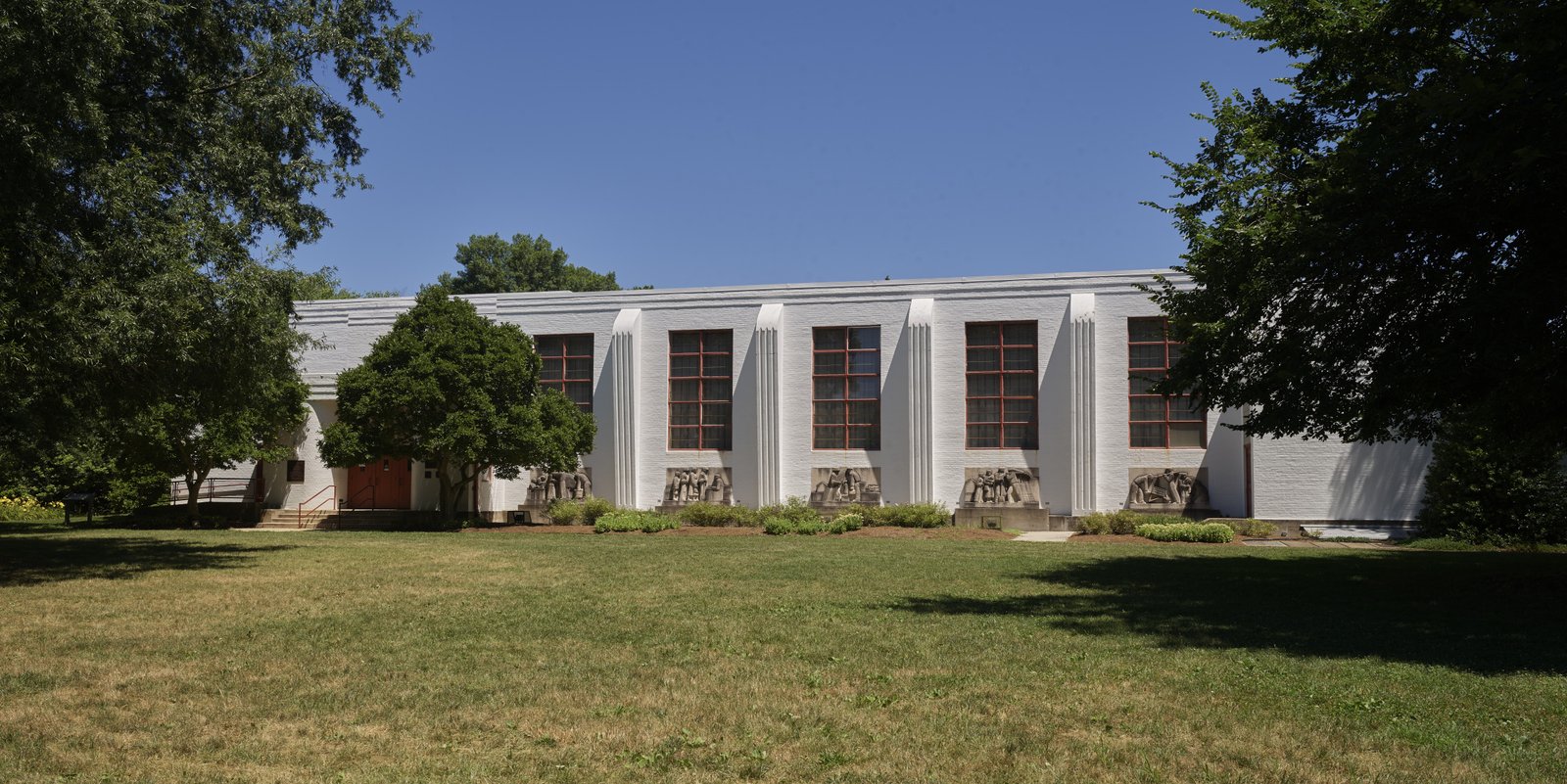
The civic heart of one of three “greenbelt towns” planned and built by Roosevelt’s Resettlement Administration beginning in 1936 — a Streamline Art Deco complex in Greenbelt, Maryland whose curved facades and ribbon windows embody the New Deal’s belief that the federal government could build not just buildings but entire communities, designated a National Historic Landmark in 1997 as one of the finest surviving examples of 1930s American urban planning.
At a glance
The Greenbelt Community Center stands at Roosevelt Center in Greenbelt, Maryland, a planned community 12 miles northeast of Washington, D.C. Built by the federal government’s Resettlement Administration beginning in January 1936, the community center opened to its first tenants on September 30, 1937, and has served as the civic core of Greenbelt ever since. Designed by Douglas D. Ellington with associate architect Reginald D. Wadsworth in the Streamline Art Deco style, the complex — with its curved corners, flat roof, ribbon windows, and smooth white concrete surfaces — typifies the Art Deco vocabulary that the New Deal applied to a federally planned community intended to demonstrate that modern design, cooperative economics, and access to green space could transform the lives of working families displaced by the Depression. The building and the community that surrounds it were designated a National Historic Landmark in 1997.
Key facts
- Built: 1936–1937 (construction began January 13, 1936; first tenants September 30, 1937)
- Style: Art Deco / Streamline Moderne
- Architects: Douglas D. Ellington (principal); Reginald D. Wadsworth (associate); Hale Walker (town planner)
- Sponsor: Resettlement Administration (New Deal), under Rexford Tugwell
- NRHP listed: November 25, 1980
- National Historic Landmark: February 18, 1997 (Greenbelt Historic District)
- Sculpture: “Mother and Child” (1938) by Lenore Thomas Straus, Roosevelt Center courtyard
- Current tenants: Old Greenbelt Theatre, Greenbelt Co-op Supermarket & Pharmacy, New Deal Cafe, Greenbelt Arts Center
- Community context: One of 3 New Deal “greenbelt towns” (with Greenhills OH and Greendale WI)
- Address: Roosevelt Center, Greenbelt, Maryland 20770
- GPS: 39.00278, −76.89111
History
The greenbelt towns were Rexford Tugwell’s most ambitious undertaking as director of the Resettlement Administration under Franklin Roosevelt. Tugwell — a Columbia University economist and key New Deal brain-truster — believed that the Depression’s most severe suffering was concentrated in urban slums and marginal rural areas, and that the federal government could address both problems simultaneously by building entirely new communities that combined cooperative institutions, access to agricultural land, and a new model of low-density housing at the edge of major cities. Three greenbelt towns were planned and built: Greenbelt, Maryland (outside Washington), Greenhills, Ohio (outside Cincinnati), and Greendale, Wisconsin (outside Milwaukee). Greenbelt, Maryland was the largest and the most architecturally realized.
Construction on Greenbelt began in August 1935 after several months of planning; the community center — formally designated Roosevelt Center to honor the president whose administration made it possible — was among the first and most important buildings completed. Designed by Douglas Ellington, one of Asheville’s leading Art Deco architects (who had designed the City Building in Asheville in 1926), the center’s Streamline Moderne vocabulary — curved corners, flat roof, ribbon windows, smooth white surfaces — expressed both the aesthetic modernity of the New Deal’s vision and the practical economy of a federal building program operating under Depression-era budget constraints. The community center housed the cooperative store, the community theater, the community pool, and the administrative offices of Greenbelt’s cooperative government from the day it opened. The cooperative institutions that Tugwell built into the community’s structure — the Greenbelt Consumer Services cooperative, the oldest surviving food cooperative in the United States, still operates in the building today as the Greenbelt Co-op Supermarket & Pharmacy.
What you see
The Greenbelt Community Center is the most complete surviving example of New Deal civic Art Deco at a community scale in the United States. The complex’s Streamline Moderne exterior — smooth white-painted concrete surfaces, the curved corners that eliminate the hard edges of earlier Art Deco, the continuous horizontal ribbon windows that band the facades — belongs to the late-1930s shift within the Art Deco tradition from the ornamental surface richness of the Zig Zag Moderne toward the cleaner, more aerodynamic forms of the Streamline. At Greenbelt this transition was not driven by commercial fashion but by federal design policy: the Resettlement Administration wanted buildings that looked modern, democratic, and purposeful without the conspicuous ornament that might seem extravagant in a Depression-era public works program.
The courtyard between the community center’s wings contains one of the most important pieces of New Deal public sculpture: Lenore Thomas Straus’s “Mother and Child” (1938), a limestone group commissioned through the Federal Art Project. The sculpture’s subject — a monumental mother sheltering a child — embodies the social agenda of the greenbelt town program as concisely as any document. The community center complex as a whole is among the best arguments for the proposition that New Deal federal architecture — at its best — produced environments that still function and still inspire.
Practical information
- Roosevelt Center is an active commercial and civic hub; the Old Greenbelt Theatre, Greenbelt Co-op, New Deal Cafe, and Greenbelt Arts Center are open to the public with regular hours.
- The courtyard with the “Mother and Child” sculpture is accessible at all times.
- The Old Greenbelt Theatre screens art-house and repertory films; check current schedule for showtimes.
- The broader Greenbelt Historic District — the curved residential courts surrounding Roosevelt Center — is a National Historic Landmark open to pedestrian exploration at all times.
Getting there
Greenbelt Community Center is at Roosevelt Center in Greenbelt, Maryland, approximately 12 miles northeast of Washington, D.C. Ronald Reagan Washington National Airport (DCA) is approximately 20 miles southwest; Baltimore-Washington International Airport (BWI) is approximately 15 miles north. The Greenbelt Metro station (Green Line) is approximately 1 mile west of Roosevelt Center; a Greenbelt Circulator bus connects the station to the historic town center. By car, Interstate 95/495 (Capital Beltway) passes just west of Greenbelt; the Greenbelt exit provides direct access to the historic district.
Nearby
- NASA Goddard Space Flight Center — immediately adjacent to Greenbelt on the east; the Visitor Center is open to the public and includes exhibits on space science and NASA missions; the facility’s physical proximity to the New Deal community is coincidental but historically interesting
- National Agricultural Library (Beltsville) — the largest agricultural library in the world, part of the USDA campus approximately 5 miles north in Beltsville; the surrounding area still contains research farms that recall the agricultural-research context of the original greenbelt planning
- College Park Aviation Museum — located at College Park Airport (the world’s oldest continuously operating airport, in use since 1909), approximately 3 miles south; strong connection to the early aviation history that was another face of 1930s American modernity
Sources
- Wikipedia: “Greenbelt, Maryland”; “Greenbelt Community Center”
- National Historic Landmark designation, Greenbelt Historic District, February 18, 1997
- Knepper, Cathy D.: Greenbelt, Maryland: A Living Legacy of the New Deal (2001) — the standard history of the Greenbelt community
- Library of Congress Prints and Photographs Division: Carol M. Highsmith Archive, highsm.51628
- Wikimedia Commons: Greenbelt_Community_Center_2018.jpg, Public Domain, Carol M. Highsmith / Library of Congress
Find it on the map
See this place and what’s around it →Record researched and written by Luigi De Marchi for Cultural Heritage Online, 2026.
📷 Become a Cultural Heritage Online photographer
Share your photos of places: they stay published under your name as the author. The more they're seen, the more you get noticed — and soon a contest will reward the most appreciated photos.
Log in or sign up free to add a photoIs this page about you?
This page is read by travellers and heritage enthusiasts who find it on Google. Tell us how you are connected to this place and we will take it from there.