

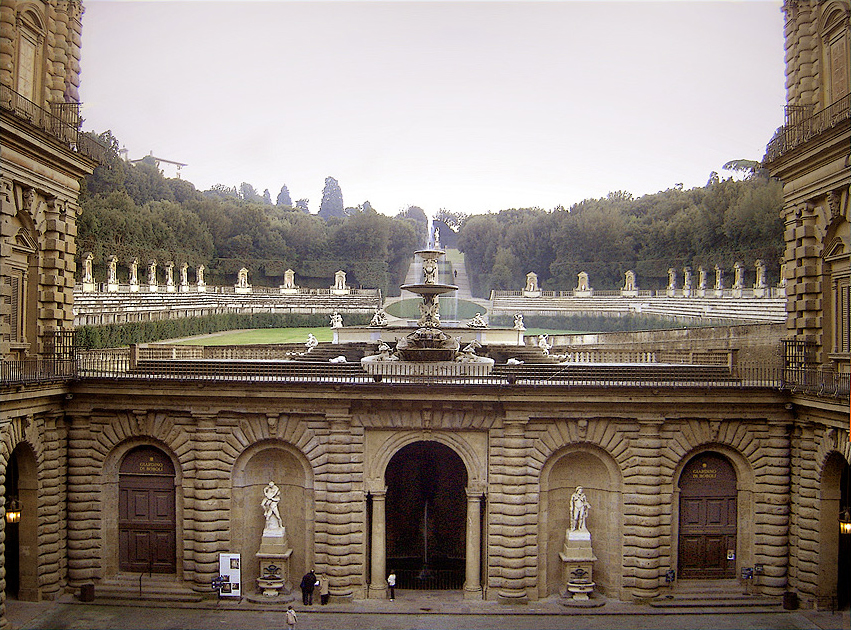
The Boboli Gardens are a 45,000-square-metre Medici garden laid out behind the Pitti Palace in Florence from 1549, conceived for Eleonora di Toledo, wife of Cosimo I de’ Medici. Carved into the hillside as a sequence of axial avenues, terraces, grottoes and water features, they are among the earliest fully formal Italian gardens and established the model that influenced aristocratic gardens across Europe for two centuries. Together with the historic centre of Florence they have been inscribed on the UNESCO World Heritage List since 1982 and are today administered by the Gallerie degli Uffizi.
- Address
- Piazza de' Pitti 1, 50125 Firenze FI
- Period
- Begun 1549 by Eleonora di Toledo and Cosimo I de' Medici
- Designers
- Niccolò Tribolo (initial layout); Bartolomeo Ammannati, Bernardo Buontalenti, Giulio and Alfonso Parigi (later phases)
- Function
- Princely garden of the Pitti Palace, Medici grand-ducal residence
- Current use
- Operated by the Gallerie degli Uffizi; UNESCO World Heritage Site (Centro Storico Firenze, 1982)
- Coordinates
- 43.7625° N, 11.2486° E
- Notes
- Houses Giambologna's Oceanus fountain (1576) on the Isolotto and the Grotta del Buontalenti (1583–1593)
Gallery
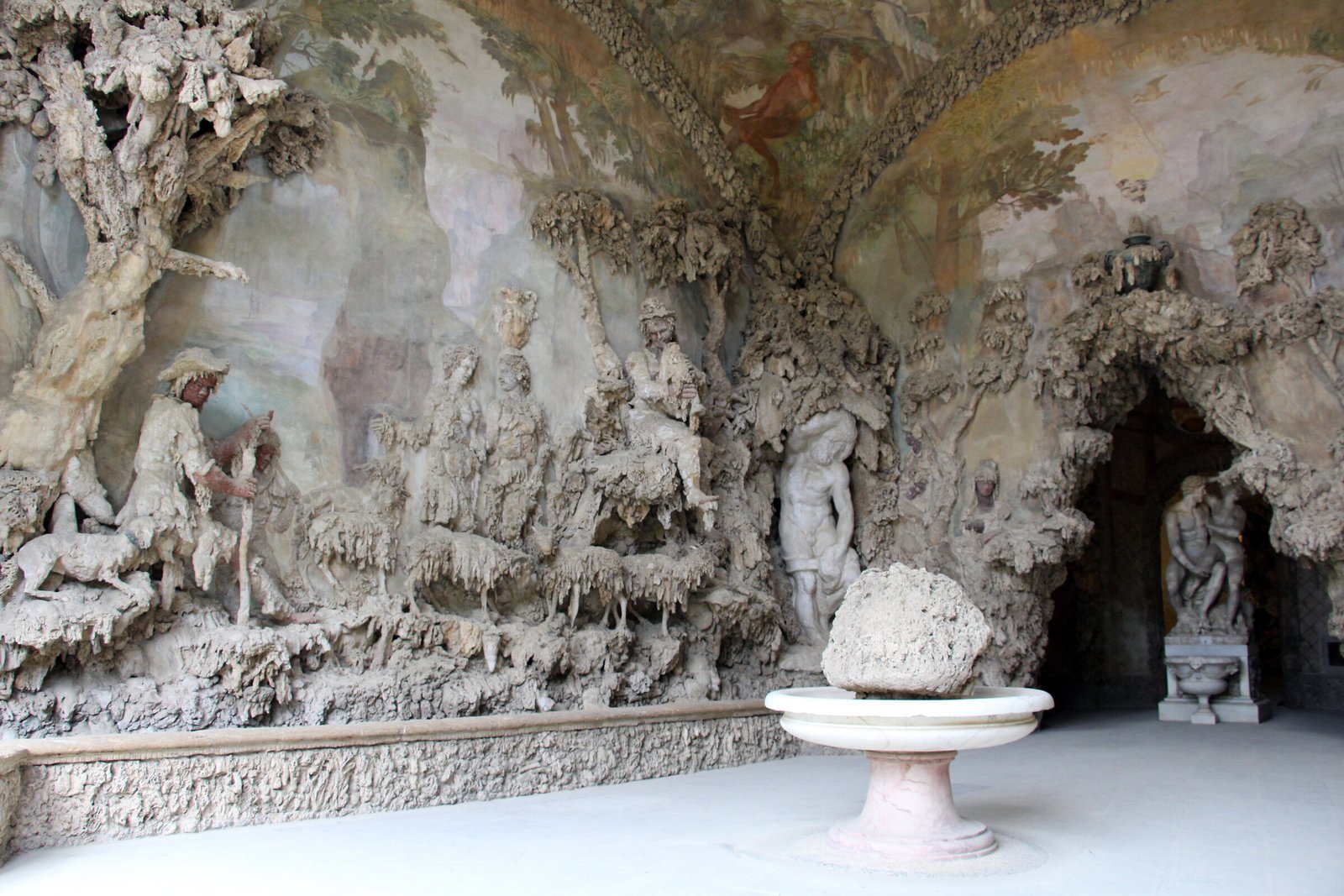
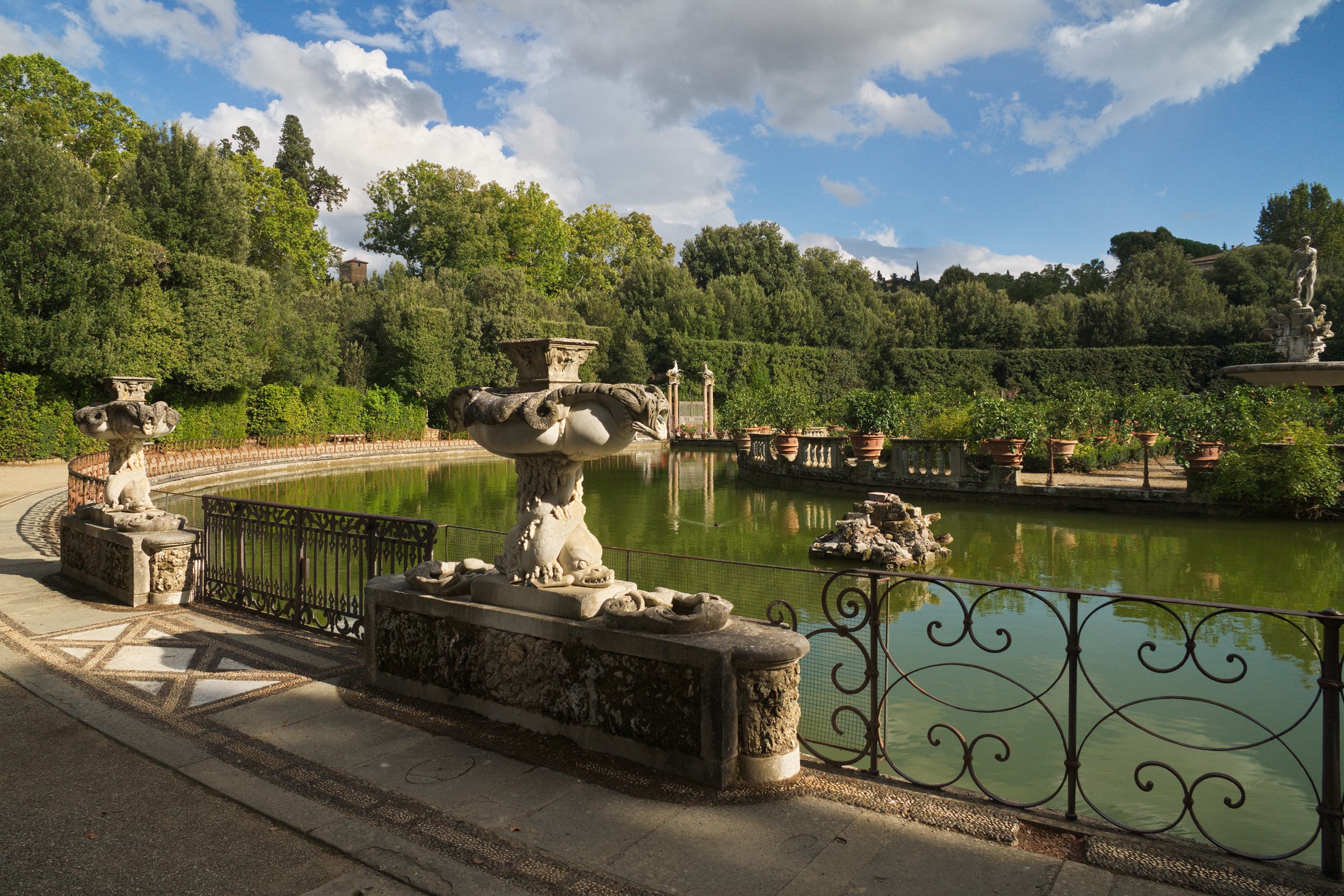
Two of the set-pieces that shaped the Italian garden tradition: Buontalenti’s grotto courtyard and the Isolotto with Giambologna’s Oceanus.
Visit on the map
Piazza de’ Pitti 1 · 43.7625° N, 11.2486° E
Download for your navigator
A single waypoint, ready for GPS apps, navigators, and contacts.
The garden takes its name from the hillside acquired in 1549 by Eleonora di Toledo, wife of Cosimo I de’ Medici, when she bought the unfinished Pitti Palace from the Pitti family. Cosimo commissioned the sculptor and architect Niccolò Tribolo to lay out the grounds, but Tribolo died the following year. Work continued under Bartolomeo Ammannati, with contributions from Giorgio Vasari, on a steep site that climbs from the rear of the palace up to the line of the city walls towards the Forte Belvedere. The first stage produced the long primary axis behind the palace and the deep amphitheatre, dug into the hillside in the shape of a half-hippodrome.
Between 1583 and 1593 Bernardo Buontalenti completed the Grotta Grande, a three-chamber mannerist grotto whose first room was conceived as an artificial cave for shepherds and originally held Michelangelo’s Prisoners — long since transferred to the Galleria dell’Accademia and replaced on site by copies — while inner rooms display Giambologna’s Bathing Venus. Under Giulio and Alfonso Parigi the garden was extended in the early seventeenth century along a long secondary axis, the Viottolone, a corridor of cypresses descending to the Isolotto: an oval island in a tree-enclosed pond, laid out around 1618 to host Giambologna’s Oceanus fountain (1576), transferred there from the amphitheatre. The amphitheatre itself, initially an earth-and-hedge enclosure, was rebuilt in stone and centred on the Ancient Egyptian Boboli obelisk brought from the Villa Medici in Rome.
After the extinction of the Medici line in 1737 the gardens passed with the grand duchy to the House of Lorraine, who opened parts of the grounds to the public in the late eighteenth and nineteenth centuries. Successive campaigns brought the site to its present extent of about 45,000 square metres, organised as an open-air museum of garden sculpture spanning Roman antiquities and Renaissance and Baroque works. The Boboli Gardens are today managed by the Gallerie degli Uffizi together with the Pitti Palace and accessed on a combined ticket; they were included in the UNESCO World Heritage listing of the historic centre of Florence in 1982 and remain the reference example of the giardino all’italiana that shaped formal garden design from Versailles to Vienna.
Resources & References
Editorial picks across Wikipedia, photo archives, and the official portal.
All photographs Wikimedia Commons (CC-BY / CC-BY-SA / Public Domain) unless otherwise stated. Editorial text Cultural Heritage Online, OASIS Tech LLC USA.
Plan your visit
Open to visitors year-round; check local tourism offices for seasonal hours, admission fees, and guided tour availability. GPS coordinates: 43.7642112, 11.2524255.
Find it on the map
See this place and what’s around it →📷 Become a Cultural Heritage Online photographer
Share your photos of places: they stay published under your name as the author. The more they're seen, the more you get noticed — and soon a contest will reward the most appreciated photos.
Log in or sign up free to add a photo