
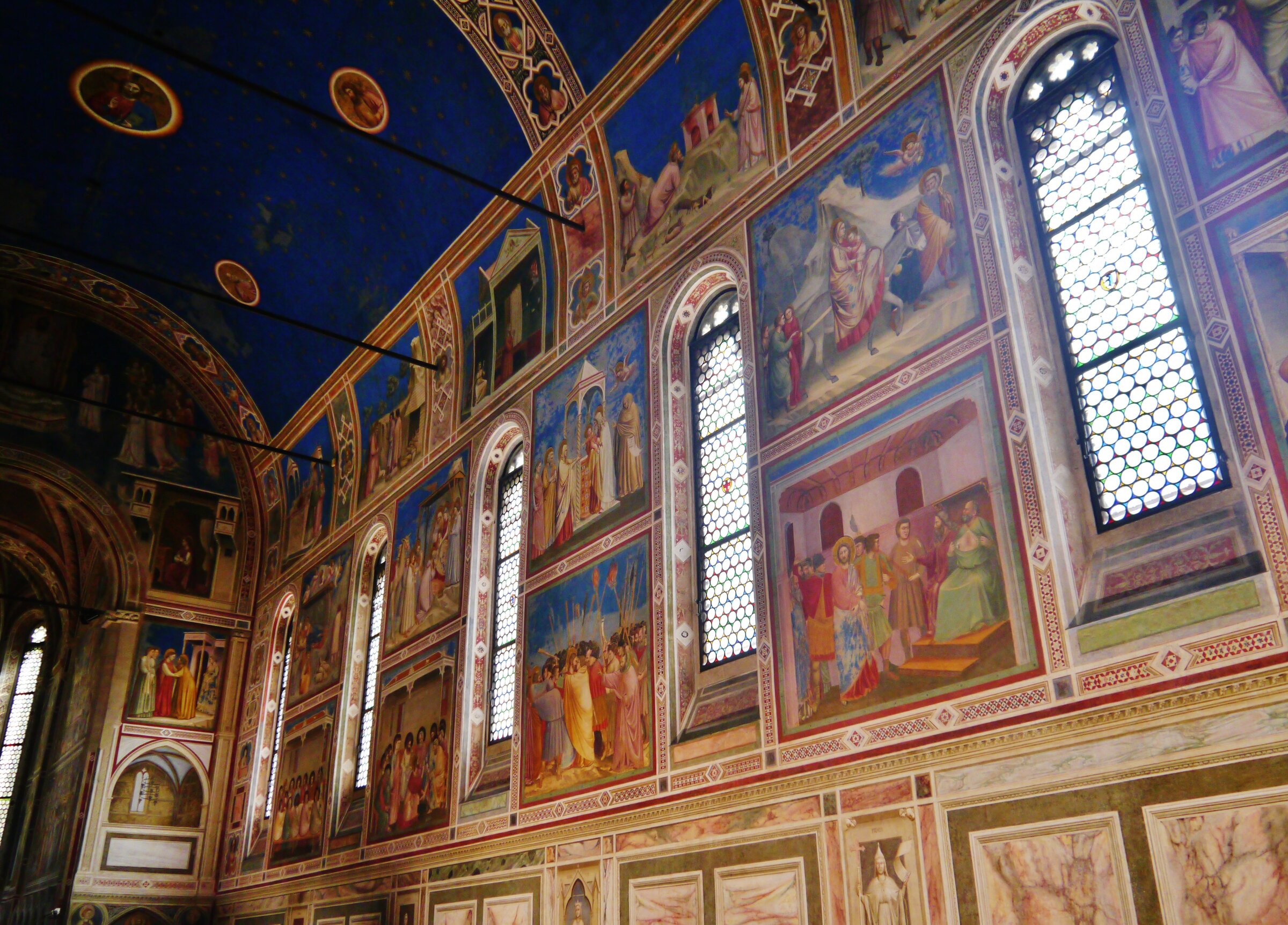
Between 1303 and 1305 the Florentine painter Giotto di Bondone covered every interior surface of the Scrovegni Chapel in Padua with a unified fresco cycle commissioned by the banker Enrico Scrovegni. Thirty-eight narrative episodes drawn from the lives of Joachim and Anna, the Virgin Mary and Christ unfold across three tiers, closed on the western wall by a vast Last Judgment in which the patron himself kneels offering the chapel to three Marian intercessors. In 2021 the cycle was inscribed by UNESCO as part of ‘Padua’s fourteenth-century fresco cycles’, a serial site of eight buildings known collectively as Padova Urbs Picta.
- Address
- Piazza Eremitani 8, 35121 Padova PD
- Period
- Land purchased 1300; chapel first consecrated 25 March 1303; Giotto fresco cycle 1303–1305; definitive consecration 25 March 1305
- Patron
- Enrico degli Scrovegni, Paduan banker
- Painter
- Giotto di Bondone, with a workshop of about forty collaborators
- Function
- Originally private oratory and intended funerary monument of the Scrovegni family, annexed to their palace on the site of the Roman arena
- Current use
- Museum visit under climate-controlled access (15-minute viewing slots preceded by a 15-minute dehumidification vestibule); part of Musei Civici di Padova; UNESCO World Heritage Site 2021 (Padua's fourteenth-century fresco cycles)
- Coordinates
- 45.4117° N, 11.8800° E
- Notes
- 38 narrative episodes; allegories of the Virtues and Vices in grisaille; vast Last Judgment on the western counter-façade with the donor portrait of Enrico Scrovegni
Gallery
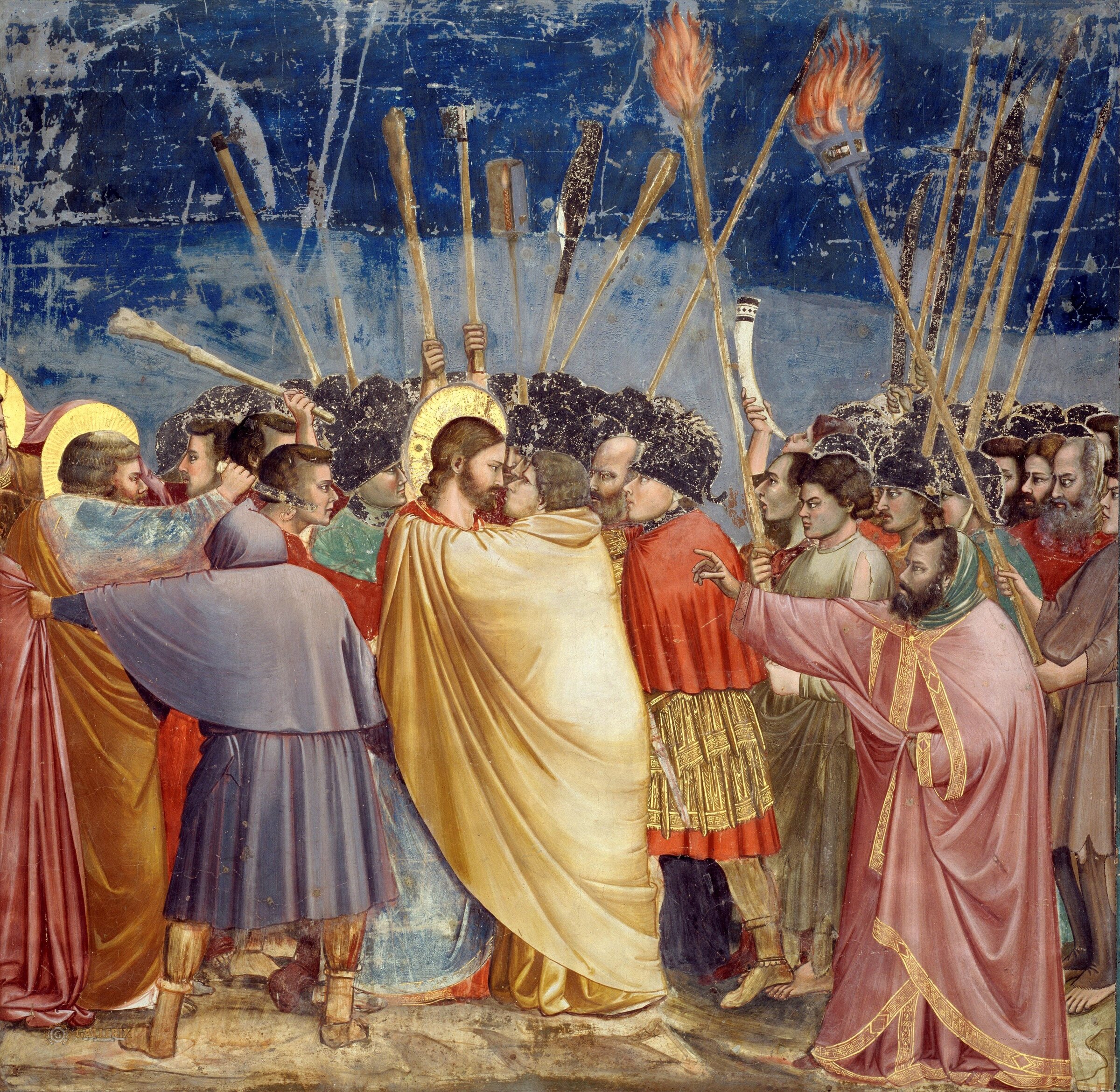
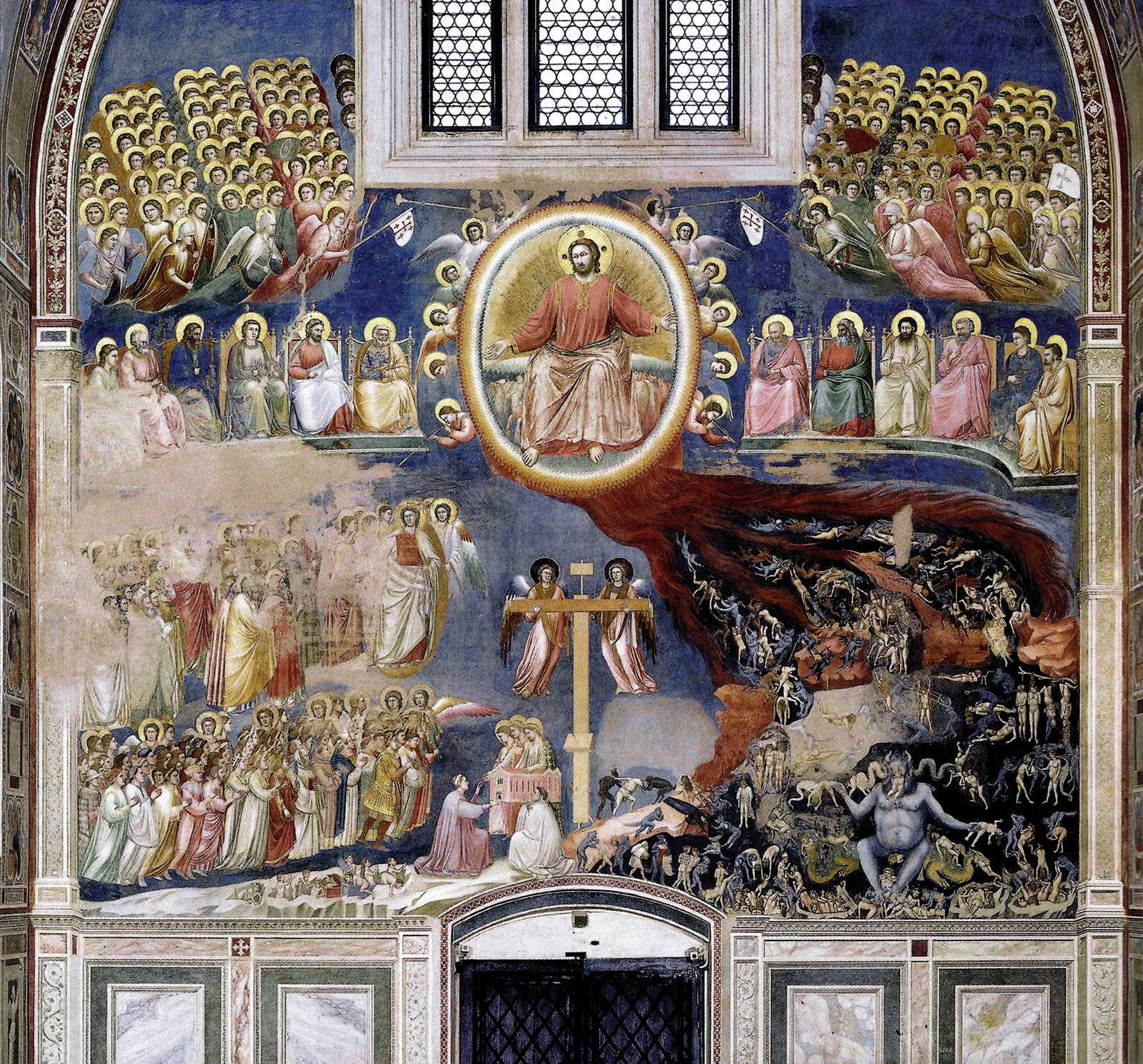
Two scenes from the cycle that anchor the visual programme: the dramatic close-up of the Kiss of Judas on the north wall, and the monumental Last Judgment that closes the chapel on the entrance wall and includes the donor portrait of Enrico Scrovegni.
Visit on the map
Piazza Eremitani 8 · 45.4117° N, 11.8800° E
Download for your navigator
A single waypoint, ready for GPS apps, navigators, and contacts.
The chapel rises on land Enrico degli Scrovegni purchased in February 1300 from Manfredo Dalesmanini — the elliptical footprint of the Roman arena of Padua, which gave the building its alternative name of Arena Chapel. Adjacent to a new family palace (demolished in 1827), the small church was conceived as a private oratory and as the funerary monument of the Scrovegni. The bishop of Padua authorised the building before 1302; first consecration followed on 25 March 1303, the feast of the Annunciation, and the definitive consecration on 25 March 1305. The project carried a personal weight: Enrico’s father, Reginaldo degli Scrovegni, had been placed by Dante among the usurers of the seventh circle of the Inferno, and the chapel is read by much of the scholarship as an act of expiation as much as of private devotion.
Giotto, then about thirty-six years old and already working in Padua for the Basilica of Saint Anthony, frescoed the entire interior with a workshop of around forty collaborators across an estimated 625 working days. The iconographic programme — devised, according to Giuliano Pisani’s reading, by the Augustinian theologian Friar Alberto da Padova — runs in three narrative tiers around the nave: the lives of Joachim and Anna, then the life of the Virgin Mary, then the life of Christ, for a total of thirty-eight episodes. Below the narrative scenes a lower band carries fourteen allegories of the Virtues and Vices in grisaille. The barrel vault is painted as a deep lapis-lazuli sky scattered with gold stars and medallions of Christ, the Virgin and the prophets. The western counter-façade is entirely occupied by a vast Last Judgment, at the foot of which Enrico Scrovegni is portrayed kneeling, offering a model of the chapel to three Marian intercessors.
Stylistically the cycle marks the visual passage from the Byzantine manner toward the early Renaissance: Giotto articulates three-dimensional space, gives weight and anatomy to his figures, and stages emotionally legible narrative compositions such as the Lamentation and the Kiss of Judas. After two decades of preparatory study, the Istituto Centrale per il Restauro carried out the definitive cleaning campaign of the frescoes between June 2001 and March 2002 under the direction of Giuseppe Basile; the same intervention installed the Corpo Tecnologico Attrezzato, a climate-controlled vestibule in which visitors wait fifteen minutes for body humidity and airborne particulate to be filtered out before entering the chapel for a further fifteen-minute viewing slot. In 2021 UNESCO inscribed the chapel as part of ‘Padua’s fourteenth-century fresco cycles’, a serial World Heritage Site of eight buildings — among them the Baptistery of the Cathedral, the Palazzo della Ragione, the Oratory of San Michele and the Oratory of San Giorgio — promoted under the name Padova Urbs Picta.
Resources & References
Editorial picks across Wikipedia, photo archives, and the official portal.
All photographs Wikimedia Commons (CC-BY / CC-BY-SA / Public Domain) unless otherwise stated. Editorial text Cultural Heritage Online, OASIS Tech LLC USA.
Plan your visit
Open to visitors year-round; check local tourism offices for seasonal hours, admission fees, and guided tour availability. GPS coordinates: 45.41182410759192, 11.87945544719696.
Find it on the map
See this place and what’s around it →📷 Become a Cultural Heritage Online photographer
Share your photos of places: they stay published under your name as the author. The more they're seen, the more you get noticed — and soon a contest will reward the most appreciated photos.
Log in or sign up free to add a photoIs this page about you?
This page is read by travellers and heritage enthusiasts who find it on Google. Tell us how you are connected to this place and we will take it from there.