
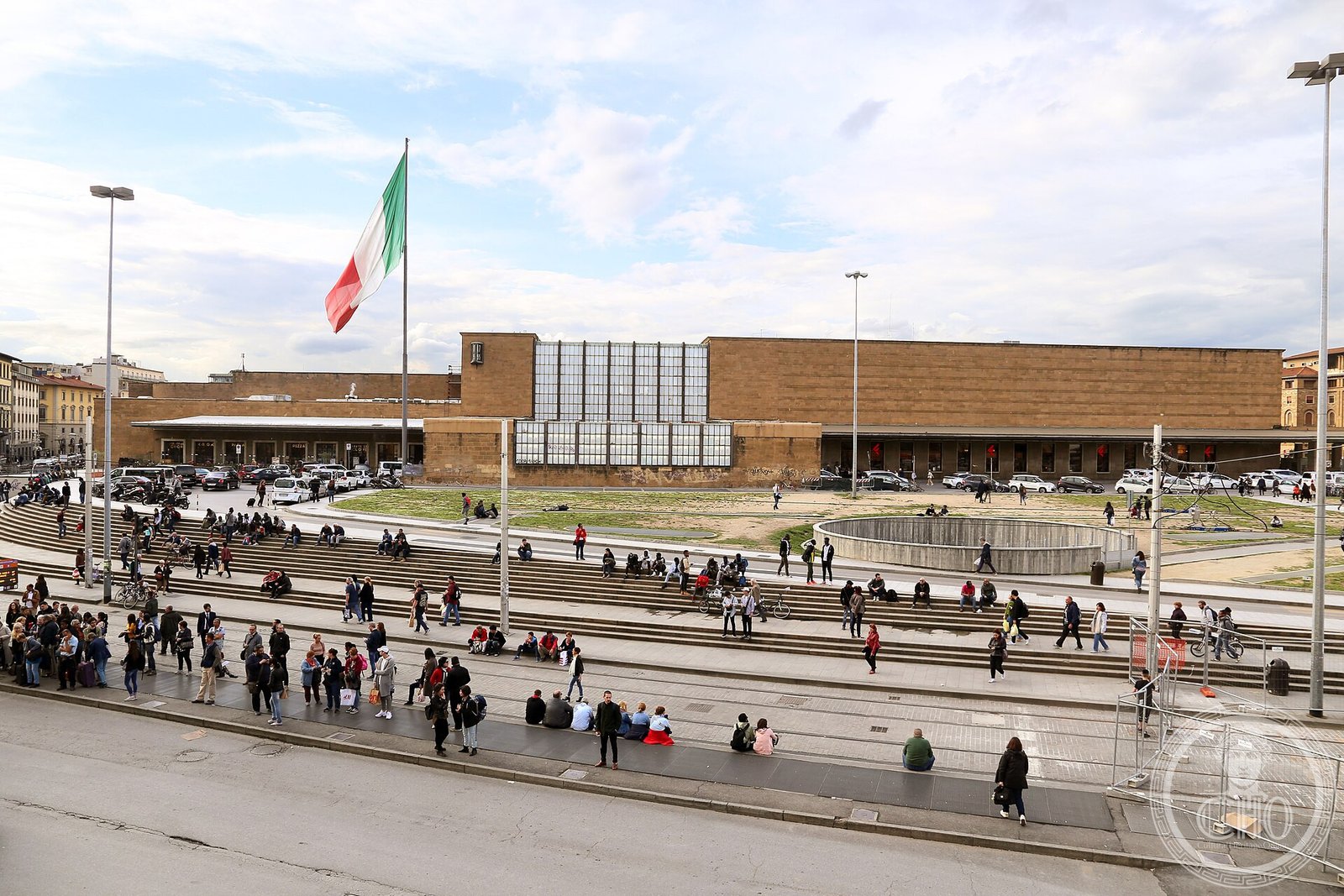
Florence is synonymous with the Renaissance — yet it gave Italy one of its most important modern buildings: the Santa Maria Novella station (1935), where Giovanni Michelucci demonstrated that Rationalism could be horizontal, tactile and deeply embedded in its setting, without competing with the Gothic church it faces across the piazza.
At a glance
Florence’s contribution to the CHO period is concentrated at two ends of the temporal spectrum. In 1882, the Great Synagogue of Florence opened in Via Farini, east of the Duomo — a magnificent eclectic-Moorish structure that documents the Belle Époque’s appetite for orientalist ornament in a city that rarely permitted anything foreign to its Renaissance fabric. In 1935, the Stazione di Santa Maria Novella, designed by the Gruppo Toscano under Giovanni Michelucci’s leadership, placed a horizontal slab of stone, steel and glass directly opposite Alberti’s fifteenth-century church facade — and made it work. Pier Luigi Nervi’s Stadio Artemio Franchi (1931) and Michelucci’s later Chiesa dell’Autostrada del Sole (1964) complete the picture of a city that engaged with modernity selectively but with extraordinary quality when it chose to do so.
Key facts
- Country: Italy (Toscana)
- Key periods: Eclettico moresco (1880s); Razionalismo (1930s); Architettura organica (1960s)
- Key figure: Giovanni Michelucci (1891–1990) — architect of the SMN station, the Chiesa dell’Autostrada and numerous civic buildings
- Also notable: Pier Luigi Nervi (Stadio Franchi), the Architettura Radicale movement (Superstudio, Archizoom, founded Florence 1966)
- UNESCO heritage: Historic Centre of Florence (World Heritage since 1982)
- Essential sites: Stazione SMN, Stadio Artemio Franchi, Sinagoga Grande, Fortezza da Basso, Cinema La Compagnia (Natalini)
History
Giovanni Michelucci was born in Pistoia in 1891 and trained as an architect in Florence. He came to national prominence as the leader of the Gruppo Toscano, which won the 1932–33 competition for the new Santa Maria Novella station with a project that was simultaneously the most radical and the most contextual of the submissions: a single horizontal structure clad in pietra forte, with no ornament and no historical quotation, that acknowledged the Gothic church across the piazza by refusing to compete with it in height or decoration. The building opened in 1935 and remains in daily use as Florence’s main station.
Pier Luigi Nervi’s Stadio Artemio Franchi, designed from 1929 and built in two phases between 1930 and 1933, predates the station and is, if anything, more structurally adventurous: its exposed reinforced concrete — the cantilevered roof over the main stand, the helical staircases, the 55-metre Marathon Tower — turns structural engineering into architectural expression. The original Nervi structure is protected by the heritage superintendency. The Cinema La Compagnia (Via Cavour 50r), radically redesigned by Adolfo Natalini of Superstudio in 1987, connects Florence’s Rationalist inheritance to the Postmodern moment in a building that uses pietra serena — the grey sandstone of Brunelleschi — as a contemporary material.
The Architettura Radicale movement was founded in Florence in the late 1960s by groups including Superstudio and Archizoom: a critique of the modern movement’s social optimism in the form of ironic megastructure proposals and utopian anti-architecture manifestos. Superstudio’s Continuous Monument (1969) — a reflective grid-surfaced slab extending across every landscape — became the most influential architectural provocation of its generation. Its founders, including Adolfo Natalini and Cristiano Toraldo di Francia, continued to practise in Florence into the 2000s.
What you see
The Santa Maria Novella station is the most accessible Michelucci building: it is Florence’s main transport hub, entered and exited by millions of visitors each year. Stand at the far end of the departure hall to appreciate the full length of the glass-and-steel roof and the stone walls. The Stadio Artemio Franchi (Viale Manfredo Fanti 4) is best read from the outside: walk round the ground to see the helical concrete staircases and the Marathon Tower.
The Great Synagogue of Florence (Via Luigi Carlo Farini 4) opens for guided tours and is freely visible from the street; its green copper dome stands out on the city skyline seen from the hills. The Cinema La Compagnia (Via Cavour 50r) screens films and hosts festivals — Natalini’s pietra serena interior is experienced most effectively during an evening screening or during Firenze Archeofilm in March. The Palazzo dei Congressi (Viale Filippo Strozzi, Spadolini 1969) and the Fortezza da Basso (Sangallo 1534) are both readily accessible; see their individual CHO cards for detail.
Practical information
- Stazione SMN: always accessible as a functioning station; free
- Stadio Franchi: exterior visible at any time from Viale Manfredo Fanti; inside on match days and events
- Sinagoga: open Sun–Fri for guided tours; firenzebraica.it
- Cinema La Compagnia: screening programme at cinemalacompagnia.it
- Firenze Card: covers 72 museums in 72 hours including the Uffizi and Accademia
- Time needed: half-day for SMN + Franchi; full day adding Sinagoga, Fortezza, Compagnia
Getting there
Florence Peretola Airport (FLR) is 5 km northwest; a tram line T2 connects it to SMN station in 20 minutes. Pisa Airport (PSA, 80 km) is served by Pisa Centrale–SMN direct trains (1h). From SMN, the historic centre is a 10-minute walk. High-speed trains connect Florence to Rome (1h30), Bologna (35 min), Milan (1h45) and Venice (2h15).
Related in CHO
- Palazzo dei Congressi — Firenze (existing CHO card ID 9973)
- Fortezza da Basso — Firenze (existing CHO card ID 9999)
- Cinema La Compagnia — Firenze (existing CHO card ID 9975)
- Roma — Liberty Romano e EUR
- Bologna — Liberty, Razionalismo e Portici UNESCO
Sources
Find it on the map
See this place and what’s around it →Record researched and written by Stefano Vigolo for Cultural Heritage Online, 2026.
Events here — now on & upcoming
- Death Anniversary: Pietro Annigoni — October 28, 198828 Oct 2026See the event →
- Birth Anniversary: Luca Alinari — October 27, 194327 Oct 2026See the event →
- Death Anniversary: Luca Alinari — March 15, 201915 Mar 2027See the event →
📷 Become a Cultural Heritage Online photographer
Share your photos of places: they stay published under your name as the author. The more they're seen, the more you get noticed — and soon a contest will reward the most appreciated photos.
Log in or sign up free to add a photo