
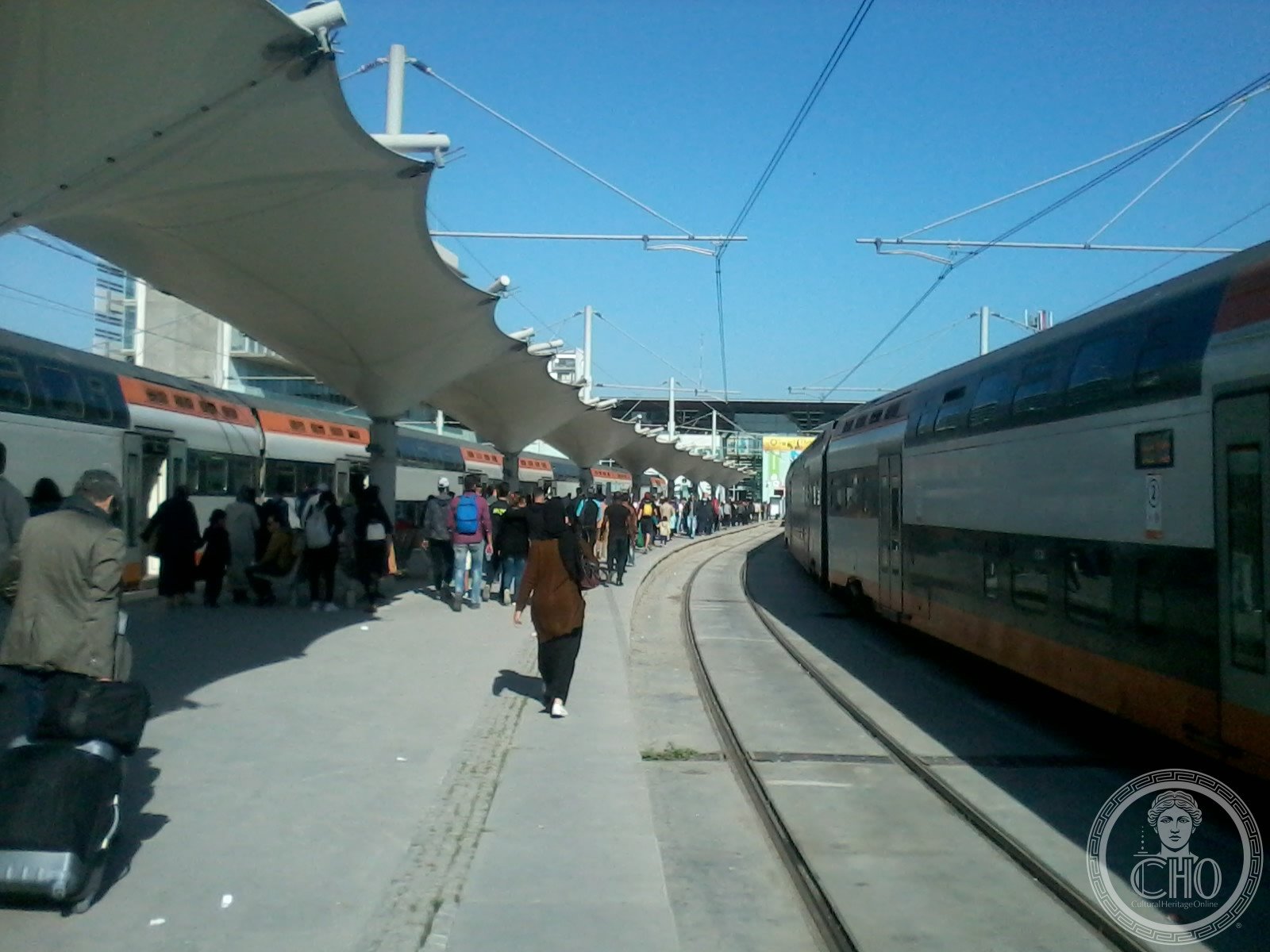
The Gare de Casablanca-Port, known in English as Casa-Port railway station, is one of the principal railway termini of Casablanca, Morocco, located in the Sidi Belyout district adjacent to the city’s historic port. Built during the French Protectorate period in the 1920s, the station presents a handsome Art Déco colonial facade that blends European modernist geometry with decorative Moroccan references. As both an active transport hub and an architectural landmark, it anchors one of Casablanca’s most historically layered neighbourhoods, where the old medina, the European quarter, and the working port converge. The station remains an entry point for travellers arriving by suburban and regional train services operated by the national railway company ONCF.
At a glance
- Type
- Railway terminal / Public building
- Period
- French Protectorate era, 1920s
- Style
- Art Déco Colonial
- Location
- Sidi Belyout district, Casablanca, Morocco
- Coordinates
- 33.5992° N, 7.6119° W
- Operator
- ONCF (Office National des Chemins de Fer du Maroc)
Overview
Casa-Port station serves as one of two main railway termini in Casablanca alongside Casa-Voyageurs. Positioned close to the port and the historic centre, it primarily handles suburban and regional trains including the Train Navette Rapide (TNR) service that connects Casablanca with Kenitra and other Atlantic coast cities. The station building, with its characteristic interwar facade, is part of the broader architectural legacy of French urban planning in Casablanca, a city that became one of the most intensively redeveloped colonial metropolises in Africa during the first half of the twentieth century.
History
Railway infrastructure in Casablanca developed rapidly under the French Protectorate after 1912, as France sought to connect its Atlantic port city to the interior of Morocco and to the wider North African rail network. The station at the port end of the city was constructed during the 1920s to serve the growing volume of freight and passenger traffic generated by Casablanca’s explosive commercial expansion. Over the following decades, the station was integrated into the national ONCF network that emerged after Moroccan independence in 1956. Subsequent modernisation works have updated the operational infrastructure while the original Protectorate-era building fabric has been retained as a heritage asset.
Architecture & Design
The station facade embodies the Art Déco colonial idiom that French architects and public works engineers applied to institutional buildings across Morocco during the interwar period. Characteristic elements include a symmetrical composition organised around a central portal, horizontal banding contrasting with vertical accents, and restrained geometric ornamentation. As was common in Protectorate-era buildings, the design incorporates decorative references to Moroccan and Islamic architectural traditions, such as arched window openings and patterned tile or stone infill, negotiating a visual dialogue between European modernism and local context. The result is a building that reads simultaneously as a functional transit hub and a civic monument.
Cultural significance
Casa-Port station is part of the remarkable concentration of interwar Art Déco architecture that makes Casablanca one of the most important repositories of this style outside Europe and the Americas. Together with the civic buildings of Place Mohammed V, the cinemas of the old European quarter, and the residential blocks of the Habous district, the station contributes to an urban landscape that has attracted growing international attention from architectural historians and heritage bodies. Its continuing use as a working railway station rather than a museum or commercial conversion gives it an authenticity that enhances its value as a living piece of the city’s built history. The colonial context of its construction is acknowledged by Moroccan heritage authorities as a complex but integral part of the national story.
Visiting today
Casa-Port is an operational railway station open to the public during service hours. Visitors can admire the exterior facade and the main concourse as working passengers. The surrounding Sidi Belyout neighbourhood, including the old medina and the seafront corniche, is within easy walking distance. The station is also a convenient base for exploring the Art Déco buildings concentrated in the nearby city centre. Rail travellers arriving from Kenitra, Rabat, or the airport express at Casa-Voyageurs can connect to Casa-Port via the TNR suburban service.
Getting there
Casa-Port station is itself a transport hub and the arrival point for ONCF suburban and regional trains. The Casablanca Tramway stops near the station, connecting it to the broader city network. Taxis are available outside the main entrance. From Mohammed V International Airport, take the Airport Express to Casa-Voyageurs and change to the TNR suburban line to reach Casa-Port. The station is approximately one kilometre north of Place Mohammed V, making it easily walkable for visitors exploring the Art Déco civic centre.
Sources & resources
Find it on the map
See this place and what’s around it →📷 Diventa un fotografo di Cultural Heritage Online
Condividi le tue foto dei luoghi: restano pubblicate con la tua firma come autore. Più vengono viste, più ti fai conoscere — e presto un concorso premierà le foto più apprezzate.
Accedi o registrati gratis per aggiungere una fotoDo you manage this place?
This page is read by travellers and heritage enthusiasts who find it on Google. Keep it accurate — and make it work for you. Free for non-profit heritage institutions.