
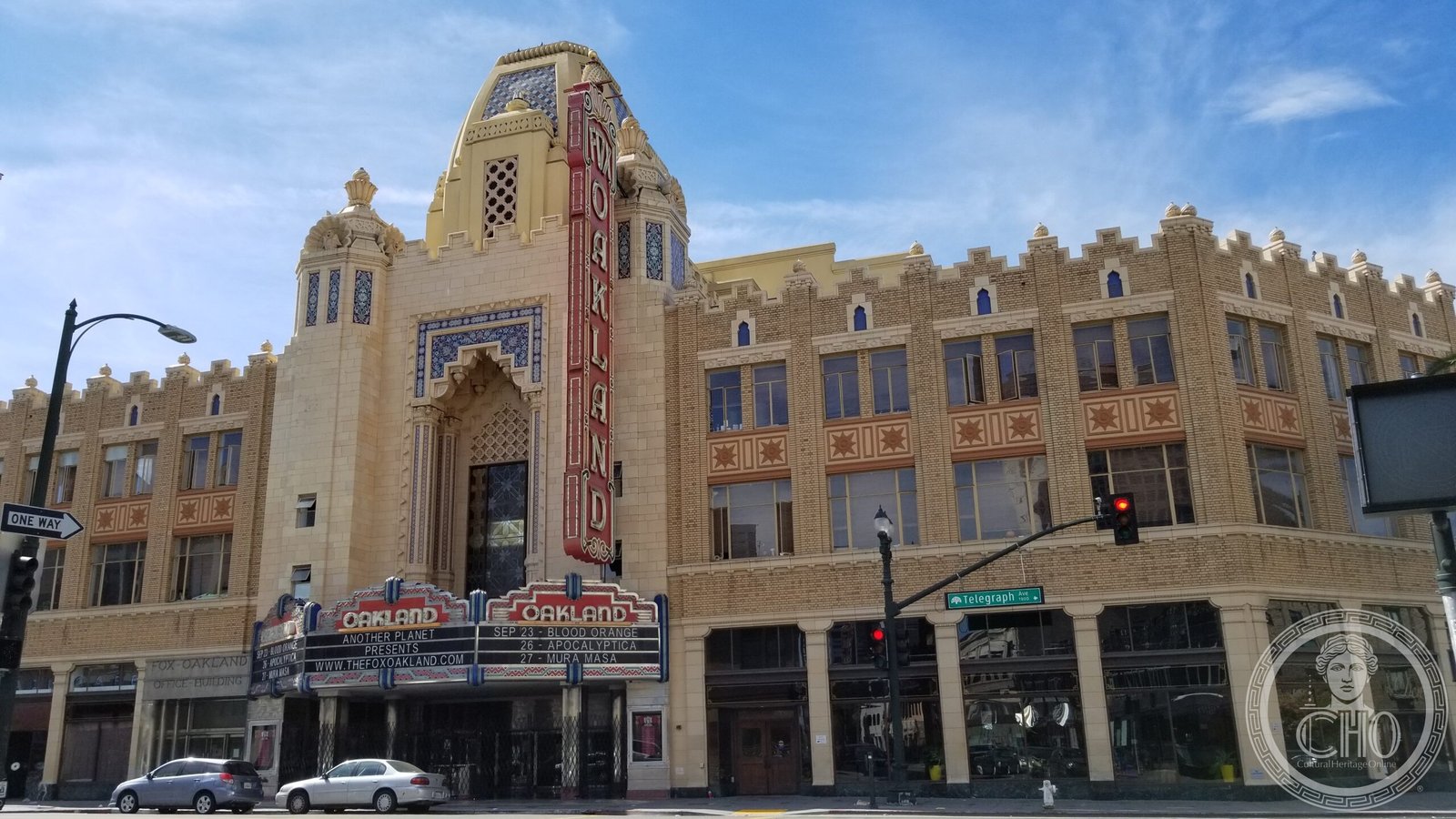
A grand Moorish atmospheric palace on Telegraph Avenue designed in 1928, closed for forty-three years and spectacularly restored in 2009 — the Fox Theater now anchors Oakland’s Uptown entertainment district as one of the Pacific Coast’s premier live music venues.
At a glance
The Fox Theater opened on Telegraph Avenue on 4 July 1928, one of the Fox West Coast Theatres circuit’s major commissions. The building’s interior — a Moorish fantasy of horseshoe arches, Arabic calligraphy panels, domed plaster ceilings and hand-painted wall murals — placed Oakland in the company of cities where the atmospheric style had reached its fullest expression. With approximately 2,800 seats, the Fox was the largest movie palace on the east side of the Bay at its opening. It closed in 1966 as suburban multiplex cinemas drew audiences from downtown. A 43-year closure followed, during which the building survived various demolition proposals, until Anschutz Entertainment Group launched a $75 million restoration in 2007 that returned it to life in February 2009 as a concert venue of the first rank.
Key facts
- Opened: 4 July 1928; restored and reopened February 2009
- Style: Moorish atmospheric — horseshoe arches, Arabic calligraphy ornament, hand-painted murals
- Capacity: approximately 2,800 seats
- Client: Fox West Coast Theatres
- Restoration cost: approximately $75 million (2007–2009), by AEG Live
- Address: 1807 Telegraph Avenue, Oakland, CA 94612
- GPS: 37.8053°N, 122.2716°W
- Status: National Register of Historic Places; active live music venue (AEG / Live Nation)
History
Fox West Coast Theatres operated dozens of movie palaces up and down the Pacific Coast in the late 1920s, and the Oakland Fox was among the most ambitious. Opening on Independence Day 1928, the building entered a city at the height of its early twentieth-century prosperity — Oakland’s port was competing vigorously with San Francisco’s, its downtown was dense with commerce, and its population had been growing rapidly since the post-earthquake influx of 1906.
The theatre presented first-run films through the golden age of Hollywood, adapting smoothly from silents to talkies in 1929 and continuing through the Depression. In the postwar period, as the suburban dispersal of American urban populations began to thin downtown cinema audiences, the Fox West Coast circuit’s theatres became less viable. The Oakland Fox closed in 1966, leaving the building in limbo. Various proposals over the following decades — including residential conversion and demolition — came and went without resolution.
The preservation breakthrough came in the 2000s when the City of Oakland, recognising the Fox as the anchor of a planned Uptown entertainment district, partnered with the developer to enable the restoration. Anschutz Entertainment Group invested approximately $75 million in a two-year project, working with preservation architects to restore the Moorish plasterwork, murals and historic fabric while upgrading the building for contemporary concert use. The reopening in February 2009, headlined by Los Lobos, launched a new chapter for the building and the surrounding neighbourhood.
What you see
The Telegraph Avenue facade is a composition in orange-yellow terracotta with Moorish geometric detail above the street-level arcade, surmounted by a large central window in an arched Moorish frame. The vertical FOX sign, in period neon lettering, rises above the roofline. The lobby transitions from a street-level arcade into an enclosed hall with Arabesque mosaic tile floors, Moorish archways and plaster screens derived from the Alhambra.
The auditorium is the building’s triumph: a high rectangular space in which every surface has been articulated as part of an imaginary Moorish palace courtyard. The side walls carry tiers of balconied windows — painted as if overlooking a garden below the star-filled sky of the ceiling. Arabic calligraphy panels run along the upper wall zone, each panel individually composed and gilded. The painted murals — restored in the 2009 campaign by specialist conservators — depict Moorish gardens, flowering plants and architectural vistas that extend the atmospheric illusion across every surface. The ceiling itself simulates an open-air sky in deepening blue, punctuated by plaster corbels in the form of Moorish stalactite niches.
Practical information
- Access: 1807 Telegraph Avenue, Oakland CA 94612 — in the Uptown district
- Events: active concert venue; tickets via AEG / Live Nation and the Fox Theater box office
- Transit: 19th Street BART station, one block east to Broadway then one block north
- Parking: surface lots on Broadway and Telegraph; BART park-and-ride at 19th Street station
- Time needed: 30 minutes for exterior exploration; 2.5–3.5 hours for an evening show
Getting there
The Fox Theater is the visual anchor of Oakland’s Uptown district on Telegraph Avenue, two blocks west of the 19th Street BART station — the same station that serves the Paramount Theatre Oakland two blocks to the northeast. From San Francisco, take the BART to 19th Street Oakland (about 12 minutes from Embarcadero). Oakland International Airport (OAK) is 8 miles south via I-880; San Francisco International (SFO) is 25 miles southwest. By car, the building is two blocks from the I-980 freeway at the 17th Street exit.
Nearby
- Paramount Theatre (1931) — Timothy Pflueger’s Art Deco masterpiece with monumental mosaic facade, two blocks northeast on Broadway — Oakland’s other great restored movie palace. See the CHO guide.
- 19th Street BART Station — One block east to Broadway, then one block north to 19th Street — connecting to all points in the Bay Area.
- Uptown Oakland — The restored entertainment district around the Fox includes restaurants, galleries and bars that have made the neighbourhood one of the most active in the East Bay.
- Oakland Museum of California — Comprehensive California history, art and natural history collections, four blocks south on Oak Street.
Sources
- Fox Theater Oakland official site — history and events information
- National Register of Historic Places nomination, Fox Theater, Oakland
- Oakland Tribune archives — 1928 opening and 2009 reopening coverage
- AEG Live press materials — $75 million restoration documentation
- Historic American Buildings Survey (HABS) documentation, Fox Theater Oakland
Find it on the map
See this place and what’s around it →📷 Become a Cultural Heritage Online photographer
Share your photos of places: they stay published under your name as the author. The more they're seen, the more you get noticed — and soon a contest will reward the most appreciated photos.
Log in or sign up free to add a photoIs this page about you?
This page is read by travellers and heritage enthusiasts who find it on Google. Tell us how you are connected to this place and we will take it from there.