
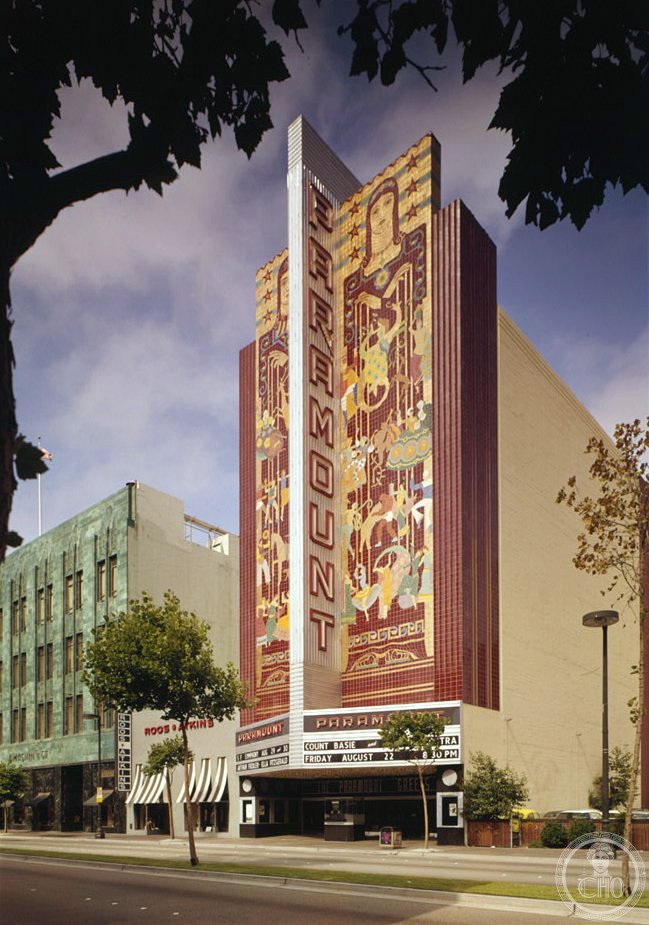
Timothy Pflueger’s 1931 masterpiece rises above Broadway with two monumental mosaic panels and an interior of gilded Art Deco splendour; the Paramount is one of the few American movie theatres designated a National Historic Landmark.
At a glance
Designed by Timothy Pflueger of the San Francisco firm Miller & Pflueger, the Paramount Theatre opened on 16 December 1931 to a Depression-era Oakland starved for spectacle. The building’s facade on Broadway is dominated by two vast mosaic panels — stylised human figures in gold, amber and terracotta tones, framed by vertical neon-lit pilasters — that announce the interior’s commitment to total Art Deco immersion. Inside, Pflueger placed gilded grillework, starburst ceiling medallions and backlit onyx panels across a 3,476-seat auditorium that remains among the finest intact movie palaces in the United States. Acquired for $1 in 1972 and restored over 14 months, it reopened in 1973 as one of the first historic theatre restorations in American history, a model that influenced the preservation movement nationally.
Key facts
- Opened: 16 December 1931, Oakland, California
- Architect: Timothy Pflueger, Miller & Pflueger (San Francisco)
- Style: Art Deco — geometric facade, monumental mosaics, gilded interior
- Capacity: 3,476 seats
- Facade mosaics: designed by Anthony Heinsbergen, depicting stylised human figures in gold and amber
- Address: 2025 Broadway, Oakland, CA 94612
- GPS: 37.8073°N, 122.2701°W
- Status: National Register of Historic Places (1977); National Historic Landmark (1981); home of Oakland East Bay Symphony
History
When the Paramount opened in December 1931, the United States was twenty-six months into the Great Depression and Oakland’s commercial district was contracting. The Fox West Coast Theatres chain, which commissioned the building, was betting that an extraordinary venue could draw audiences who might otherwise stay home. Pflueger delivered something extraordinary: a building whose exterior alone — two stories of backlit mosaic panels rising above the Broadway sidewalk — was worth crossing the Bay Bridge to see.
The theatre operated continuously through the 1930s and 1940s, then declined with the movie palaces of its era as suburban multiplexes drew audiences away from urban centres. The Paramount closed in 1970. Two years later the Oakland Symphony Association, searching for a permanent concert hall, purchased the derelict building from Paramount Pictures for a symbolic dollar. A $1 million restoration — painstaking in its attention to original materials and craftwork — returned the building to public life in September 1973. The reopening launched a national conversation about the viability of historic theatre restoration that continues today.
In 1977 the Paramount was listed on the National Register of Historic Places; in 1981 it became one of only a handful of movie theatres in the country designated a National Historic Landmark, reflecting its architectural and cultural significance. The Oakland East Bay Symphony now calls it home, alongside the Oakland Ballet and touring Broadway productions.
What you see
The Broadway facade is structured like a triumphal arch framed by two tall mosaic panels, each depicting a central figure surrounded by stylised foliage and geometric borders. The mosaics — designed by Anthony Heinsbergen, the master decorator responsible for interiors across the American Southwest — use a palette of gold, amber, copper and ivory that glows at night under uplighting. The vertical PARAMOUNT sign, in the original period neon, bisects the facade vertically. Between the mosaic panels the entry canopy is a cascade of stepped chrome and glass.
Inside, the lobby ceiling is a grid of backlit glass squares in muted gold. The auditorium ceiling is an expansive starburst medallion radiating from a central rose, surrounded by secondary geometric fields. Gilded grillework sheathes the side walls at balcony level; the proscenium arch is framed by two towers of stacked ornament in bronze and ivory lacquer. Heinsbergen’s color system coordinates every surface: the greens, golds and umbers of the lobby become more saturated in the auditorium, deepening toward the stage.
Practical information
- Access: 2025 Broadway, Oakland CA 94612 — between 19th and 20th Streets
- Tours: guided tours offered on the first and third Saturdays of most months; tickets required
- Events: Oakland East Bay Symphony concerts, Broadway touring shows, film screenings; tickets via the Paramount’s box office
- Transit: 19th Street BART station, two blocks south on Telegraph Avenue
- Time needed: 1.5 hours for a guided tour; 2.5–3.5 hours for an evening performance
Getting there
The Paramount occupies the heart of downtown Oakland, one block south of the 19th Street BART station — making it one of the most transit-accessible major theatres in California. From San Francisco, the BART ride from Embarcadero to 19th Street Oakland takes approximately 12 minutes. San Francisco International Airport (SFO) is 25 miles southwest; Oakland International Airport (OAK) is 8 miles south via I-880. By car, the building is two blocks east of I-980 at the 17th Street exit. Street parking is limited; several garages operate within two blocks on Telegraph and Broadway.
Nearby
- Fox Theater Oakland (1928) — A second grand atmospheric theatre three blocks south on Telegraph Avenue, restored 2009; note the different Fox from the Detroit or St. Louis chain venues.
- Oakland Museum of California — Comprehensive California history, art and natural history collections, four blocks east on Oak Street.
- Jack London Square — Oakland’s historic waterfront district, 1 mile south via Broadway, with ferry connections to San Francisco.
- Lake Merritt — Urban lake and park at the edge of downtown; the neoclassical Camron-Stanford House (1876) overlooks the water three blocks from the Paramount.
Sources
- Paramount Theatre Oakland official site — tour and events information
- National Historic Landmark nomination, Paramount Theatre, Oakland, 1981
- Jeffrey Limerick et al., America’s Grand Movie Theaters (1988)
- Anthony Heinsbergen papers, UCLA Library Special Collections
- Oakland Tribune archives — opening night and 1973 restoration coverage
Find it on the map
See this place and what’s around it →📷 Become a Cultural Heritage Online photographer
Share your photos of places: they stay published under your name as the author. The more they're seen, the more you get noticed — and soon a contest will reward the most appreciated photos.
Log in or sign up free to add a photoIs this page about you?
This page is read by travellers and heritage enthusiasts who find it on Google. Tell us how you are connected to this place and we will take it from there.