
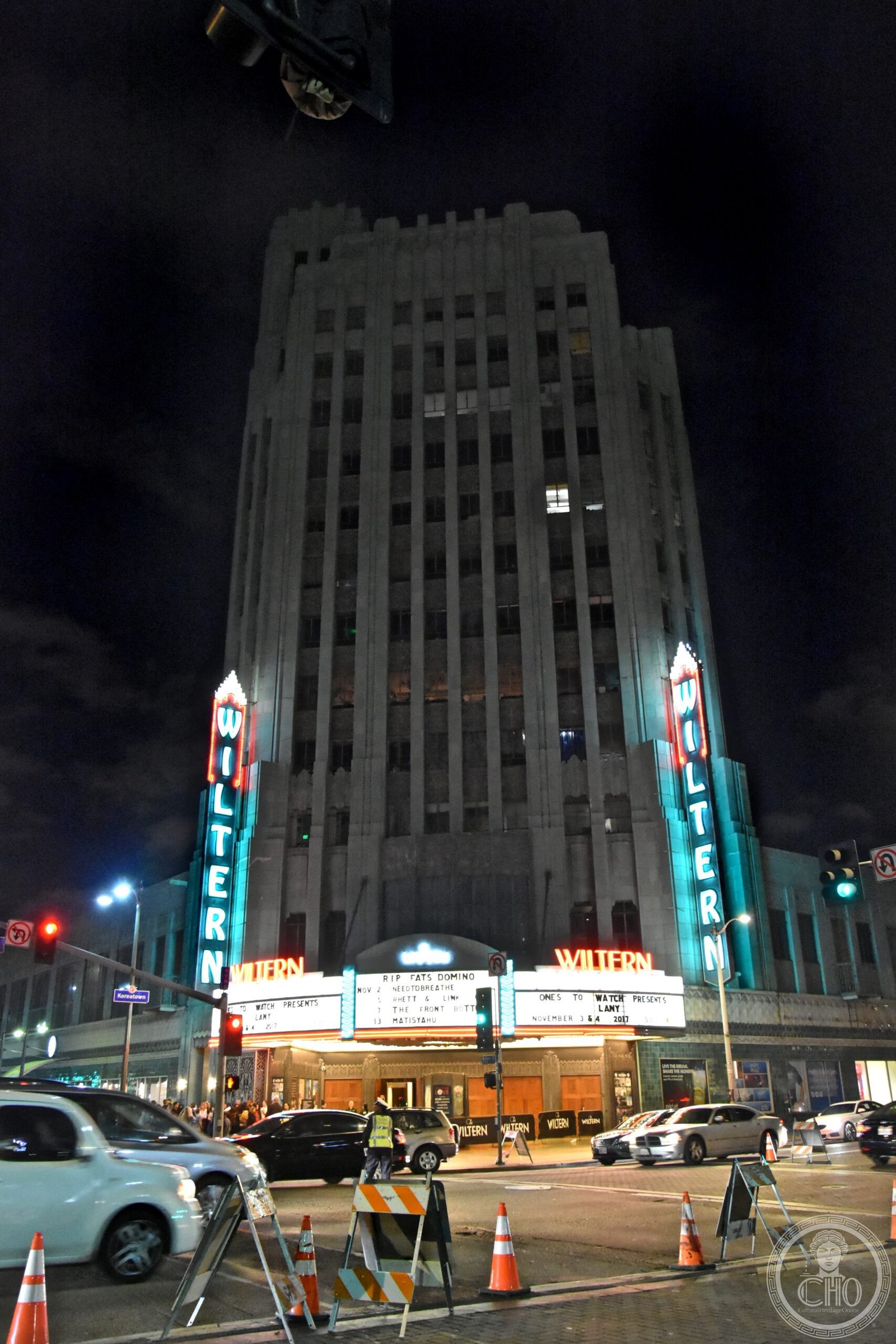
Morgan, Walls & Clements’ 1931 Pellissier Building is one of the most visually distinctive Art Deco structures in Los Angeles — its turquoise glazed terracotta skin and sunburst geometric ornament earning it recognition as an irreplaceable landmark of the Zigzag Moderne style.
At a glance
The building that houses the Wiltern Theatre was completed in 1931 at the corner of Wilshire Boulevard and Western Avenue in what was then one of Los Angeles’s most fashionable commercial corridors. Commissioned by the Pellissier family and designed by the prolific Los Angeles firm Morgan, Walls & Clements, the twelve-story structure combines an office tower with a theatre at its base — a vertical programming of uses that the Civic Opera House in Chicago had pioneered two years earlier. What sets the building apart is its exterior cladding: thousands of glazed terra cotta tiles in a distinctive blue-green turquoise, applied in geometric patterns of sunbursts and stepped pylons that catch light differently at every hour of the day. Closed and threatened with demolition in the 1970s, the building was restored and reopened as the Wiltern in 1985, taking its name from its Wilshire and Western intersection.
Key facts
- Completed: 1931 as the Pellissier Building; theatre portion opened as Warner Bros. Western Theatre
- Architect: Morgan, Walls & Clements, Los Angeles
- Style: Art Deco Zigzag Moderne — turquoise glazed terracotta, geometric sunburst ornament, stepped massing
- Building height: 12 stories
- Theatre capacity: approximately 1,850 seats
- Name origin: “Wiltern” = Wilshire + Western (the intersection)
- Address: 3790 Wilshire Blvd, Los Angeles, CA 90010
- GPS: 34.0595°N, 118.3090°W
- Status: Los Angeles Historic-Cultural Monument No. 171; NRHP listed; active concert venue
History
Wilshire Boulevard in 1931 was still evolving from a residential boulevard into the commercial “Miracle Mile” corridor that would define mid-twentieth-century Los Angeles. The Pellissier family, who owned the corner property, commissioned Morgan, Walls & Clements — the firm also responsible for the Mayan Theater (1927) on South Hill Street — to design a building that would capitalise on that evolution. The result was the most colour-saturated office tower in the city: twelve stories clad in turquoise terracotta, rising from a theatre that Warner Bros. equipped for talking pictures.
The Warner Bros. Western Theatre presented films through the Depression and the war years, then went through several name changes and programming shifts as the Wilshire corridor aged around it. By the 1970s the theatre was closed and the building’s future was in doubt. The Los Angeles Conservancy and local preservation advocates campaigned successfully for its designation as a Historic-Cultural Monument in 1980, and in 1985 a complete restoration by architect Brenda Levin returned the building to use. The renamed Wiltern quickly established itself as a mid-sized rock and pop concert venue, and today it is one of the most sought-after bookings in Southern California for artists in the 2,000-capacity range.
Morgan, Walls & Clements’ other major Art Deco commission — the Oviatt Building (1927) on Olive Street — provides the most direct comparison: the two buildings share the firm’s precise geometric vocabulary but take it in opposite colour directions, the Oviatt in black and gold, the Wiltern in turquoise and silver.
What you see
The corner composition is structured as a tower rising from a two-story theatre base, with the angle of Wilshire and Western treated as the building’s front door. The turquoise terracotta is the defining element: not a single uniform colour but a modulated range from deep teal at the base to pale aquamarine at the upper floors, applied in geometric patterns of raised ribs, sunburst medallions and stepped pylons. At street level the theatre entrance is framed by a triple arch of the same material, its spandrels filled with abstract foliate ornament in the Zigzag Moderne vocabulary.
Inside the theatre, the Deco geometry continues in the ceiling’s fan-vaulted plasterwork, originally in gold and ivory but restored in the 1985 renovation. The proscenium arch is framed by stepped pilasters that rise to meet a central geometric keystone; the side walls carry vertical sconces in chrome and frosted glass. The balcony is cantilevered without visible support columns — a structural expression of the same progressive confidence that distinguishes the exterior. Architect Brenda Levin’s 1985 work was careful to restore original surface treatments while upgrading acoustic and technical systems without obscuring the 1931 fabric.
Practical information
- Access: 3790 Wilshire Blvd, Los Angeles CA 90010 — corner of Wilshire and Western Ave, Koreatown
- Events: active live music venue; tickets via the Wiltern box office and major ticket platforms
- Transit: Metro Purple Line (D Line) Wilshire/Western station is at the building’s front door
- Parking: Metro park-and-ride at the station; street parking on Western Ave; commercial lots nearby
- Time needed: 30 minutes for exterior exploration; 2.5–3.5 hours for an evening concert
Getting there
The Wiltern’s most convenient approach is by Metro: the Purple Line (D Line) has a station directly below the building at Wilshire/Western, linking to downtown Los Angeles Union Station in 20 minutes and to Koreatown and Westwood. Los Angeles International Airport (LAX) is approximately 12 miles southwest — 25–40 minutes by car depending on traffic, or via the Metro Express Bus to the D Line. Hollywood is 4 miles north via Western Avenue. The Hollywood Freeway (US-101) is 3 miles north and east; the Santa Monica Freeway (I-10) is 2 miles south.
Nearby
- Oviatt Building (1927) — Morgan, Walls & Clements’ other major Art Deco Los Angeles commission — black steel and gold Art Deco — in downtown LA, 4 miles east. See the CHO guide.
- Koreatown — Los Angeles’s densest urban neighbourhood surrounds the Wiltern; the Korean Cultural Center at 5505 Wilshire is 1 mile east.
- Griffith Observatory (1935) — Art Deco observatory on the hillside above Hollywood, approximately 6 miles northeast — the city’s most visible landmark from street level.
- Pantages Theatre (1930) — B. Marcus Priteca’s Deco masterpiece on Hollywood Boulevard, home of the Tony Awards’ West Coast season, 5 miles northeast. See the CHO guide.
Sources
- Los Angeles Conservancy — Wiltern / Pellissier Building documentation
- Los Angeles Historic-Cultural Monument declaration No. 171
- National Register of Historic Places nomination, Pellissier Building / Wiltern Theatre
- Alison Martino, Vintage Los Angeles — Pellissier Building history
- Brenda Levin Associates — 1985 restoration project documentation
Find it on the map
See this place and what’s around it →📷 Become a Cultural Heritage Online photographer
Share your photos of places: they stay published under your name as the author. The more they're seen, the more you get noticed — and soon a contest will reward the most appreciated photos.
Log in or sign up free to add a photoIs this page about you?
This page is read by travellers and heritage enthusiasts who find it on Google. Tell us how you are connected to this place and we will take it from there.