
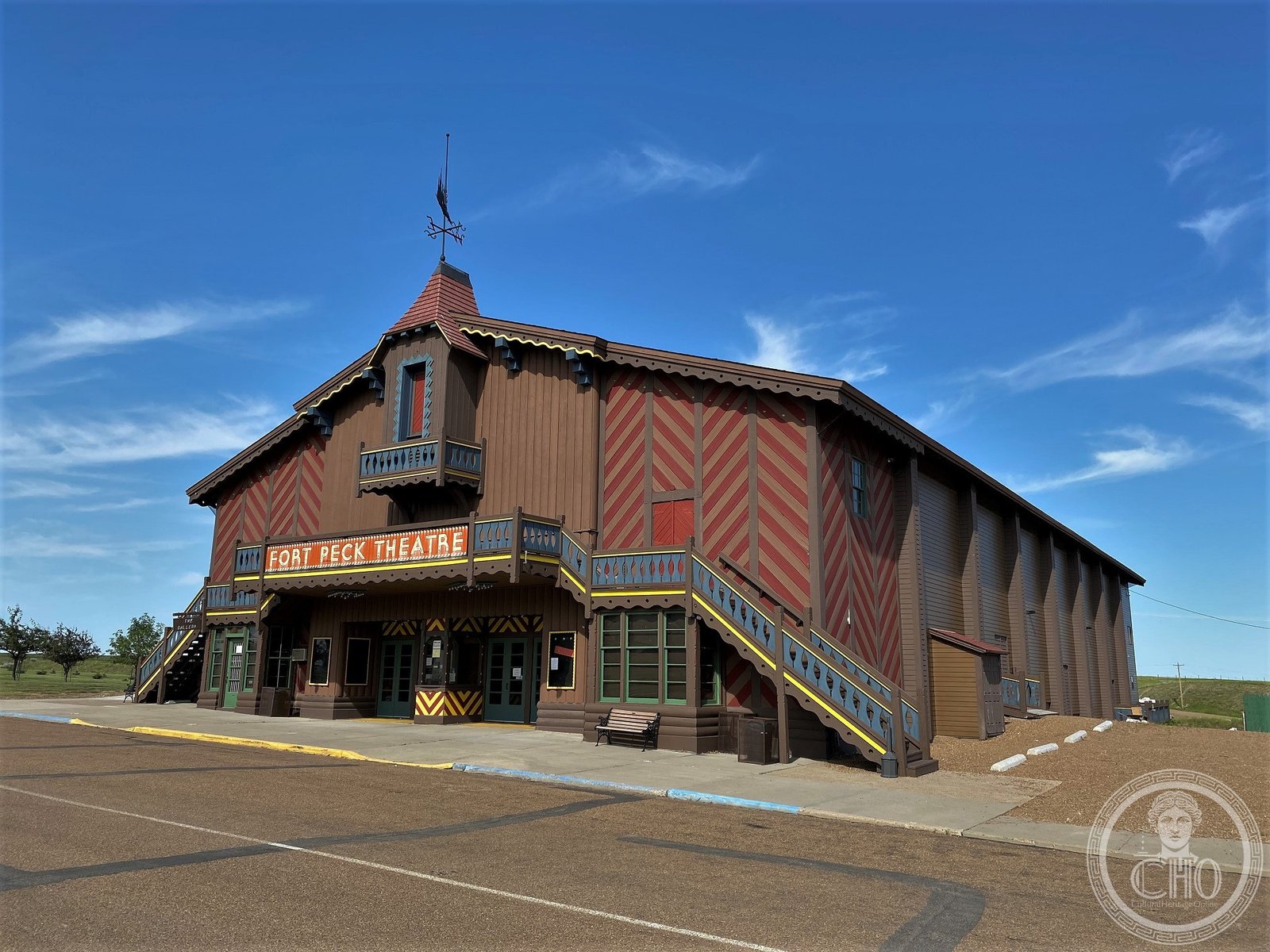
Built in 1934 for the workers constructing the Fort Peck Dam on the Missouri River, the Fort Peck Theatre is a rare surviving example of Art Deco workers’ architecture in the American West — a full-scale community theatre erected in a remote New Deal boomtown on the Montana prairie.
At a glance
The Fort Peck Theatre was built by the Army Corps of Engineers to serve the social and recreational needs of the thousands of workers employed on the Fort Peck Dam project — one of the largest public works projects of the New Deal era. The dam itself, when completed in 1940, created one of the largest reservoirs in the United States and was among the world’s largest hydraulic earth-fill dams. The theatre, designed in a confident Art Deco idiom, has operated continuously since its construction and remains in active use as a performing arts venue and community gathering place, in a town that has otherwise retained much of its 1930s character.
Key facts
- Built: 1934, Army Corps of Engineers
- Style: Art Deco (New Deal workers’ architecture)
- Location: Fort Peck, Valley County, Montana
- Context: Built during construction of Fort Peck Dam (completed 1940)
- Designation: National Register of Historic Places
- Status: Active community theatre and performing arts venue
History
Construction on Fort Peck Dam began in 1933, as one of the first large-scale New Deal public works projects authorised by the Roosevelt administration. At its peak the project employed thousands of workers, who lived in a series of construction camps and government-built towns on the otherwise sparsely settled Montana High Plains. Fort Peck, the official government town, was the administrative centre: it contained dormitories, a hospital, schools, and civic facilities including the theatre, all designed and built by the Army Corps of Engineers.
The theatre was completed in 1934 and immediately became the social heart of the dam community. It hosted films, dances, theatrical productions, and public events — the full range of organised leisure for a workforce living far from any city. The design, by Corps architects, applied Art Deco decorative conventions — geometric ornament, streamlined massing, symmetrical façades with vertical emphasis — to a modest wooden structure that had to be both economical and durable enough for frontier conditions. Fort Peck appeared on the cover of the inaugural issue of LIFE magazine in November 1936, in a photograph by Margaret Bourke-White that made the dam and its surrounding town internationally known.
After the dam’s completion in 1940 the construction workforce departed and the boomtown contracted sharply. The theatre survived as the anchor of the small permanent community that remained. It was listed on the National Register of Historic Places and continues to operate as Fort Peck Summer Theatre, hosting a professional summer stock season that draws audiences from across the region.
What you see
The theatre is a two-storey wood-frame structure with a symmetrical street façade organised around a central entrance bay. The Art Deco vocabulary is exercised with the economy appropriate to a government construction project: geometric relief panels around the entrance, stepped parapets, and a controlled horizontal banding that gives the building a horizontal weight without recourse to expensive stone or metal cladding. The colour scheme — white with dark trim — echoes the other government buildings of the Fort Peck compound, giving the historic townsite a consistent 1930s character that has survived largely intact.
Inside, the main auditorium retains its original configuration: a raked orchestra floor and a balcony, with a stage sized for full theatrical productions. The intimacy of the space — a proper theatre built with federal money in a landscape where such a thing was deeply improbable — is the building’s most affecting quality. On a summer evening, with the reservoir shimmering to the south and the great dam visible on the horizon, the Fort Peck Theatre is a reminder that New Deal America built not only infrastructure but the cultural fabric that communities need to endure.
Practical information
- Summer Theatre season: Professional productions run July–August; check fortpecktheatre.org for current schedule
- Reservations: Recommended for summer performances; the theatre sells out for popular productions
- Fort Peck Dam visitor centre: Open daily in summer; provides full context on dam construction history
- Fort Peck Lake: One of the largest reservoirs in the US; excellent fishing, boating, and wildlife viewing
- Time needed: Allow a full day to combine the theatre, dam visitor centre, and lake
- Season: Best visited June–September; winter access can be limited
Getting there
Fort Peck is located in Valley County, northeastern Montana, approximately 20 miles south of Glasgow, MT. From Glasgow, take US Highway 2 east to State Highway 24 south, then follow signs to Fort Peck. Glasgow is the nearest town with hotel accommodation; the nearest commercial airports are in Billings (approximately 4 hours by car) or Havre (approximately 2 hours). Fort Peck is remote — this is genuinely frontier Montana — but the journey through the Missouri River Breaks landscape is part of the experience.
Nearby
- Fort Peck Dam — one of the largest earthen dams in the world, with a visitor centre and interpretive exhibits on the New Deal construction project; spillways and powerhouses are visible from the dam crest
- Fort Peck Lake — 1,520 miles of shoreline in the Charles M. Russell National Wildlife Refuge; outstanding walleye, northern pike, and paddlefish fishing
- Charles M. Russell National Wildlife Refuge — 1.1 million acres of Missouri River Breaks habitat; bighorn sheep, elk, pronghorn, and birds of prey
Sources
- National Register of Historic Places — Fort Peck Historic District nomination (includes theatre)
- US Army Corps of Engineers — Fort Peck Dam and townsite history documentation
- Fort Peck Summer Theatre, fortpecktheatre.org — active venue and current season information
- Wikipedia: Fort Peck Theatre — historical context and NRHP data
Find it on the map
See this place and what’s around it →Record researched and written by Luigi De Marchi for Cultural Heritage Online, 2026.
📷 Become a Cultural Heritage Online photographer
Share your photos of places: they stay published under your name as the author. The more they're seen, the more you get noticed — and soon a contest will reward the most appreciated photos.
Log in or sign up free to add a photoIs this page about you?
This page is read by travellers and heritage enthusiasts who find it on Google. Tell us how you are connected to this place and we will take it from there.