

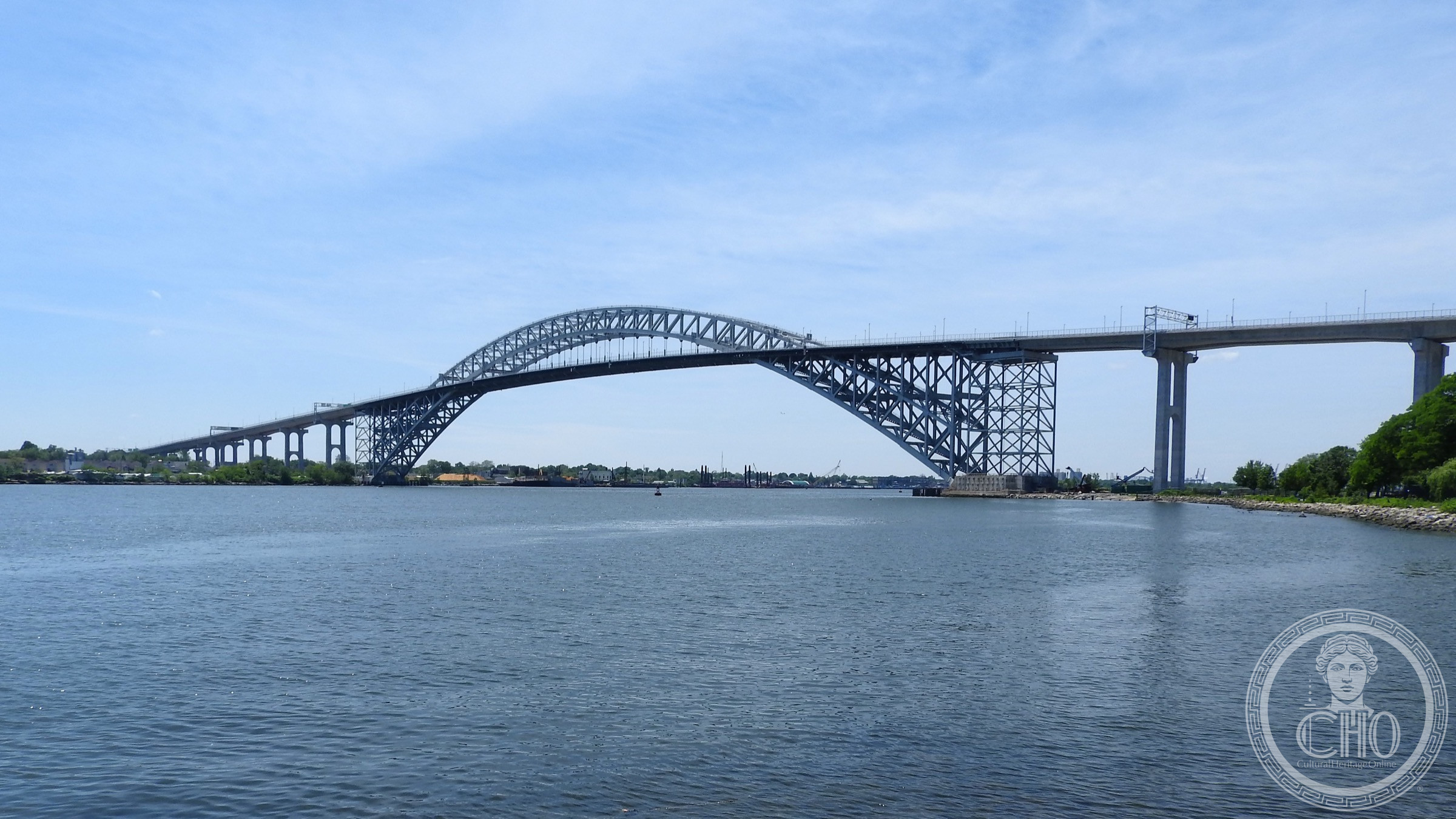
Designed by engineer Othmar Ammann and architect Cass Gilbert — the same partnership that delivered the George Washington Bridge the same year — the Bayonne Bridge held the record for the world’s longest steel arch for nearly five decades after its opening in 1931.
At a glance
The Bayonne Bridge is a steel arch bridge spanning the Kill Van Kull waterway between Bayonne, New Jersey and Port Richmond on Staten Island, New York. Its arch span of 1,675 feet was the longest of any steel arch bridge in the world from its completion in 1931 until 1977, when the New River Gorge Bridge in West Virginia surpassed it. Architecturally it is one of the clearest examples of Art Deco styling applied to major infrastructure: the granite-faced approach towers and the refined proportioning of the arch reflect the hand of Cass Gilbert, who brought the same aesthetic sensibility to the bridge that he had applied to the Woolworth Building two decades earlier.
Key facts
- Opened: 15 November 1931
- Type: Steel arch bridge
- Engineer: Othmar H. Ammann, Port Authority of New York
- Architect: Cass Gilbert
- Arch span: 1,675 feet (511 m)
- Record held: World’s longest steel arch bridge, 1931–1977
- Designation: National Historic Civil Engineering Landmark (ASCE)
- Raised: Roadway elevated in 2017 to accommodate Post-Panamax container ships
History
The Bayonne Bridge was conceived to replace the ferry service crossing the Kill Van Kull and to link the New Jersey industrial waterfront to Staten Island and, via the Goethals Bridge and Outerbridge Crossing, to the rest of the New York metropolitan region. Planning and design were entrusted to Othmar H. Ammann, the Swiss-born engineer who was simultaneously designing the George Washington Bridge across the Hudson. The two bridges, both completed in 1931, together with the Goethals Bridge and Outerbridge Crossing, represented the most ambitious single infrastructure programme in the history of the Port Authority of New York.
The bridge opened on 15 November 1931, just days after the George Washington Bridge, and immediately set the world record for steel arch span at 1,675 feet. That record stood for 46 years. The selection of Cass Gilbert as consulting architect — Gilbert, best known for the Woolworth Building in Manhattan, was sought for his proven ability to give large infrastructure projects architectural dignity — ensured that the bridge’s approach towers and ornamental elements carried weight beyond the purely functional. The granite-faced pylons at each end of the arch are among the most accomplished pieces of Art Deco civic design in the New York metropolitan area.
In the 2010s the Port Authority undertook an ambitious raising of the bridge’s roadway by approximately 64 feet, completed in 2017, to allow Post-Panamax container ships serving the expanded Panama Canal to reach the Port Newark–Elizabeth Marine Terminal without restriction. The raising preserved the original arch — only the roadway deck and approach structures were altered.
What you see
The arch itself dominates: a single continuous parabola in structural steel, its upper chord rising to a crown of around 266 feet above the water. The arch is painted a warm grey that shifts with the light and the season — silvery on overcast afternoons, almost bronze in low winter sun. But the Art Deco programme is most legible in the approach towers at each end of the bridge, where Cass Gilbert’s hand is clear. Faced in rough-cut granite, the towers step back in vertical planes as they rise, their proportions borrowed from the contemporary skyscraper vocabulary of Manhattan and New Jersey’s own industrial waterfront.
The most rewarding views are from the waterfront parks along the Kill Van Kull in Bayonne, where the full arc of the bridge reads against the Staten Island skyline, or from a container ship transiting the channel below — an angle available only on Port Authority vessel tours. From above, seen from the raised roadway, the arch disappears beneath the deck and the bridge becomes simply a passage through space, the kill glittering far below on both sides.
Practical information
- Tolls: Paid westbound (New Jersey to Staten Island); cashless collection via E-ZPass or Pay By Mail
- Pedestrians/cyclists: No pedestrian or cycling access on the bridge
- Best viewpoint: Veterans Memorial Park, Bayonne NJ waterfront; Newark Bay area
- Time needed: 30–45 minutes for waterfront viewing at the Bayonne approach
- Note: Large container ships transit the Kill Van Kull regularly — the channel below the arch is one of the busiest in the US; checking tide and ship schedules adds interest to a visit
Getting there
The Bayonne Bridge connects Route 440 in Bayonne, New Jersey with Richmond Terrace on Staten Island, New York. From Manhattan, the New Jersey Transit Light Rail reaches Bayonne in under 30 minutes from the Exchange Place station in Jersey City. By car from the New Jersey Turnpike, exit 14A (I-78) connects to Route 1 and 9 southbound toward Bayonne. From Staten Island, the bridge is accessible directly from the Staten Island Expressway (I-278) via Richmond Terrace.
Nearby
- Goethals Bridge (1928) — another Port Authority steel bridge, connecting Staten Island to Elizabeth, NJ; original structure being replaced in phases
- Snug Harbor Cultural Center & Botanical Garden, Staten Island — Greek Revival sailors’ home complex turned arts campus, overlooking the Kill Van Kull
- Kill Van Kull waterway — one of the world’s busiest commercial waterways, carrying container traffic to Port Newark–Elizabeth; excellent for maritime photography
Sources
- Port Authority of New York and New Jersey — Bayonne Bridge history and raise project documentation
- American Society of Civil Engineers — National Historic Civil Engineering Landmark designation record
- Jameson W. Doig, Empire on the Hudson (Columbia University Press, 2001) — Ammann and the Port Authority bridge programme
- Wikipedia: Bayonne Bridge — engineering data and historical sources
Find it on the map
See this place and what’s around it →Record researched and written by Luigi De Marchi for Cultural Heritage Online, 2026.
📷 Become a Cultural Heritage Online photographer
Share your photos of places: they stay published under your name as the author. The more they're seen, the more you get noticed — and soon a contest will reward the most appreciated photos.
Log in or sign up free to add a photoIs this page about you?
This page is read by travellers and heritage enthusiasts who find it on Google. Tell us how you are connected to this place and we will take it from there.