
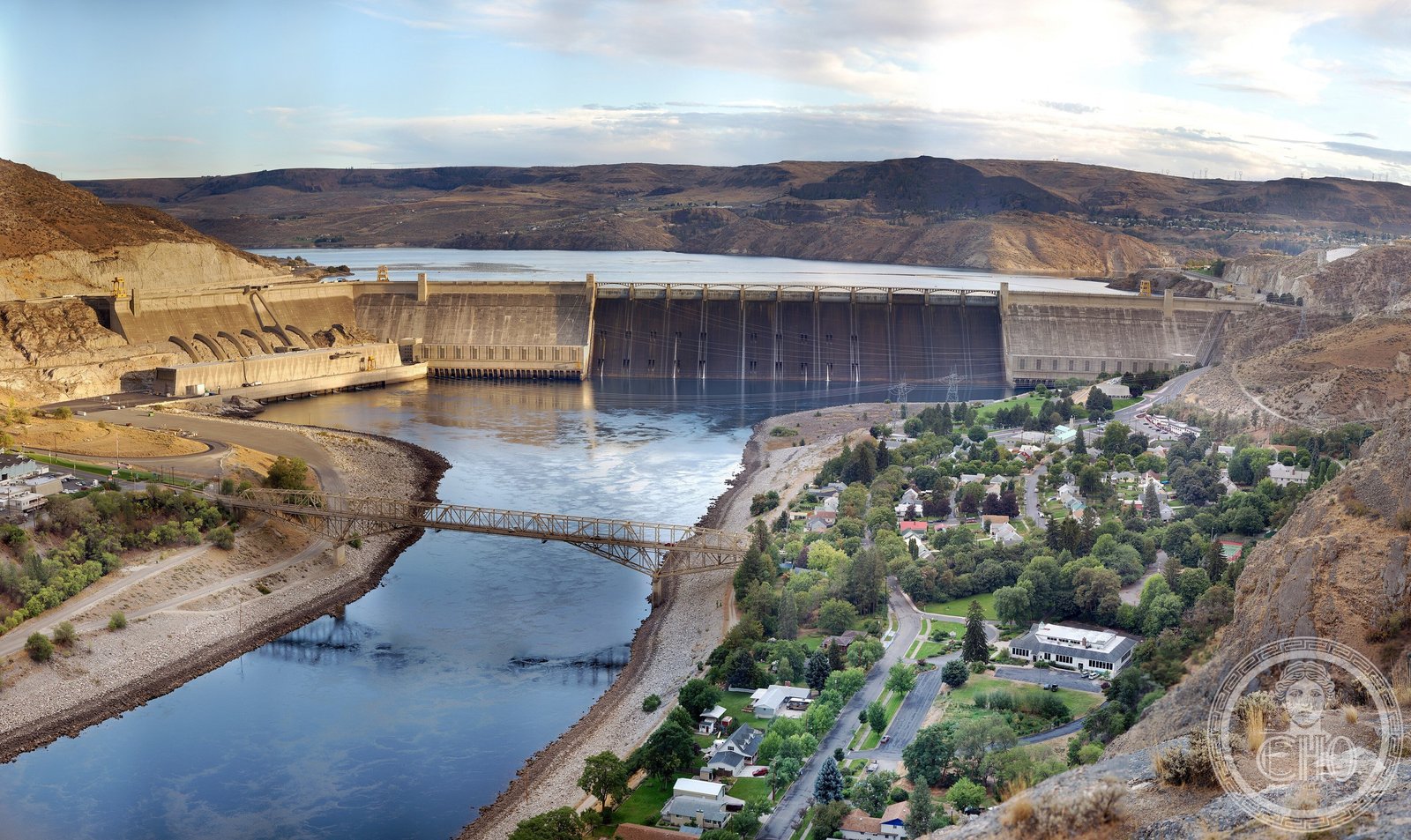
The grandest act of public works in American history, Grand Coulee turned a dry plateau into an irrigated empire and became the New Deal’s most eloquent argument in concrete and steel.
At a glance
Spanning the Columbia River in eastern Washington State, Grand Coulee Dam was the largest concrete structure in the United States when it was completed and remains one of the world’s great hydroelectric installations. Built as a Public Works Administration project beginning in 1933, the dam’s administration buildings and powerhouses are clad in the austere, planar ornament of PWA Moderne — the federal government’s signature variant of Art Deco, favoring rational geometry over the commercial flamboyance of its urban counterparts. Today the dam drives summer evenings with a laser light show projected onto the mile-long spillway.
Key facts
- Location: Columbia River, Coulee Dam, Grant / Okanogan Counties, Washington State
- Construction: 1933–1942 (original structure; Third Power Plant added 1970s)
- Agency: Bureau of Reclamation, US Department of the Interior
- Principal engineer: Frank Banks, Bureau of Reclamation
- Reservoir: Lake Roosevelt, extending approximately 150 miles upstream
- Style: PWA Moderne / Streamline Moderne (powerhouses and admin buildings)
- Status: National Historic Landmark; active generating facility
History
The idea of damming the Columbia at Grand Coulee dates to the early twentieth century, but it was the New Deal that turned the vision into reality. President Franklin Roosevelt authorised construction in 1933 under the Public Works Administration, framing the project as employment relief as much as infrastructure. At its peak the dam employed several thousand workers, who lived in the purpose-built company town of Mason City — later renamed Coulee Dam.
Construction advanced in two halves: the west section was poured first while the east section remained open to the river, then the flow was diverted and the east half completed. The dam’s spillway was first tested in 1942, when the original power plant came fully online. The project brought electricity to a vast swathe of the Pacific Northwest — cheap power that would prove decisive in aluminium smelting for wartime aircraft production and, later, in drawing tech and aerospace industry to the region.
In 1941, folk singer Woody Guthrie was commissioned by the Bonneville Power Administration to write songs celebrating the dam and the Columbia River system. He produced twenty-six songs in a single month, including Roll On, Columbia, which became the official state folk song of Washington. The songs remain among the most celebrated pieces of American vernacular music connected to a single engineering project.
What you see
From the visitor centre overlook, the dam presents itself as a sheer white cliff of concrete spanning the Columbia — a structure so large that its scale only registers gradually as the eye searches for familiar reference points. The spillway, running across the full width of the dam face, can discharge water at rates that dwarf any natural waterfall in the region. The Administration Building, set at the Washington State end of the structure, is the clearest expression of PWA Moderne in the complex: a flat-roofed block whose entrance bay carries low-relief geometric ornament in the Art Deco idiom — stylised chevrons, stepped cornices, and bronzed metalwork framing the doors.
The powerhouses, strung along the base of the dam on both banks, are long, low industrial structures whose rhythmic window bays and simplified pilaster strips reflect the same modernist restraint. The Third Power Plant — added decades later — aligns with the earlier aesthetic rather than departing from it. What distinguishes Grand Coulee from purely utilitarian engineering is precisely this attention to surface: the Bureau of Reclamation’s in-house architects understood that a project of this civic ambition required architecture, not merely construction.
Practical information
- Visitor centre: Free admission; year-round, hours vary seasonally
- Laser light show: Projected onto the spillway on summer evenings (May–September approximately); free and open to the public from the outdoor amphitheatre
- Tours: Guided powerhouse tours available (advance booking recommended in summer)
- Drive time: Approximately 3.5 hours from Seattle, 1.5 hours from Spokane
- Nearby: Lake Roosevelt National Recreation Area, Colville Reservation cultural sites
Getting there
Grand Coulee Dam is located on US Route 2 in central Washington State. The nearest major airports are Spokane International Airport (GEG), approximately 90 miles east, and Seattle-Tacoma International Airport (SEA), approximately 220 miles west. There is no passenger rail or regular bus service to the dam; a private vehicle is the practical means of arrival. From Spokane, take US-2 west through Davenport and Wilbur to Grand Coulee.
Nearby
- Bonneville Dam (1937) — the Columbia River’s other great New Deal dam, further west near the Oregon border
- Fort Spokane — late nineteenth-century Army post within Lake Roosevelt NRA
- Colville Confederated Tribes Museum — cultural heritage of the plateau peoples whose land the dam transformed
Sources
- US Bureau of Reclamation — Grand Coulee Dam official history and visitor information, usbr.gov
- National Park Service — National Historic Landmark nomination, Grand Coulee Dam
- Paul C. Pitzer, Grand Coulee: Harnessing a Dream, WSU Press, 1994
- Bonneville Power Administration — Woody Guthrie commission documentation, 1941
- Wikipedia — Grand Coulee Dam (cross-checked against Bureau of Reclamation sources)
Find it on the map
See this place and what’s around it →Record researched and written by Luigi De Marchi for Cultural Heritage Online, 2026.
📷 Become a Cultural Heritage Online photographer
Share your photos of places: they stay published under your name as the author. The more they're seen, the more you get noticed — and soon a contest will reward the most appreciated photos.
Log in or sign up free to add a photoIs this page about you?
This page is read by travellers and heritage enthusiasts who find it on Google. Tell us how you are connected to this place and we will take it from there.