
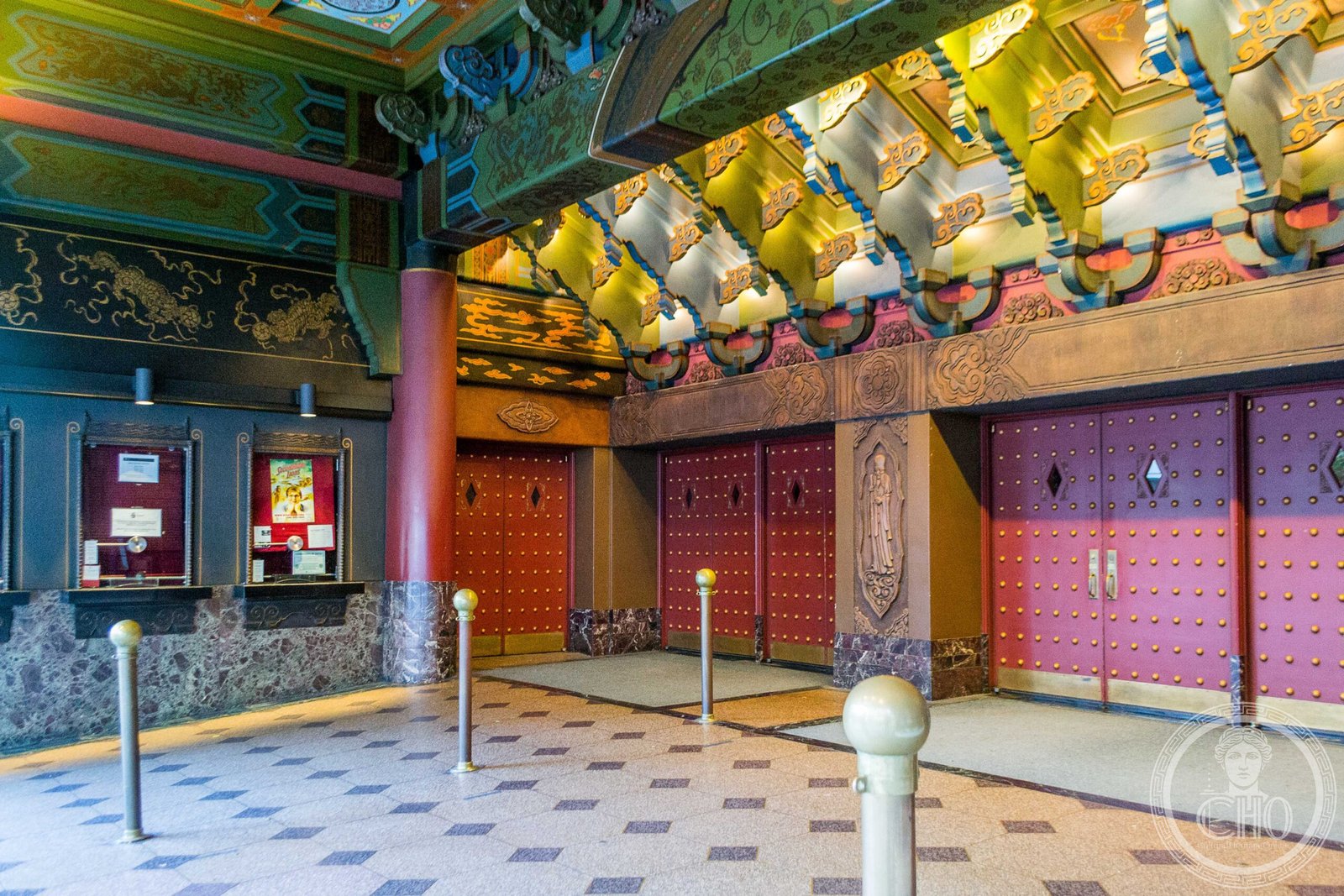
A Chinoiserie fantasy on Seattle’s main commercial avenue, the Fifth Avenue Theatre opened in 1926 with an interior modelled on the imperial halls of Beijing’s Forbidden City.
At a glance
Completed in 1926, the Fifth Avenue Theatre stands at 1308 5th Avenue as one of the most theatrically exotic movie palaces in the Pacific Northwest. Its exterior gives little away—a clean terra-cotta front that blends into Seattle’s commercial streetscape—but the lobby and auditorium unveil an elaborate recreation of Chinese imperial architecture, complete with a colossal coffered ceiling, gilt dragons coiling around the proscenium arch, and lanterns suspended from carved lotus pendants. After a period of closure and near-demolition, the theatre was restored and reopened in 1980, and today serves as Seattle’s primary venue for touring Broadway productions.
Key facts
- Address: 1308 5th Avenue, Seattle, WA 98101
- Opened: September 24, 1926
- Style origin: Chinese imperial Chinoiserie, inspired by the Forbidden City, Beijing
- Style: Chinoiserie / Chinese Imperial Revival
- Original capacity: 2,130 seats
- Heritage listing: National Register of Historic Places
- Current use: Broadway touring house, operated by The 5th Avenue Theatre Association
History
The Fifth Avenue Theatre opened on September 24, 1926, presenting silent films accompanied by a thirty-piece orchestra. The “Roaring Twenties” were at their peak, and the craze for all things Oriental—fuelled by Hollywood’s Chinoiserie films, the popularity of Chinese export porcelain, and a general vogue for exotic escapism—made the theatre’s imperial Chinese aesthetic both fashionable and commercially shrewd. Seattle, with its longstanding ties to Pacific Rim trade, embraced the design enthusiastically.
The coming of sound in 1927—1928, the Great Depression, and the rise of the neighbourhood multiplex slowly eroded the grand movie palace model. The Fifth Avenue closed in 1978. The following year the theatre was designated a Seattle Landmark. After a restoration funded by community stakeholders, it reopened in 1980 as a live performance venue. The 5th Avenue Theatre Association, a non-profit organisation, has operated it since 1980, making the theatre one of the last in America to preserve the grand movie palace tradition under civic stewardship. Over subsequent decades the Association’s producing arm developed a national reputation for nurturing original musicals, co-producing a number of shows that subsequently moved to Broadway and cementing the Fifth Avenue’s place in the American musical theatre landscape.
What you see
The lobby introduces the imperial theme through a moon-gate entrance framed by carved columns and painted in ochre, vermillion, and gold. Above the doors, latticed screens replicate the decorative woodwork seen in Qing dynasty courtyard architecture. The ceiling of the lobby is panelled in lacquered coffers, each containing a stylised lotus rosette. The transition from Seattle’s overcast streetscape to this interior warmth was—and remains—deliberately theatrical.
The auditorium is dominated by a vast dome modelled on the ceiling of the Temple of Heaven in Beijing. The dome’s coffered surface is painted in gold and deep blue, with a central oculus surrounded by concentric rings of carved ornament. Four gilded dragons coil around the proscenium, their scales individually applied in polychrome lacquer. The side walls are articulated with painted silk-finish panels and pierced balcony railings, while ornate plasterwork lanterns cast a warm amber light across the stalls. The effect is of sitting inside an imperial ceremonial hall transported intact to the Pacific Northwest.
Practical information
- Season: Year-round; Broadway season runs September through June
- Tickets: Via the 5th Avenue Theatre box office and ticketing partners
- Tours: Limited architectural tours available; check the theatre’s website for schedule
- Dress code: Smart casual for performances; no formal dress requirement
- Access: Fully accessible; designated seating available for mobility-impaired visitors
Getting there
The Fifth Avenue Theatre occupies the heart of downtown Seattle, one block east of Pike Street Market and two blocks south of the Pike Place Market complex. Seattle-Tacoma International Airport (SEA) is approximately 25 minutes by light rail to the Westlake Station stop, which exits within 300 metres of the theatre’s front door. The King Street Station Amtrak terminal is a 10-minute walk south. Multiple bus lines stop on 5th Avenue directly outside the building.
Nearby
- Pike Place Market (1907) — Seattle’s oldest farmers market and urban arcade, three blocks northwest on Pike Street, overlooking Elliott Bay.
- Seattle Art Museum (1991) — Jonathan Borofsky’s Hammering Man sculpture marks the entrance one block north; the permanent collection includes significant Northwest Coast Indigenous works.
- Central Library (2004) — Rem Koolhaas / OMA’s crystalline glass-and-steel public library, three blocks north on 4th Avenue, represents a radically different but equally bold civic architectural vision.
- Seattle Tower / Northern Life Tower (1929) — An Art Deco office tower two blocks west on 3rd Avenue, another survivor of Seattle’s 1920s building boom.
Sources
- National Register of Historic Places nomination, Fifth Avenue Theatre, Seattle, Washington
- The 5th Avenue Theatre Association, institutional history documentation
- Naylor, David. American Picture Palaces: The Architecture of Fantasy. Van Nostrand Reinhold, 1981
- Nasaw, David. Going Out: The Rise and Fall of Public Amusements. Harvard University Press, 1999
- Seattle Landmarks Preservation Board, designation report, 1979
Find it on the map
See this place and what’s around it →Record researched and written by Luigi De Marchi for Cultural Heritage Online, 2026.
📷 Become a Cultural Heritage Online photographer
Share your photos of places: they stay published under your name as the author. The more they're seen, the more you get noticed — and soon a contest will reward the most appreciated photos.
Log in or sign up free to add a photoIs this page about you?
This page is read by travellers and heritage enthusiasts who find it on Google. Tell us how you are connected to this place and we will take it from there.