
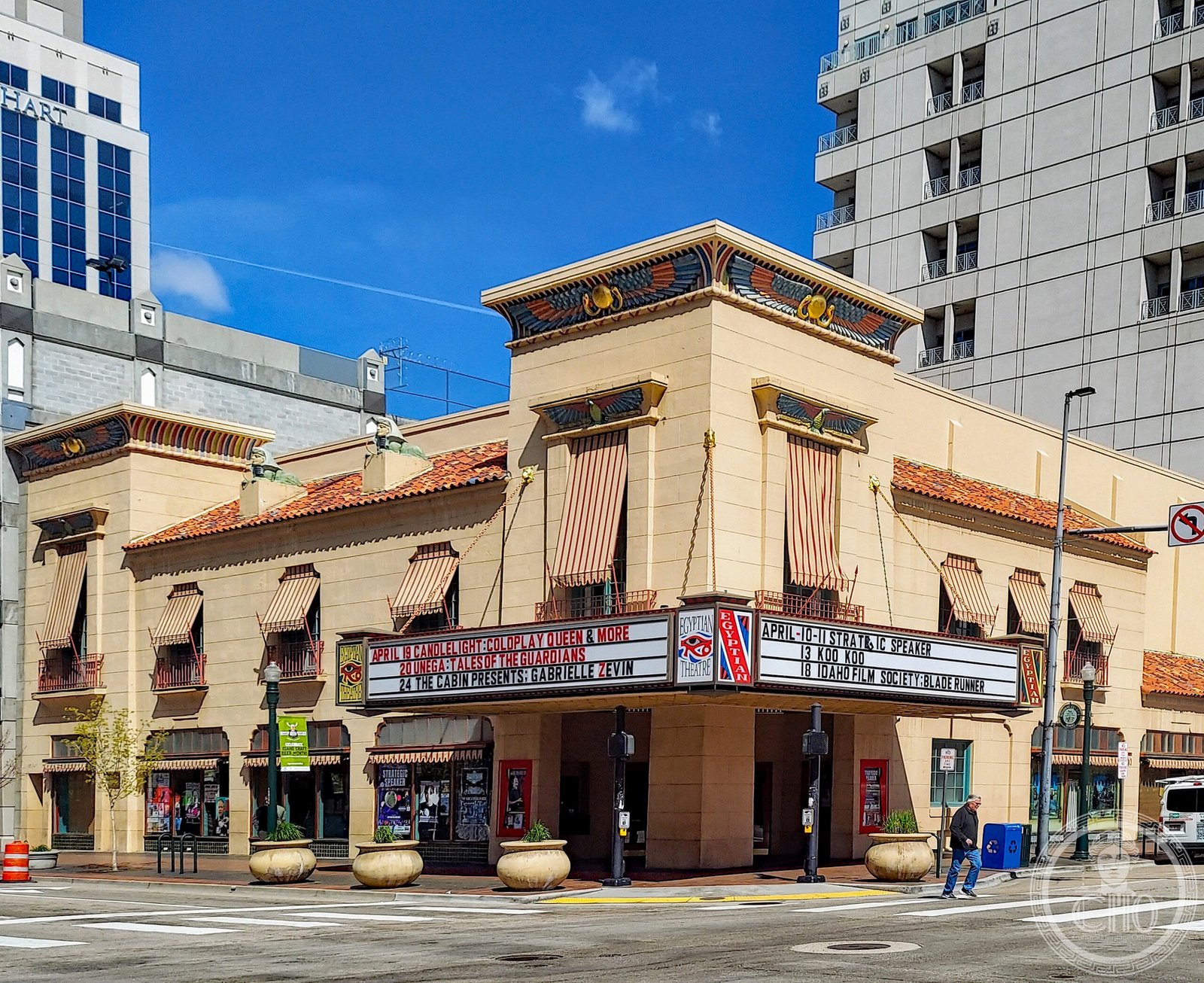
Opened in 1927 at the height of the Tutankhamun fever that swept American popular culture following the 1922 discovery of the pharaoh’s tomb, Boise’s Egyptian Theatre brought the colours and geometry of ancient Egypt to the main street of Idaho’s capital — sphinx reliefs, lotus columns, and hieroglyphic-style ornament framing a cinema that could seat an entire neighbourhood.
At a glance
The Egyptian Theatre at 700 West Main Street, Boise, was built in 1927 and is one of the surviving Egyptian Revival theatres in the American West. The building’s architectural programme draws on the intense popular enthusiasm for ancient Egyptian culture that followed Howard Carter’s discovery of the tomb of Tutankhamun in November 1922 — a fascination that produced, across America and Europe, a wave of Egyptian Revival ornament in cinema interiors, shop facades, and public buildings. The theatre was constructed as the Ada Theatre, named for Ada County, Idaho, of which Boise is the county seat; the “Egyptian Theatre” name has become its common designation and reflects its defining architectural character. Listed on the National Register of Historic Places, the building today operates as a performing arts venue.
- Opened: 1927
- Style: Egyptian Revival — lotus columns, sphinx reliefs, hieroglyphic-style ornament
- Original name: Ada Theatre (Ada County, Idaho)
- Common name: Egyptian Theatre
- Address: 700 West Main Street, Boise, ID 83702
- National Register of Historic Places
Key facts
- Tutankhamun context: Carter’s discovery of the intact royal tomb in November 1922 generated global media coverage and a five-year wave of “Egyptomania” in design and popular culture
- American Egyptian Revival theatres: A small number survive from this period; the Boise example is among the most intact in the Pacific Northwest
- Facade elements: Sphinx heads, lotus-bud columns, winged sun-disc motif, polychrome painted ornament
- Interior: Egyptian-themed decorative scheme continued into the lobby and auditorium
- Operator: Egyptian Theatre Preservation Association
- Current use: Independent film screenings, live performances, community events
History
The discovery of Tutankhamun’s tomb by Howard Carter on November 4, 1922, was the most widely reported archaeological event of the twentieth century up to that point. The intact treasures of the “boy pharaoh” — golden death mask, throne, chariots, jewellery — were documented in photographs that circulated worldwide within days, and within months Egyptian motifs had appeared in fashion, furniture, jewellery, and architecture on both sides of the Atlantic. Movie studios were particularly quick to respond: Egyptian mythology had already been a cinema staple, and the visual vocabulary of sphinx, lotus, and hieroglyph was readily available for theatre facades.
Boise’s Ada Theatre was built in 1927, near the peak of the Egyptomania wave, as a purpose-built cinema for the capital of Idaho. The building’s location on West Main Street placed it in the commercial heart of the city; its Egyptian Revival facade was a deliberate act of civic display, intended to attract customers to what was then one of the most technologically sophisticated entertainment venues in the region. The interior carried the Egyptian theme into the lobby decoration and auditorium, creating a total environment that transported audiences — for the price of a cinema ticket — from the sagebrush country of southern Idaho to the banks of the Nile.
The theatre operated as a cinema through most of the twentieth century. As with many single-screen theatres, the arrival of multiplexes and home video progressively reduced its commercial viability. A preservation campaign led to the building’s listing on the National Register of Historic Places and the establishment of the Egyptian Theatre Preservation Association, which assumed operation of the venue and restored it to use as a performing arts space, hosting independent films, concerts, lectures, and community events.
What you see
The street facade of the Egyptian Theatre is the building’s principal statement. The composition is organised around a central entrance flanked by lotus-bud columns — the characteristic Egyptian column whose shaft widens from a narrow base to a voluminous capital formed by clustered lotus buds, painted in ochre, turquoise, and red. Sphinx heads project from the wall surface at the level of the cornice, their faces gazing along West Main Street. The winged sun-disc — the Horus emblem, which in Egyptian iconography represents divine protection and royal authority — appears above the central entrance. The overall colour palette of the facade, combining warm stone tones with polychrome painted detail, reproduces the visual richness of New Kingdom temple decoration while translating it into a flat, geometrised idiom that is entirely compatible with the Art Deco ornamental tradition operating simultaneously in 1920s America.
Inside the lobby, the Egyptian vocabulary continues in the decorative scheme: painted wall panels, geometric tiled floors, and a ceiling whose ornament combines Egyptian fan-and-frond motifs with the stepped geometry of Art Deco cornices. The effect is of a coherent period interior that blurs the distinction — never very sharp — between Egyptian Revival and the Art Deco movement that absorbed so many of its visual conventions.
Practical information
- Access: Performances and film screenings only; check the Egyptian Theatre schedule at egyptiantheatre.net
- Box office: On-site at 700 West Main Street; tickets also available online
- Parking: Metered street parking on Main Street; paid garages within two blocks
- Nearby: Downtown Boise’s Basque Block — the highest concentration of Basque culture outside the Basque Country — is two blocks east
- Best visit: The exterior is most impressive at night when the illuminated facade is at full effect
Getting there
The Egyptian Theatre is in downtown Boise on West Main Street, two blocks west of Capitol Boulevard and two blocks north of the Boise Depot. Boise Airport (BOI) is 3 miles south of downtown, accessible by Valley Regional Transit bus Route 3 to downtown. By car: I-84 to Exit 54 (downtown Boise), north on Capitol Boulevard to Main Street, then west two blocks.
Nearby
- Basque Block — Two blocks east on Grove Street; the Basque Museum and Cultural Center, the Basque Market, and several Basque restaurants document Boise’s unusually large Basque community, descended from shepherds who arrived in Idaho in the late nineteenth century.
- Idaho State Capitol (1920) — The Neoclassical state house on Jefferson Street near Capitol Boulevard, with a sandstone exterior quarried from Idaho’s Table Rock, capped by a copper-clad dome; within walking distance of the theatre.
- Boise Contemporary Theater — The performing arts scene anchored by the Egyptian Theatre extends through several venues in downtown Boise; the Contemporary Theater on Main Street is among the most active.
- Boise River Greenbelt — The 25-mile riverside trail system along the Boise River runs within four blocks of the theatre; a popular walking and cycling route connecting downtown to Boise State University.
Sources
- National Register of Historic Places Nomination, Ada Theatre (Egyptian Theatre), Boise, Idaho
- Historic American Buildings Survey (HABS) documentation, Ada Theatre, 700 Main Street, Boise, ID HABS ID,1-BOISE,8
- Egyptian Theatre Preservation Association — building history and restoration documentation
- Curl, James Stevens. The Egyptian Revival: Ancient Egypt as the Inspiration for Design Motifs in the West. Routledge, 2005
- Idaho State Historical Society — Boise commercial history records
Find it on the map
See this place and what’s around it →📷 Become a Cultural Heritage Online photographer
Share your photos of places: they stay published under your name as the author. The more they're seen, the more you get noticed — and soon a contest will reward the most appreciated photos.
Log in or sign up free to add a photoIs this page about you?
This page is read by travellers and heritage enthusiasts who find it on Google. Tell us how you are connected to this place and we will take it from there.