
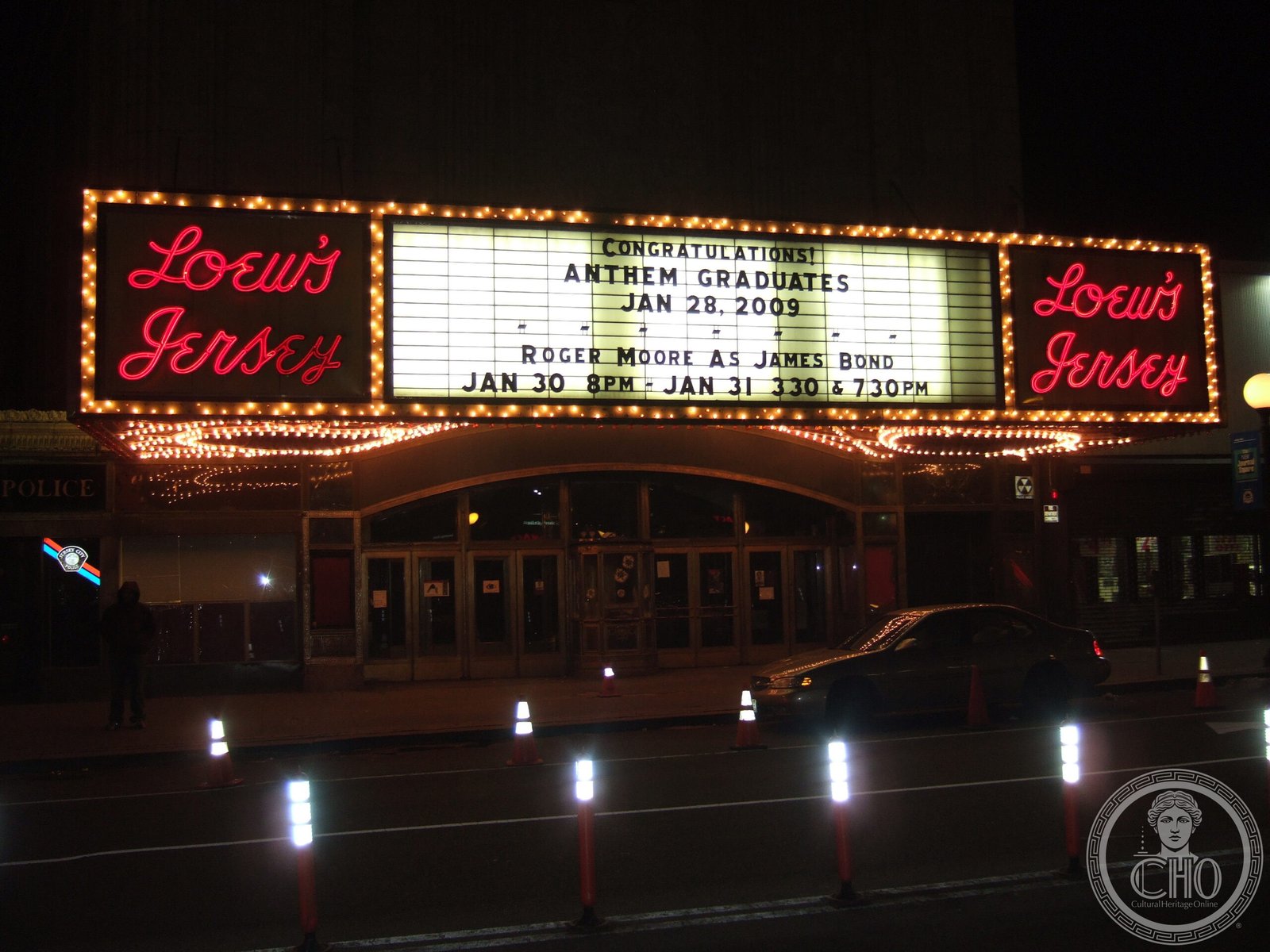
One of the five Loew’s “Wonder Theatres” built around the New York metropolitan area in 1929–1930, the Loew’s Jersey at Journal Square brought the Spanish Baroque atmospheric tradition to New Jersey with a palatial interior that seats more than three thousand.
At a glance
Designed by Thomas W. Lamb and completed in October 1929, the Loew’s Jersey at 54 Journal Square is the sole surviving Wonder Theatre to have retained most of its original ornamental programme. The auditorium—designed as an outdoor Spanish courtyard under a simulated night sky—features painted cloud effects, fibrous plaster castle turrets along the side walls, illuminated stars overhead, and a massive coffered proscenium flanked by wrought-iron grilles. Seating originally exceeded 3,100 in stalls, mezzanine, and balcony tiers. After closing in 1986, the theatre was saved by a grassroots preservation campaign; the non-profit Friends of Loew’s has operated it since 2003 as a venue for concerts, classic film screenings, and community events.
Key facts
- Address: 54 Journal Square, Jersey City, NJ 07306
- Opened: October 3, 1929
- Architect: Thomas W. Lamb (1871–1942)
- Style: Spanish Baroque Atmospheric / Movie Palace
- Original capacity: approximately 3,161 seats
- Heritage listing: National Register of Historic Places
- Wonder Theatre group: Loew’s Jersey; Loew’s Kings (Brooklyn); Loew’s Valencia (Queens); Loew’s Paradise (Bronx); Loew’s 175th Street (Manhattan)
- Current operator: Friends of Loew’s Jersey (non-profit)
History
By 1929 the Loew’s cinema chain was the largest movie-theatre operator in the United States, and its founder Marcus Loew had recently died leaving a legacy of theatrical ambition. The company’s response to competition from the rival Balaban and Katz circuit in Chicago and the Publix circuit in the South was to commission five grand movie palaces—the “Wonder Theatres”—across the New York metropolitan area simultaneously. Thomas W. Lamb, who had spent two decades designing theatres across America including Madison Square Garden (1925) and the Loew’s State in Times Square (1921), was the obvious architect for the project.
The Jersey City theatre was strategically located at Journal Square, the commercial and transport hub of Hudson County. Loew’s management calculated that the square’s concentration of commuter rail lines and street-car connections would deliver audiences from across New Jersey who could not access the Manhattan theatres. The building opened on October 3, 1929, just three weeks before the Wall Street Crash that inaugurated the Great Depression. Despite the timing, the theatre prospered through the 1930s and 1940s as an affordable entertainment destination in a heavily working-class market.
The decline of the single-screen palace, multiplexing, and suburban flight eroded attendance through the 1960s and 1970s. Loew’s closed the Jersey in 1986. A preservation coalition that would eventually become Friends of Loew’s formed to prevent demolition, and after a decade of advocacy secured the building for restoration. Restoration work, funded through a combination of state grants, federal tax credits, and private donations, has addressed the lobby, auditorium plasterwork, and organ. The theatre reopened for public events in 2003 and continues to serve as a community arts venue.
What you see
The exterior on Journal Square presents a two-storey terra-cotta facade with a marquee above the main entrance, relatively modest compared to the palatial interior beyond. Lamb’s design philosophy for Loew’s Wonder Theatres was to let the exterior suggest wealth while reserving the full visual assault for the lobby and auditorium.
The lobby is dressed in cream marble and gilded plasterwork, with Spanish Renaissance archways framing the entrances to the mezzanine staircases. The auditorium is the revelation: a Spanish colonial courtyard at perpetual twilight, with painted sky panels overhead glittering with artificial stars. Along the side walls, illuminated niches contain painted garden scenes between mock castle towers in warm ochre stucco. The coffered proscenium arch rises eighty feet above the orchestra floor. The Wurlitzer organ—which the Friends of Loew’s have partially restored—occupies side chambers masked by the ornamental grilles. The cumulative effect is of an outdoor Andalusian palace transported wholesale to Hudson County.
Practical information
- Season: Events scheduled throughout the year; check the Friends of Loew’s Jersey website for programme
- Tours: Architectural tours offered on select Saturdays; small admission fee; book in advance
- Organ concerts: The Wurlitzer is heard at classic film screenings and select organ events
- Access: Ground-floor entrance at Journal Square; some areas under active restoration—confirm accessibility with the venue ahead of visit
Getting there
Loew’s Jersey sits directly above the Journal Square Transportation Center, served by the Port Authority Trans-Hudson (PATH) rail from Manhattan’s 33rd Street and 6th Avenue stations (approximately 20 minutes). From Newark Liberty International Airport (EWR), take the AirTrain to Newark Penn Station, then NJ Transit or PATH to Journal Square—total journey approximately 40 minutes. No parking is provided by the venue; street parking and a multi-storey car park are available within a short walk on Journal Square.
Nearby
- Jersey City Museum (1901) — A municipal art and history museum in a former public school building at 350 Montgomery Street, documenting Hudson County’s industrial and immigrant history.
- Hamilton Park Historic District — A preserved enclave of Federal and Italianate townhouses from the 1840s–1870s on Hamilton Park, six blocks southeast—evidence of Jersey City’s mercantile prosperity before the age of cinema.
- Exchange Place — Jersey City’s financial district on the Hudson River waterfront, with panoramic views of the Manhattan skyline, 20 minutes on foot or two PATH stops east.
- Liberty State Park — A waterfront park on Upper New York Bay providing direct ferry access to the Statue of Liberty and Ellis Island, two miles south of Journal Square.
Sources
- National Register of Historic Places nomination, Loew’s Jersey Theatre, Jersey City, New Jersey
- Friends of Loew’s Jersey, institutional history and restoration documentation
- Naylor, David. American Picture Palaces: The Architecture of Fantasy. Van Nostrand Reinhold, 1981
- Glassman, Don, and Rob Lenihan. The Loew’s Wonder Theatres. Society of Architectural Historians, 2004
- Motion Picture Herald coverage, October 1929
Find it on the map
See this place and what’s around it →Record researched and written by Luigi De Marchi for Cultural Heritage Online, 2026.
📷 Become a Cultural Heritage Online photographer
Share your photos of places: they stay published under your name as the author. The more they're seen, the more you get noticed — and soon a contest will reward the most appreciated photos.
Log in or sign up free to add a photoIs this page about you?
This page is read by travellers and heritage enthusiasts who find it on Google. Tell us how you are connected to this place and we will take it from there.