
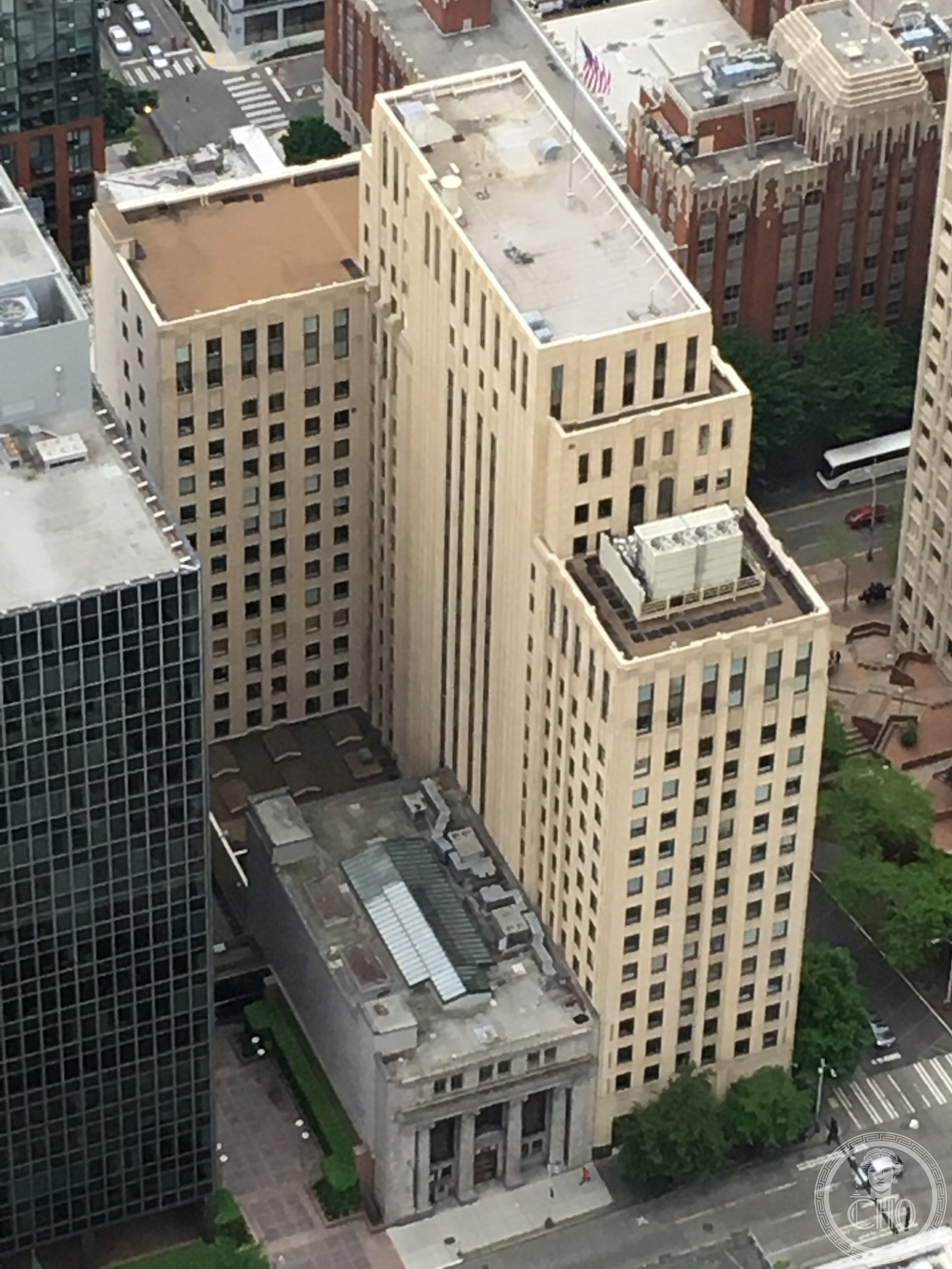
A twenty-three-story Art Deco tower at 821 Second Avenue in downtown Seattle — built to house the Seattle Stock Exchange, at completion the second-tallest reinforced concrete skyscraper in the United States, and one of the defining works of English-born architect John Graham.
At a glance
The Exchange Building stands at 821 Second Avenue in the heart of downtown Seattle, Washington. Completed in 1930 for John Graham & Associates — the English-born architect who also designed the Frederick & Nelson department store (now Nordstrom flagship), the Bon Marché (now Macy’s), and the Dexter Horton Building — the twenty-three-story reinforced concrete tower was built specifically to accommodate the Seattle Stock Exchange. At its opening, it ranked as the second-tallest reinforced concrete skyscraper in the United States. Designated a Seattle Landmark on April 16, 1990, the building was awarded Office Building of the Year by the Building Owners and Managers Association in 2002 and today houses a roster of professional services firms under Beacon Capital Partners’ ownership.
Key facts
- Completed: 1930
- Style: Art Deco
- Architects: John Graham & Associates (with Mithun Architects); general contractor Turner Construction
- Height: 275 feet (83.82 m) to roof, 23 stories
- Floor area: 296,530 sq ft (27,549 m²)
- Original purpose: Seattle Stock Exchange headquarters
- Structural distinction: Second-tallest reinforced concrete skyscraper in the US at completion
- Seattle Landmark designation: April 16, 1990
- BOMA Award: Office Building of the Year, 2002
- Current owner: Beacon Capital Partners
- Address: 821 Second Avenue, Seattle, Washington 98104
- GPS: 47.60425, −122.33481
History
The Exchange Building’s origins are inseparable from the economic ambitions of Seattle in the 1920s. The city’s boosters had long sought to establish a financial infrastructure that could rival San Francisco’s dominance of the Pacific Coast economy. A dedicated home for the Seattle Stock Exchange — housed in a building that announced the seriousness of Seattle’s financial community through the prestige of its architecture — was the clearest possible statement of those ambitions. John Graham, the English-born architect whose earlier commissions in Seattle had included the city’s leading department stores, was the natural choice for a building that had to project stability and modernity in equal measure.
The building was completed in 1930, at the threshold of the Great Depression, and the timing tested the resilience of its original program. The Seattle Stock Exchange, like financial exchanges across the country, contracted sharply in the early 1930s. But the building itself, with its roster of early tenants that included General Electric, Standard Oil, Edison Lamp Works, and Underwriters Laboratories, survived the Depression decade intact — proof that Graham’s design had correctly calculated the mid-range of the Seattle commercial market rather than the speculative high end. The building went on to house Pacific Northwest Bell and King County Metro before becoming the home of a new generation of professional services firms including Slalom Consulting, Deloitte Digital, and Nuance Communications. Its designation as a Seattle Landmark in 1990 formalized what the market had already established: the Exchange Building was one of the essential Art Deco towers of the Pacific Northwest.
What you see
The Exchange Building’s Art Deco character is expressed through its massing strategy, its surface treatment, and its relationship to the Seattle street grid. The twenty-three-story reinforced concrete tower uses the stepped-back upper-story profile characteristic of the best Art Deco commercial work: the lower floors lock into the street datum of Second Avenue while the upper floors step back progressively, giving the building a silhouette that reads clearly against Seattle’s sky. Graham’s design is restrained rather than exuberant — the decorative program is concentrated at the cornice and at street level, where the building’s base meets the pedestrian at human scale — in a way that places the Exchange Building firmly in the tradition of the best commercial Art Deco: buildings that perform seriousness without sacrificing ornamental ambition.
The building’s structural distinction — its position as the second-tallest reinforced concrete skyscraper in the US at the time of its completion — is a technical fact that has a visible consequence: the solidity and mass of the building’s exterior, with its thick wall planes and restrained window openings, communicates the weight-bearing logic of its structure directly. In an era when steel frames were making possible ever-lighter curtain walls, the Exchange Building’s reinforced concrete asserts a different aesthetic: heavy, authoritative, and built for the long run. The 1990 Seattle Landmark designation recognized precisely this quality: a building whose character had not diminished with the decades.
Practical information
- The Exchange Building is an active commercial office tower; public access is limited to the lobby and ground-floor retail areas during business hours.
- The exterior is best viewed from Second Avenue or Third Avenue between Madison Street and Spring Street.
- The Seattle Landmark designation plaque is at the main entrance on Second Avenue.
Getting there
The Exchange Building is at 821 Second Avenue in downtown Seattle. Seattle-Tacoma International Airport (SEA) is approximately 14 miles south of downtown via Interstate 5. King County Metro buses serve Second Avenue extensively; the nearest Link Light Rail station is University Street Station (1 Line), approximately 2 blocks north on Third Avenue. By car, Interstate 5 runs along the eastern edge of downtown Seattle; the Madison Street exit provides the most direct access to Second Avenue. The building is within easy walking distance of Pike Place Market (3 blocks northwest), Seattle Art Museum (1 block north), and the Seattle waterfront (4 blocks west via Madison Street).
Nearby
- Pike Place Market (1907) — approximately 3 blocks northwest at First Avenue and Pike Street; the historic farmers’ market and public market overlooking Elliott Bay, operating continuously since 1907; open daily year-round; the signature neon sign and the flying-fish tradition of the Pike Place Fish Market are the most-photographed elements of Seattle’s public space
- Seattle Art Museum — approximately 1 block north at 1300 First Avenue; the city’s major fine arts institution in a 1991 building by Robert Venturi and Denise Scott Brown, expanded in 2007; collection of 25,000 works with particular strengths in Northwest Coast Native art and African art
- Smith Tower (1914) — approximately 5 blocks south at 506 Second Avenue; the 42-story neoclassical tower that was the tallest building west of the Mississippi River at its opening; the Chinese Room on the 35th floor and observation deck are open to the public
Sources
- Wikipedia: “Exchange Building (Seattle)”
- City of Seattle Landmarks Preservation Board: Exchange Building designation, April 16, 1990
- Wikimedia Commons: Exchange_Building,_Seattle.jpg, CC BY-SA 4.0, Toohool
Find it on the map
See this place and what’s around it →Record researched and written by Luigi De Marchi for Cultural Heritage Online, 2026.
📷 Become a Cultural Heritage Online photographer
Share your photos of places: they stay published under your name as the author. The more they're seen, the more you get noticed — and soon a contest will reward the most appreciated photos.
Log in or sign up free to add a photoIs this page about you?
This page is read by travellers and heritage enthusiasts who find it on Google. Tell us how you are connected to this place and we will take it from there.