

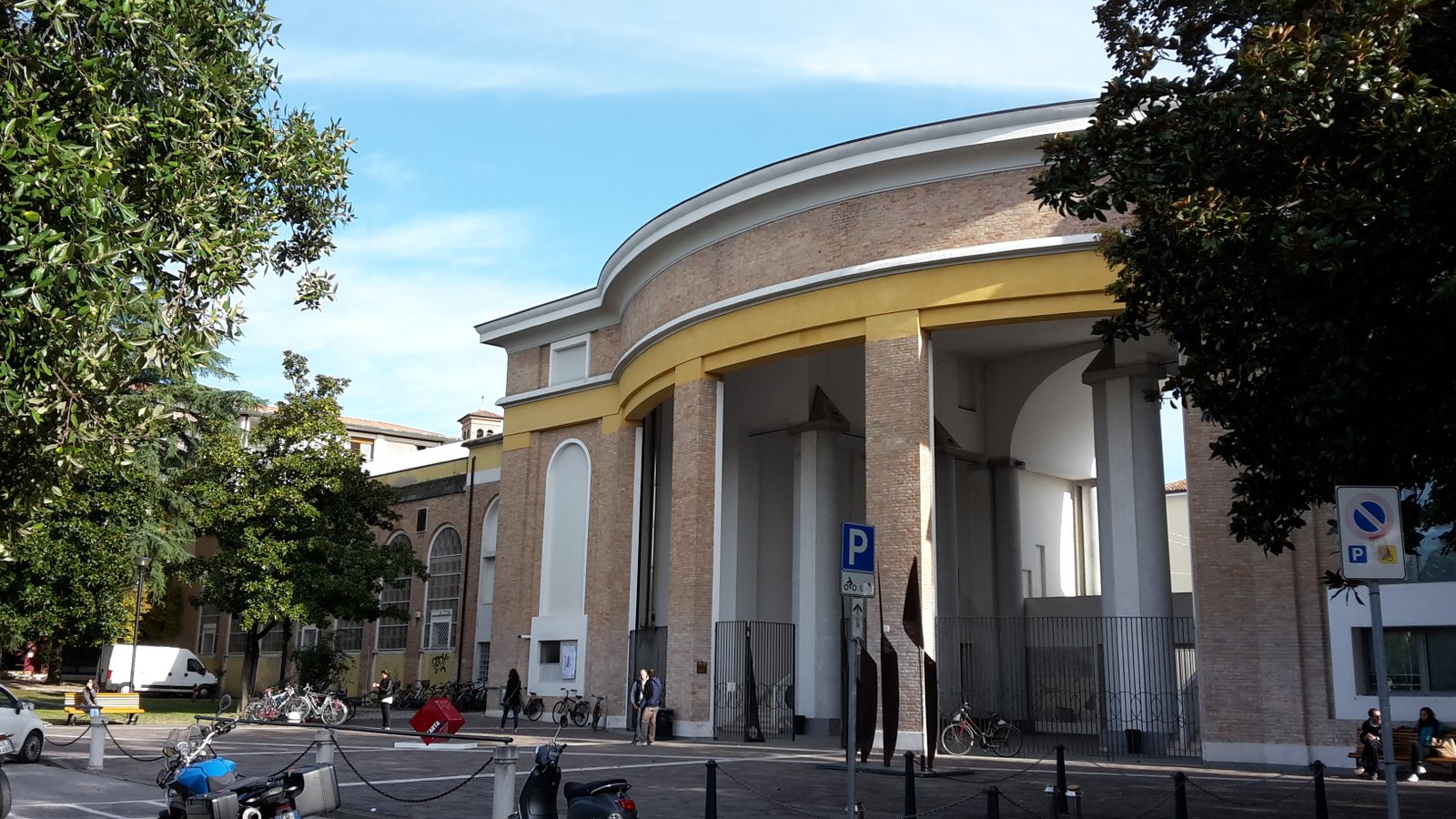
Designed in 1930 by Pietro Motta and inaugurated in 1933 as the Casa del Balilla, the building stands in the Citta Giardino district of Treviso as one of the clearest expressions of pronounced Italian Rationalism in the Veneto. A monumental central pronaos quotes Roman classicism while two symmetrical wings deliver the gymnasium-and-library programme of the regime’s youth organisation. Restored after decades of neglect, the building now hosts the civic library named after the poet Andrea Zanzotto.
- Address
- Via Luigi Giacomelli 10, 31100 Treviso, Italy
- Period
- Designed 1930; completed 1933; renamed GIL in 1937
- Architects
- Pietro Motta (Mogliano Veneto)
- Client
- Opera Nazionale Balilla (later Gioventu Italiana del Littorio)
- Style
- Italian Rationalism (Razionalismo italiano)
- Function
- Originally fascist youth centre with gymnasium, theatre and library; today Biblioteca Citta Giardino “Andrea Zanzotto”
- Composition
- Central monumental block with classical pronaos plus two symmetrical lateral wings
- Status
- Public civic building, restored in 1990 and 2005, expansion works ongoing in the 2020s
- Coordinates
- 45.6661° N, 12.2383° E
Visit on the map
Via Luigi Giacomelli 10, 31100 Treviso · 45.6661° N, 12.2383° E
Download for your navigator
A single waypoint, ready for GPS apps, navigators, and contacts.
Story
The commission belongs to the wave of Case del Balilla that the Opera Nazionale Balilla rolled out across Italian provincial capitals at the turn of the 1930s. Treviso, expanding south of its Venetian walls into a new garden-suburb plan known as Citta Giardino, set aside a parcel along what is today Via Luigi Giacomelli for a youth centre that would combine indoor sport, performance and reading rooms under a single civic roof. The brief was awarded in 1930 to Pietro Motta, an architect from nearby Mogliano Veneto, whose project organised the programme into a tripartite plan: a tall central block flanked by two symmetrical wings. Work proceeded over three years and the building was inaugurated in 1933 as Casa del Balilla, before being rebranded GIL in 1937 when the Balilla organisation was absorbed into the Gioventu Italiana del Littorio.
Motta’s design sits squarely inside the rationalist current that swept Italian public architecture in those years, yet it also negotiates with the regime’s pull towards Roman monumentality. The lateral wings read as the rationalist half of the bargain: flat wall planes, regular fenestration arranged in long horizontal bands, plain stuccoed surfaces, no historicist mouldings, a stripped geometry that lets the structural grid carry the composition.
The central block answers a different demand. A wide pronaos with squared piers carries the entablature like the porch of a small Roman temple, signalling civic gravitas to anyone arriving from the avenue. Inside, the plan was equally disciplined: a gymnasium on one side, a theatre on the other, a library room above, corridors and offices ordered around the longitudinal spine. The result is one of the few Treviso buildings of the period that can be read as a textbook of the compromise between Razionalismo and the Novecento monumentalism preferred by the regime.
The building survived the war but lost its political function with the fall of the regime in 1943 and the dissolution of the GIL. For decades it served the city in piecemeal ways, with sections used as schools, offices and storage while the fabric slowly deteriorated. A first restoration campaign was carried out in 1990, followed by a more thorough intervention in 2005 that prepared the building for its current civic role. In 2016 the municipality concentrated the Biblioteca Citta Giardino “Andrea Zanzotto” here, naming it after the great Veneto poet who lived nearby. Further enlargement works began in 2024 to roughly double the available space and consolidate Treviso’s plan for a “university city” district around the ex GIL. The building is today fully accessible to the public during library hours and remains the most legible piece of 1930s rationalist civic architecture in the city.
Resources & References
Editorial picks across Wikipedia, photo archives, and architectural databases.
Find it on the map
See this place and what’s around it →Record researched and written by Stefano Vigolo for Cultural Heritage Online, 2026.
📷 Become a Cultural Heritage Online photographer
Share your photos of places: they stay published under your name as the author. The more they're seen, the more you get noticed — and soon a contest will reward the most appreciated photos.
Log in or sign up free to add a photoIs this page about you?
This page is read by travellers and heritage enthusiasts who find it on Google. Tell us how you are connected to this place and we will take it from there.